
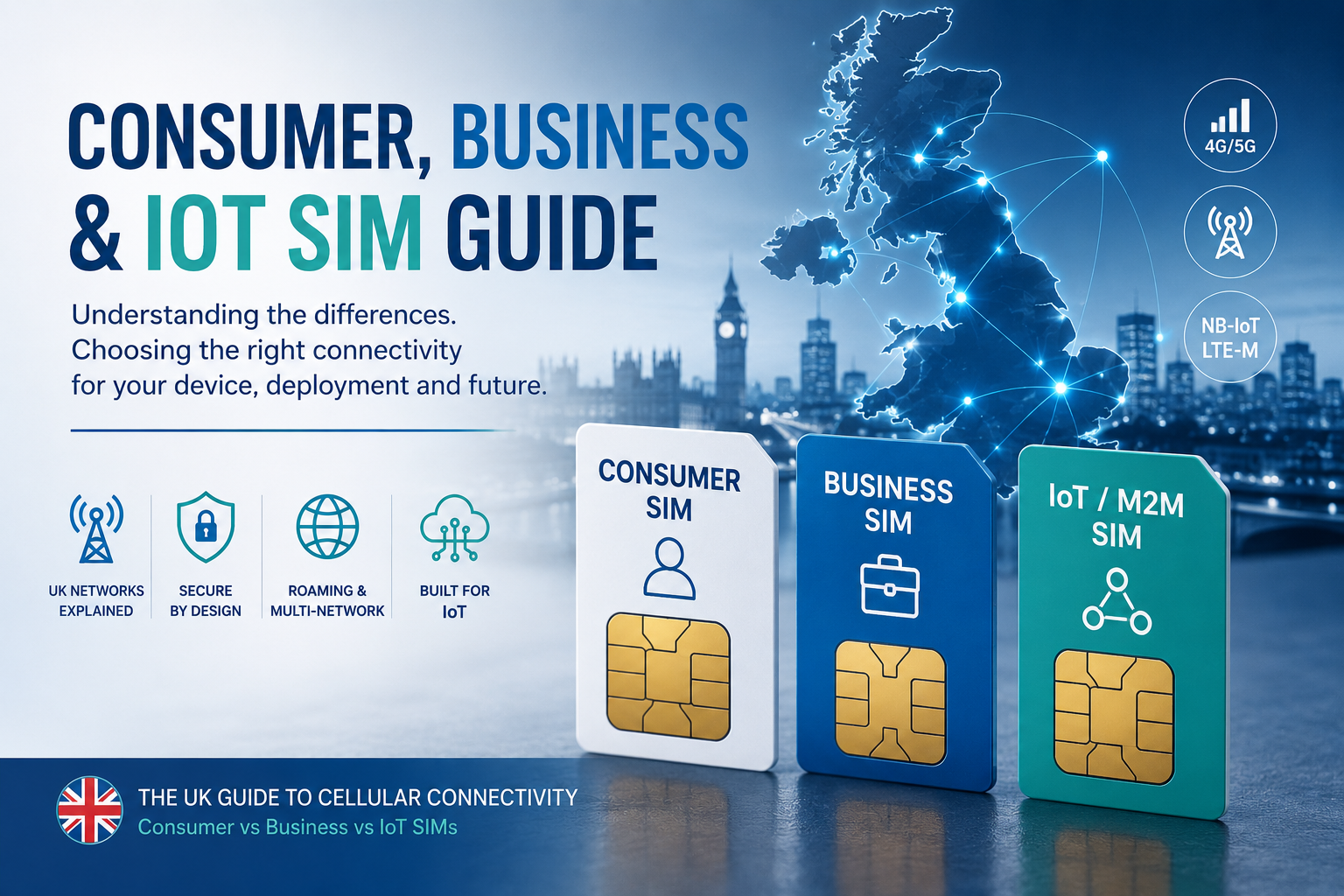
Consumer, Business or IoT SIM? A Plain-English Guide to UK Cellular Connectivity
The little chip in your phone and the one in a smart meter buried under a pavement look identical. They are not. Here is how consumer, business and IoT connectivity really differ, what all the jargon means, and why the SIM you choose can quietly make or break a deployment.
Ask three people what a SIM is and you will get three answers. To a consumer it is the thing you pop out with a paperclip when you change phones. To an IT manager it is a line item on the mobile bill. To someone deploying a thousand sensors across the country, it is a fifteen-year commitment that determines whether the fleet stays online or quietly falls off the network one firmware generation from now.
These are three genuinely different worlds, governed by different standards, sold on different terms, and built for different lifespans. The trouble is that they share a vocabulary, and a lot of that vocabulary is used loosely. SIM, eSIM, eUICC, iSIM, roaming SIM, multi-network SIM, SGP.32: these are not interchangeable, and treating them as if they are is how projects end up with the wrong connectivity baked into hardware that is expensive to touch again.
This guide is the map. We will separate consumer, business and machine-to-machine (M2M) / IoT connectivity, define the terminology properly, walk through the UK network layer underneath it all, and answer the question that brings most people here in the first place: can I just use a normal consumer SIM in my IoT device? The short answer is “sometimes, and here is exactly when it will bite you”. The long answer is below.
The three worlds of cellular connectivity
Everything starts with who, or what, is at the end of the connection. That single fact drives the standard, the commercial model and the management tools.
Consumer connectivity assumes a person. There is a human with a phone or a smartwatch, a screen to tap, a card to buy, and a monthly or pay-as-you-go tariff. The person handles setup, moves the SIM, scans the QR code, and notices immediately if the connection drops. Consumer plans are built around individual data allowances, generous roaming for holidays, and heavy retail competition on price.
Business connectivity is the same technology wrapped in a different contract. A company buys a pool of connections for staff phones, laptops and tablets, usually on a shared data plan with central billing, mobile device management and an account manager. The devices still have human users; the difference is procurement, control and volume, not the underlying radio.
M2M and IoT connectivity is where the assumptions break. There is often no human, no screen and no one watching. The device might be a water meter, a vehicle tracker, a lift alarm, a solar inverter or an environmental sensor. It may sit in one spot for a decade, or cross borders daily. It cannot scan a QR code, it may only wake for a few seconds a day, and if it drops off the network nobody finds out until the data stops arriving. This world needs remote management, predictable long-life tariffs, resilient coverage and security you can certify. It is a different discipline, and it is the one this publication mostly cares about.
The one-line version: consumer and business SIMs are built around a human who can intervene. IoT connectivity is built for a machine that cannot. Almost every practical difference flows from that.
| Consumer SIM | Business SIM | M2M / IoT SIM | |
|---|---|---|---|
| Who or what uses it | An individual person | Staff, on company devices | An unattended machine |
| Billing model | Personal monthly / PAYG | Shared corporate pool | Per-device, often low-data, long term |
| Typical lifespan | 1-3 years (device churn) | 2-4 years | 5-15 years in the field |
| Networks | Single home network + roaming | Single network, business terms | Often multi-network or steerable |
| Roaming policy | Fair-use, holiday-oriented | Fair-use, business travel | Watch for permanent-roaming limits |
| Remote management | None needed (user does it) | Basic MDM | Essential: remote provisioning at fleet scale |
| eSIM standard | SGP.22 (Consumer) | SGP.22 (Consumer) | SGP.02 (M2M) or SGP.32 (IoT) |
| Form factor | Nano SIM or eSIM | Nano SIM or eSIM | Nano, solder-down MFF2, or iSIM |
| Security / certification | Standard | Standard | Often mandated (GSMA SAS, CRA, PSTI) |
| If it disconnects | User notices instantly | User reports it | Silent failure until data stops |
SIM, eSIM, eUICC, iSIM: the hardware terms, sorted
Before the standards, the physical vocabulary, because this is where most of the confusion lives. These four terms are not four competing products. They describe where the SIM lives and how it is built.
- SIM is the removable card. It has shrunk over the years from full-size to mini (2FF), micro (3FF) and nano (4FF), but it is still a plastic chip you can pull out.
- eSIM means “embedded SIM”, and it refers to a SIM that can be reprogrammed over the air rather than physically swapped. Confusingly, “eSIM” is used both for the capability (remote provisioning) and for a soldered chip. The defining feature is that you can change the operator profile without touching the hardware.
- eUICC is the correct technical term for the secure chip that makes an eSIM work. The eUICC (embedded Universal Integrated Circuit Card) is what stores one or more operator profiles and lets you switch between them. When people say “eSIM”, the underlying component they mean is the eUICC. Our sister site euicc.co.uk is dedicated entirely to this layer if you want the deep version.
- iSIM (“integrated SIM”) goes one step further and builds the secure SIM function directly into the device’s main processor or cellular modem, removing the separate chip altogether. It saves space, cost and power, which matters enormously in small, battery-powered IoT devices.
An eSIM can be a removable card, a soldered MFF2 chip, or an integrated iSIM. The word describes the capability; the form factor is a separate choice.
| Form factor | Also called | Removable? | Where you see it |
|---|---|---|---|
| 2FF | Mini SIM | Yes | Older kit, some industrial routers |
| 3FF | Micro SIM | Yes | Legacy phones and modules |
| 4FF | Nano SIM | Yes | Modern phones, most current devices |
| MFF2 | Solder-down / embedded | No | Industrial IoT, automotive, sealed devices |
| iSIM | Integrated (in the chip) | No | Space and power-constrained IoT, wearables |
The eSIM standards: SGP.02, SGP.22 and SGP.32
Here is the part that trips up almost everyone. “eSIM” is not one standard. The GSMA, the industry body that governs mobile standards, has published three different remote SIM provisioning specifications, and they are built for different jobs.
| Standard | Built for | How profiles are managed | Human needed? |
|---|---|---|---|
| SGP.02 | M2M (machine-to-machine) | Operator “pushes” profiles from a central platform (SM-SR) | No, but rigid and operator-led |
| SGP.22 | Consumer devices | Device “pulls” a profile via a Local Profile Assistant (LPA), user confirms | Yes, a user taps to consent |
| SGP.32 | IoT devices | Remote manager (eIM) controls profiles; on-device IPA handles delivery | No, designed for headless fleets |
The consumer standard, SGP.22, is the one in your phone. It assumes a Local Profile Assistant (the LPA) with a user interface, and a person to approve the download. That works beautifully for a smartwatch and not at all for a sensor with no screen.
The IoT standard, SGP.32, fixes exactly that. As the GSMA itself describes it, the SGP.32 architecture takes the consumer LPA and splits it into two pieces: the IPA (IoT Profile Assistant) that lives on the device, and the eIM (eSIM IoT remote Manager) that lives in the cloud and replaces the human. The eIM can enable, disable, switch and delete profiles across a whole fleet remotely. It is the single most important idea in modern IoT connectivity, and it is why a device can now change its mobile network over the air, with nobody on site. Consumer eSIM versus IoT eSIM architecture In consumer SGP.22 the device LPA and a human user manage the profile. In IoT SGP.32 the LPA is split into an on-device IPA and a cloud eIM that manages fleets without a human. CONSUMER eSIM (SGP.22) Person / user taps to approve Device LPA + eUICC SM-DP+ operator profile server IoT eSIM (SGP.32) eIM (cloud) manages the fleet Fleet owner / OEM console Device IPA + eUICC SM-DP+ operator profile server remote commands The core difference: SGP.32 replaces the human user with a cloud-based eIM, so headless fleets can be managed remotely.
We have written about this architecture at length across the cluster: the standard itself on sgp32.co.uk, the eUICC layer on euicc.co.uk, and the manager component specifically on esimiotmanager.com. For this guide, the takeaway is simpler: if you see “eSIM” on an IoT product, ask which standard. Consumer SGP.22 and IoT SGP.32 are not the same thing, and the difference decides whether you can manage the device at scale.
The big question: can I use a consumer SIM in my IoT device?
This is the question that fills our inbox, usually from a startup or a systems integrator who has built a clever device and wants to connect it cheaply. The honest answer is that you often can, technically, and that it often goes wrong, commercially. Here is the real trade-off.
A consumer or business data SIM will physically work in most cellular modules. For a handful of devices, on home turf, on a generous data plan, it can be a perfectly reasonable way to get to market fast. The problems start when you scale, when you cross borders, or when the deployment has to last.
| Using a consumer SIM in IoT | What actually happens |
|---|---|
| Cost at low volume | Cheap and quick for a few units. Fine for a prototype or a pilot. |
| Single network | You are tied to one operator’s coverage. If that mast has a gap or an outage, the device is offline with no fallback. |
| Permanent roaming | Consumer roaming is built for holidays, not permanent deployment abroad. Operators throttle or cut off SIMs that “roam” indefinitely on a foreign network. A tracker shipped overseas can simply stop. |
| Fair-use policies | Always-on machine traffic can trip consumer fair-use rules and get flagged or suspended, even at low data volumes. |
| No remote management | No eIM, no fleet provisioning. Changing network means physically visiting every device. |
| Lifespan risk | Consumer tariffs, SIM types and network access change on the operator’s schedule, not yours. A ten-year deployment on a consumer plan is a bet you do not control. |
| Support | Consumer support cannot help with APNs, static IPs, or connectivity diagnostics at fleet scale. |
The permanent-roaming trap is the one that catches people out. A consumer SIM from a UK network, shipped inside a product to customers in Europe or beyond, may work for weeks and then go dark when the visited network enforces its roaming limits. By then the devices are installed and the problem is expensive. This single issue is why purpose-built IoT connectivity exists.
The rule of thumb: consumer SIMs for consumer devices, IoT SIMs for IoT. If your deployment is more than a handful of units, leaves the country, or has to run for years, a proper IoT connectivity product will cost less over its life and fail far less often. If you are weighing this up right now, our sister site simwise.co.uk is built specifically to help you choose the right SIM for a given IoT use case.
The IoT connectivity toolkit: roaming and multi-network SIMs
So what does “proper IoT connectivity” actually look like? Between the plain consumer SIM and full SGP.32 eUICC provisioning sits a practical toolkit that solves the coverage and resilience problem for most UK deployments today.
Roaming SIMs are IoT SIMs designed to connect on networks other than a single home operator, often across many countries, with tariffs and roaming permissions built for permanent deployment rather than holidays. They neatly sidestep the consumer permanent-roaming problem. We cover these in detail on roamingsim.co.uk.
Multi-network SIMs go a step further and can attach to more than one UK network. If EE has a gap at a given site but Vodafone has signal, the SIM uses whichever works. For fixed installations where you cannot predict which network has the best signal, that is a significant resilience gain over any single-network SIM. Some use multi-IMSI technology, carrying more than one network identity on the SIM and switching between them. There is a full explainer on multinetworksim.com.
And then there is SGP.32 eUICC, the strategic option: a certified eSIM whose operator profile can be swapped over the air, managed by an eIM. This is the future-proof choice for large fleets and long-life hardware, because it decouples the device from any single operator for its entire life. Most serious UK IoT deployments in 2026 use a roaming or multi-network SIM today, with SGP.32 increasingly specified for new, long-life designs.
The network underneath: which UK radio technology?
Choosing a SIM is only half the story. The other half is the radio technology the device actually talks over, and here the UK landscape is mid-transition. The generations matter because they are not all sticking around.
- 2G still exists and is committed to switch off by 2033. It underpins a surprising amount of legacy M2M, which is exactly why the deadline matters.
- 3G is effectively gone. All four UK operators have completed or all but completed their 3G switch-offs. Any device still relying on 3G needs replacing.
- 4G is the workhorse, and crucially there is no announced UK 4G switch-off date. For the overwhelming majority of IoT deployments today, 4G (including the low-power LTE-M and NB-IoT variants) is the sensible, long-runway choice. We have covered this in full in our 4G switch-off guide.
- 5G Non-Standalone (NSA) is most of the “5G” people see today. It bolts a 5G radio onto a 4G core. Faster, but it does not unlock the full 5G feature set.
- 5G Standalone (SA) is the real thing: a native 5G core that enables network slicing, ultra-low latency and, importantly for IoT, RedCap. In the UK, 5G SA is live on EE and on the merged VodafoneThree, with Virgin Media O2 building it out. Coverage is still largely urban.
The IoT radio technology ladder A spectrum of cellular IoT technologies from lowest data rate and power to highest: NB-IoT, LTE-M, LTE Cat-1 and eRedCap, 5G RedCap, 4G Cat-4 and Cat-6, and full 5G. From low-power sensors to high-bandwidth 5G lower data rate, lower power, longer battery higher data rate, more capability NB-IoT ~100s kbps metering LTE-M ~1 Mbps trackers LTE Cat-1 / eRedCap ~10 Mbps telemetry, POS 5G RedCap up to ~150 Mbps CCTV, industrial sensors 4G Cat-4/6 10s-100s Mbps routers, gateways Full 5G Gbps high bandwidth Green blocks (eRedCap and RedCap) are the emerging 5G-era IoT tiers; they need 5G Standalone coverage to work.
RedCap and eRedCap: the 5G tiers built for IoT
Full 5G is overkill for most IoT. You do not need gigabit speeds and the power draw that comes with them to send a meter reading. This is the gap RedCap (Reduced Capability, 3GPP Release 17) fills: a mid-tier 5G that offers up to around 150 Mbps at lower cost, complexity and power than full 5G. In the UK, RedCap is live on EE and Vodafone, with Three testing and O2 building the 5G SA foundation it depends on. It targets CCTV, industrial sensors, wearables and connected infrastructure. There is a full guide on 5gredcap.co.uk.
eRedCap (enhanced RedCap, Release 18, frozen in June 2024) goes lower still, aimed at replacing the huge installed base of LTE Cat-1 devices, the smart meters and basic trackers, on 5G infrastructure. eRedCap modules began reaching the market in 2026, with volume availability expected from 2027. The dedicated site is eredcap.com.
Both RedCap and eRedCap require a 5G Standalone core, not Non-Standalone. This is why 5G SA rollout, not device availability, is the real pacing factor for 5G-era IoT in the UK. It is also why network slicing and private 5G matter: on a network you control, you get SA features today without waiting for public coverage.
| Technology | UK status (2026) | Best for |
|---|---|---|
| 2G | Live, switch-off by 2033 | Legacy M2M only, plan to migrate |
| 3G | Switched off | Nothing new; replace affected devices |
| NB-IoT | Live | Static, ultra-low-power sensors, metering |
| LTE-M | Live | Low-power mobile assets, trackers |
| 4G (Cat-1 to Cat-6) | Live, no sunset date | The default workhorse for most IoT |
| 5G NSA | Widespread | Faster data, but no full 5G features |
| 5G SA | Live on EE, VodafoneThree; O2 building | Slicing, low latency, RedCap |
| 5G RedCap | Live on EE, Vodafone; growing | Mid-tier IoT: CCTV, industrial sensors |
| eRedCap | Modules from 2026, volume 2027 | Successor to LTE Cat-1 metering / trackers |
Beyond mainstream cellular
For completeness, three adjacent options come up often in UK IoT planning, and each has its place:
- LTE450 uses low 450 MHz spectrum for exceptional range and building penetration, which makes it a strong fit for utilities and critical national infrastructure. More on lte450.co.uk.
- 5G Fixed Wireless Access (FWA) delivers broadband-grade connectivity to a fixed location over 5G, a genuine alternative to fibre for sites and a useful primary or backup link for gateways. See 5gfwa.co.uk.
- LEO satellite (low-earth-orbit constellations such as Starlink, and direct-to-device satellite services) fills the true not-spots where no terrestrial network reaches. We compare satellite options for IoT on simwise.co.uk.
One more that is easy to forget: voice. Plenty of IoT still depends on a voice call, lift alarms, telecare pendants, emergency intercoms. As 2G and 3G retire, that voice path has to move to VoLTE and eventually Voice over New Radio (VoNR). If your device makes calls rather than just sending data, that transition is worth planning for now; we cover it on voltesim.co.uk and vonr.co.uk.
Putting it together: which do you actually need?
Terminology is only useful if it leads to a decision. Here is the short path from “what am I connecting” to “what should I buy”. Which SIM and connectivity to choose A decision flow: personal devices use consumer SIMs, company staff devices use business SIMs, and IoT devices use IoT SIMs, choosing multi-network or roaming SIMs for resilience and roaming, and SGP.32 eUICC for large long-life fleets. What are you connecting? A personal phone or watch Company staff devices IoT / M2M devices Consumer SIM / eSIM Business SIM Fleet, roaming or long-life? yes Multi-network / roaming SIM; SGP.32 eUICC for scale no Single IoT data SIM (pilot / small, UK-only) Then match the radio technology (NB-IoT to 5G RedCap) to the device’s data and power needs. The connectivity decision in one view. IoT is where the choices multiply, and where getting it wrong is most expensive.
Terminology glossary
SIMThe subscriber identity module that authenticates a device to a mobile network. Traditionally a removable card. eSIMAn embedded SIM that can be reprogrammed over the air. Refers to the capability and, loosely, to soldered SIM chips. eUICCThe secure chip behind an eSIM. It stores multiple operator profiles and switches between them. iSIMAn integrated SIM built into the device processor or modem, removing the separate chip. SM-DP+The operator server that prepares and delivers the eSIM profile to the device. LPALocal Profile Assistant. The on-device software that manages profiles in consumer eSIM, with a user interface. IPAIoT Profile Assistant. The lightweight SGP.32 on-device agent that replaces the LPA’s delivery role for headless devices. eIMeSIM IoT remote Manager. The cloud component in SGP.32 that manages profiles across a fleet without a human user. RSPRemote SIM Provisioning. The umbrella term for downloading and managing SIM profiles over the air. APNAccess Point Name. The gateway setting that connects a device to the operator’s data network, often private for IoT. Multi-IMSIA SIM carrying more than one network identity, able to switch between them for coverage or cost. Permanent roamingA device staying indefinitely on a foreign network. Restricted for consumer SIMs, supported by IoT roaming SIMs. NSA / SANon-Standalone 5G runs on a 4G core; Standalone 5G runs on a native 5G core and unlocks slicing and RedCap. RedCap / eRedCapReduced Capability 5G (Release 17) and its lower tier (Release 18) built for cost and power-sensitive IoT.
Frequently asked questions
What is the difference between a consumer SIM and an IoT SIM?
A consumer SIM is built for a person on a single network with holiday-style roaming and no remote management. An IoT SIM is built for unattended machines, typically offering multi-network coverage, permanent-roaming support, long-life tariffs and remote provisioning. Using a consumer SIM in a scaled or international IoT deployment risks disconnection and has no fleet management.
Is eSIM the same as eUICC?
Not quite. eUICC is the secure chip; eSIM is the capability that chip provides. When people say “eSIM” they usually mean a device with a eUICC that can be reprovisioned over the air.
What is the difference between SGP.22 and SGP.32?
SGP.22 is the consumer eSIM standard and assumes a user with a screen to approve profile downloads. SGP.32 is the IoT eSIM standard and replaces that user with a cloud-based eIM, so profiles can be managed remotely across headless fleets.
Can I use a consumer SIM in an IoT device?
Technically yes for a few UK-based units, but it becomes risky at scale, across borders, or over long lifespans, mainly due to permanent-roaming limits, single-network dependence and the absence of remote management. A purpose-built IoT SIM is usually cheaper over the device’s life and far more reliable.
Do I need 5G for IoT?
Usually not yet. 4G, LTE-M and NB-IoT cover most IoT needs and 4G has no UK switch-off date. 5G RedCap is worth specifying for new, long-life devices that need more bandwidth, but it depends on 5G Standalone coverage, which is still mostly urban in the UK.
When is 4G switching off in the UK?
There is no announced UK 4G switch-off date. 3G is already off and 2G is committed to close by 2033, but 4G is the long-term workhorse for IoT. See our full 4G switch-off guide for the detail.
Related reading across our network
- sgp32.co.uk – the SGP.32 IoT eSIM standard in depth
- euicc.co.uk – the eUICC and eSIM standards layer
- esimiotmanager.com – the eSIM IoT Manager (eIM) explained
- roamingsim.co.uk – roaming SIMs for IoT
- multinetworksim.com – multi-network and multi-IMSI SIMs
- simwise.co.uk – choosing the right IoT SIM and satellite options
- 5gredcap.co.uk and eredcap.com – RedCap and eRedCap for 5G IoT
- 5gslicing.co.uk – 5G network slicing
- 5gfwa.co.uk – 5G fixed wireless access
- When will 4G be switched off in the UK?
IoTUK is an independent technology publication. It is not affiliated with the former government-funded IoTUK programme, Digital Catapult, Future Cities Catapult or Innovate UK. Network rollout status is as at mid-2026 and changes frequently; check operator sources before specifying hardware.