
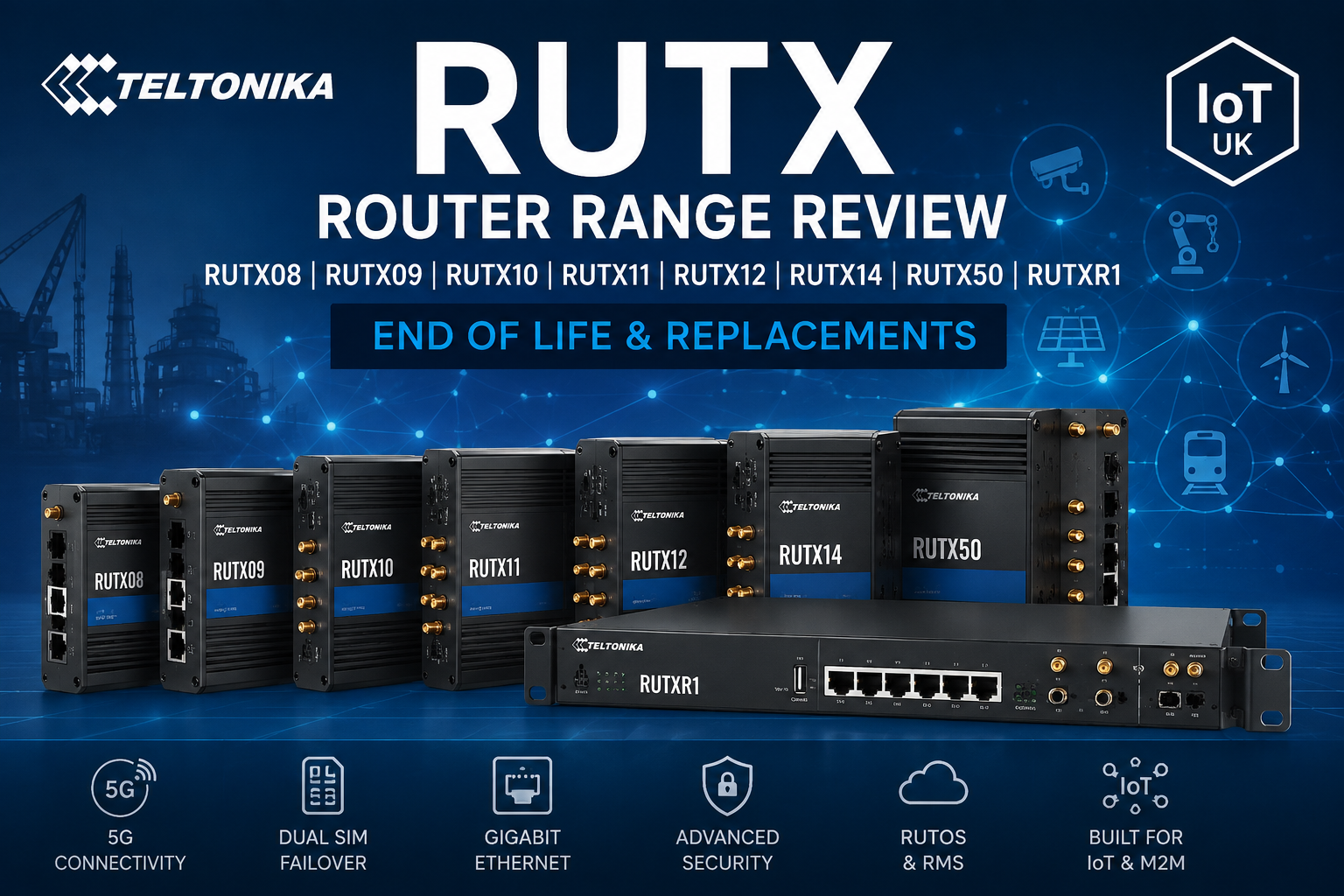
For several years, the Teltonika RUTX range has been one of the most recognisable families of industrial routers used in IoT, M2M and remote connectivity projects.
These were not simply faster versions of Teltonika’s smaller RUT routers. RUTX was the company’s higher-performance industrial platform, bringing together Gigabit Ethernet, faster cellular connectivity, dual-band Wi-Fi, more processing power, extensive VPN functionality and the increasingly sophisticated capabilities of RutOS.
The family eventually covered almost every requirement, from Ethernet-only industrial routing through LTE Cat 6 and Cat 12 to dual-modem connectivity and 5G.
There was even a 1U rack-mounted RUTX router.
Now that era is coming to an end.
Teltonika has moved the RUTX family into its End of Life programme as newer RUTM and RUTC platforms take over many of the jobs previously performed by RUTX.
You can check Teltonika’s current lifecycle information directly on its official End of Life products page.
For a wider look at what the retirement means for Teltonika’s product strategy, IoTPortal has also covered the RUTX Series: End of an Era.
This guide takes a different approach.
Rather than treating RUTX simply as an EOL announcement, we’re looking back at the complete Teltonika RUTX range, what each router actually does, where it has been used, why it became popular and what existing users should consider as its replacement.
The Complete Teltonika RUTX Range
The RUTX family consists of eight principal routers:
| RUTX Model | Main Connectivity | Typical Role | Newer Alternative |
|---|---|---|---|
| RUTX08 | Ethernet | Industrial wired router | RUTM08 |
| RUTX09 | 4G LTE Cat 6 | Cellular router without Wi-Fi | RUTM09 |
| RUTX10 | Ethernet + Wi-Fi | Industrial wired/Wi-Fi router | RUTM10 |
| RUTX11 | 4G LTE Cat 6 | General-purpose industrial cellular router | RUTM11 |
| RUTX12 | Dual 4G LTE Cat 6 | High-availability dual-modem router | RUTM52 / RUTC42 depending on requirement |
| RUTX14 | 4G LTE Cat 12 | High-performance 4G router | RUTM54 / 5G RUTM platform |
| RUTX50 | 5G | Industrial 5G router | RUTM / RUTC 5G platform |
| RUTXR1 | 4G LTE Cat 6 | Rack-mounted industrial/enterprise router | Application-specific migration |
One reason RUTX became so successful was the consistency between the products.
An engineer familiar with configuring a RUTX11 did not have to start again when moving to a RUTX14, RUTX12 or RUTX50.
The hardware changed, but RutOS provided a familiar environment for firewall rules, VPNs, SIM management, failover, routing, monitoring and remote access.
That made it possible for integrators to standardise around RUTX rather than continually introducing completely different router platforms.
Teltonika RUTX08: Industrial Ethernet Routing Without Cellular
The Teltonika RUTX08 is an interesting place to start because there is no cellular modem at all.
There is no Wi-Fi either.
Instead, RUTX08 is a compact industrial Ethernet router designed for situations where connectivity already exists but proper routing, security, VPN and network management are still required.
RUTX08 basic specifications
- 4 x Gigabit Ethernet ports
- Quad-core processor
- 256 MB RAM
- Industrial metal enclosure
- Advanced firewall
- VLAN support
- Multiple VPN technologies
- MQTT support
- Modbus TCP
- BGP
- GRE
- RutOS
- Teltonika RMS compatibility
The four Gigabit ports were particularly important when RUTX arrived because many older industrial routers were still based around 10/100 Mbps Ethernet.
RUTX08 brought proper Gigabit networking into a compact industrial format.
Where is the RUTX08 used?
The obvious application is an industrial site where the Internet connection is already provided by fibre, leased line, fixed wireless, satellite or another upstream device.
For example, imagine a factory with a corporate fibre connection.
A machine builder may not want the PLCs, HMIs and controllers inside its machinery sitting directly on the customer’s main network. The RUTX08 can create a separate machine network, apply firewall rules and establish a secure VPN for remote engineering access.
Other applications include:
- Industrial Ethernet networks
- Factory automation
- PLC remote access
- SCADA
- Building management systems
- Network segmentation
- Secure VPN gateways
- Remote monitoring
- Utility infrastructure
- Fibre-connected remote sites
- Industrial machinery
The absence of cellular and Wi-Fi can actually be an advantage in environments where neither is required. There is no point paying for radio interfaces that will never be used.
RUTX08 End of Life: what replaces it?
As the RUTX generation is retired, the obvious migration path is the Teltonika RUTM08.
This is probably the simplest migration in the whole family.
RUTM08 continues the same basic idea: a compact, rugged industrial wired router with four Gigabit Ethernet ports, VPN support, VLAN functionality, industrial protocols, RutOS and RMS compatibility.
Teltonika itself describes the RUTM family as functionally similar to the mature RUTX generation but based on alternative processor hardware.
For new Ethernet-only industrial routing projects, we would therefore look at RUTM08 rather than designing a new system around RUTX08.
Existing RUTX08 installations, however, do not suddenly need replacing simply because the product has reached the final part of its commercial lifecycle.
Teltonika RUTX09: Cat 6 Cellular Without Wi-Fi
The Teltonika RUTX09 takes the industrial routing capabilities of the RUTX platform and adds LTE Advanced Cat 6 cellular connectivity.
What it deliberately doesn’t add is Wi-Fi.
That combination makes more sense than it initially appears.
Many industrial installations simply do not need a wireless LAN.
If a router is installed inside an EV charger, CCTV cabinet, traffic control system or industrial enclosure, all the local equipment may connect over Ethernet.
RUTX09 basic specifications
- LTE Advanced Cat 6
- Cellular download speeds up to 300 Mbps
- Carrier Aggregation
- Dual SIM
- Automatic SIM failover
- 4 x Gigabit Ethernet
- GNSS
- Industrial metal enclosure
- Advanced firewall
- Multiple VPN services
- RutOS
- RMS remote management
The jump to LTE Cat 6 was significant because Carrier Aggregation allowed the modem to use multiple LTE carriers, giving it considerably greater potential throughput than conventional LTE Cat 4 industrial routers.
Where is the RUTX09 used?
Typical applications include:
- CCTV
- ANPR
- EV charging
- Solar farms
- Renewable energy
- Remote PLC access
- Industrial automation
- Digital signage
- Traffic infrastructure
- Utilities
- Remote telemetry
- Environmental monitoring
Imagine a roadside ANPR installation.
The cameras and controller connect via Ethernet. The router provides the cellular backhaul and VPN connectivity. Nobody needs to connect to the cabinet over Wi-Fi.
RUTX09 fits that job neatly.
RUTX09 End of Life: what replaces it?
The natural replacement is the Teltonika RUTM09.
Like RUTX09, RUTM09 combines LTE Advanced connectivity, dual SIM, GNSS and four Gigabit Ethernet ports without introducing Wi-Fi.
For an existing RUTX09 estate, this gives system designers a relatively clean route into the newer RUTM generation.
Teltonika RUTX10: Ethernet, Wi-Fi and Industrial Routing
The Teltonika RUTX10 takes a different approach again.
There is no cellular modem, but there is dual-band Wi-Fi.
Think of it as the wireless counterpart to RUTX08.
RUTX10 basic specifications
- 4 x Gigabit Ethernet
- Dual-band 802.11ac Wi-Fi
- Wi-Fi Wave 2
- Bluetooth Low Energy
- Industrial metal enclosure
- VLAN support
- Advanced firewall
- Multiple VPN services
- RutOS
- RMS compatibility
It is therefore suitable where Ethernet provides the WAN but Wi-Fi is needed locally.
Where is the RUTX10 used?
Examples include:
- Factories
- Warehouses
- Industrial Wi-Fi
- Building automation
- Machinery
- Retail
- Secure local networks
- IoT gateways
- Remote engineering
- Wi-Fi access for maintenance engineers
A machine manufacturer could, for example, connect the RUTX10 to the customer’s wired network while providing a separate Wi-Fi network for engineers servicing the equipment.
The router handles routing, firewalling and VPN access while also providing local wireless connectivity.
RUTX10 End of Life: what replaces it?
The obvious successor is the Teltonika RUTM10.
RUTM10 retains four Gigabit RJ45 ports and dual-band Wi-Fi 5 while adding the newer RUTM hardware platform and current RutOS capabilities.
For most new projects that would previously have specified RUTX10, RUTM10 is where we would start today.
Teltonika RUTX11: The RUTX Workhorse
If one router represents the RUTX generation, it is probably the Teltonika RUTX11.
For years, this has been one of Teltonika’s most versatile professional cellular routers.
The reason is simple.
It does almost everything that a conventional industrial IoT deployment needs without moving into specialist or particularly expensive hardware.
RUTX11 basic specifications
- LTE Advanced Cat 6
- Cellular speeds up to 300 Mbps
- Carrier Aggregation
- Dual SIM
- Automatic failover
- 4 x Gigabit Ethernet
- Dual-band 802.11ac Wi-Fi
- Bluetooth LE
- GNSS
- Advanced VPN support
- RutOS
- RMS
That combination made RUTX11 something of a Swiss Army knife for industrial connectivity.
Where is the RUTX11 used?
Pretty much everywhere.
Common examples include:
- CCTV and security
- EV charging
- Digital signage
- Retail connectivity
- Payment systems
- Smart buildings
- Factory automation
- PLC connectivity
- Public transport
- Fleet systems
- Construction sites
- Temporary offices
- Renewable energy
- Utilities
- SCADA
- WAN failover
Take EV charging.
A charger needs Internet connectivity for authorisation, payments, monitoring, firmware updates and communication with the operator’s backend.
Ethernet may provide the primary connection while LTE provides backup, or cellular may be the primary WAN.
The RUTX11 can handle either arrangement while also providing remote VPN access and dual-SIM resilience.
CCTV is another classic example.
An NVR and several cameras can connect to the Gigabit LAN while the RUTX11 provides cellular backhaul, remote access and VPN connectivity.
The real strength of RUTX11 was that an integrator could standardise on it.
One week it might go inside an EV charger. The next could be a CCTV cabinet, then a factory machine or renewable energy installation.
RUTX11 End of Life: what replaces it?
The closest successor is the Teltonika RUTM11.
For conventional RUTX11 applications, that is the product we would compare first.
The wider point, however, is that Teltonika’s portfolio has expanded.
An integrator is no longer forced to choose one general-purpose platform for everything. More powerful RUTM and RUTC models can be selected where an application needs greater cellular performance, processing power or edge functionality.
For straightforward Cat 6 industrial connectivity, RUTM11 remains the logical spiritual successor to RUTX11.
Teltonika RUTX12: Dual Modems for High Availability
The Teltonika RUTX12 solves a much more specialised problem.
What happens when losing the cellular connection really isn’t acceptable?
Most industrial dual-SIM routers contain one cellular modem.
They can use two SIM cards, but only one modem is actually connecting to the mobile network.
When the primary connection fails, the modem has to move to the backup connection.
RUTX12 is different.
It contains two LTE Cat 6 cellular modems.
RUTX12 basic specifications
- 2 x LTE Cat 6 modems
- Dual simultaneous cellular connections
- Combined cellular capability up to 600 Mbps
- Carrier Aggregation
- Load balancing
- Multi-WAN
- Gigabit Ethernet
- Dual-band Wi-Fi
- Bluetooth LE
- GNSS
- RutOS
- RMS
That makes RUTX12 a genuine dual-modem router rather than merely a dual-SIM router.
Where is the RUTX12 used?
This made it attractive for:
- Mission-critical IoT
- Broadcast
- Live streaming
- Emergency communications
- Critical CCTV
- Utilities
- SCADA
- Transport
- Public safety
- Temporary events
- High-availability remote access
Consider a live broadcast.
A standard dual-SIM router gives you a second mobile network if the first one fails.
RUTX12 can maintain two cellular connections at the same time.
Those connections can be used for failover, load balancing or other multi-WAN strategies.
The same principle applies to critical industrial systems. If connectivity matters enough that switching delays and single-modem failure are concerns, having physically separate modems becomes valuable.
RUTX12 End of Life: what replaces it?
This is where migration becomes more interesting because there isn’t simply a “RUTM12”.
One potential direction is the Teltonika RUTM52.
RUTM52 takes the dual-modem concept into 5G with two 5G modems, dual SIM/eSIM capability, multi-WAN functionality, load balancing and five Gigabit Ethernet ports.
That is a substantial performance step rather than a simple replacement.
Another option for particular applications is the Teltonika RUTC42.
RUTC42 retains a dual-modem approach using two LTE Cat 4 modules while moving onto the more powerful RUTC platform, including considerably greater scope for local edge processing.
This means RUTX12 customers should not automatically ask, “What is the new RUTX12?”
A better question is:
Why did we originally need two modems?
If the answer is maximum cellular performance as well as resilience, dual 5G may make sense.
If the requirement is resilient LTE connectivity combined with more powerful local processing, RUTC42 may be the more interesting direction.
Teltonika RUTX14: The High-Performance 4G Router
The Teltonika RUTX14 occupied the high-performance end of the 4G RUTX family.
Where RUTX11 offered LTE Cat 6, RUTX14 stepped up to LTE Advanced Cat 12.
RUTX14 basic specifications
- LTE Advanced Cat 12
- Download speeds up to 600 Mbps
- Upload speeds up to 150 Mbps
- Carrier Aggregation
- Dual SIM
- Automatic failover
- 5 x Gigabit Ethernet
- Dual-band Wi-Fi
- Bluetooth LE
- GNSS
- RutOS
- RMS
This created an interesting middle ground between conventional industrial 4G routers and 5G.
Where is the RUTX14 used?
Typical applications include:
- High-resolution CCTV
- Video transmission
- Construction sites
- Temporary offices
- Broadcast
- Digital signage
- Enterprise WAN backup
- Transport
- High-data industrial systems
- Remote infrastructure
In an area with strong 4G Carrier Aggregation but limited 5G availability, Cat 12 can still provide excellent real-world performance.
That made RUTX14 attractive during the transition period when 5G coverage was far less widespread than 4G.
RUTX14 End of Life: what replaces it?
This is another case where we would not automatically look for an identical LTE Cat 12 replacement.
Teltonika’s newer portfolio increasingly moves high-throughput applications towards 5G.
The Teltonika RUTM54, for example, is a high-performance 5G industrial router with dual SIM, eSIM, five Gigabit Ethernet ports, dual-band Wi-Fi and 4G fallback.
The precise replacement should therefore depend on the application and geographical deployment.
But the broader direction is clear: high-category LTE is increasingly being displaced by 5G rather than replaced with another high-category 4G router.
Teltonika RUTX50: The Router That Took RUTX Into 5G
The Teltonika RUTX50 deserves a special place in the history of the range.
It brought 5G into the familiar Teltonika industrial router format.
For many integrators, RUTX50 became the obvious step up when a customer needed substantially more cellular bandwidth than LTE could provide.
RUTX50 basic specifications
- 5G Sub-6 GHz
- 5G SA and NSA
- Cellular speeds up to 3.3 Gbps
- LTE Cat 20 fallback
- Dual SIM
- 5 x Gigabit Ethernet
- Dual-band Wi-Fi
- GNSS
- USB
- Digital I/O
- Automatic WAN failover
- RutOS
- RMS
The important thing about RUTX50 was not simply the headline 5G speed.
It packaged 5G into a device that industrial installers already understood.
Where is the RUTX50 used?
Typical applications include:
- 5G fixed wireless access
- Construction sites
- CCTV
- High-resolution video
- Broadcast
- Live streaming
- Industrial automation
- Utilities
- SCADA
- Smart city infrastructure
- Temporary offices
- Enterprise WAN backup
- Remote edge installations
A construction site is a good example.
Waiting months for a fixed line to be installed is often pointless when a 5G router can provide usable broadband almost immediately.
Likewise, a CCTV system that might have struggled to transmit multiple high-resolution streams over conventional 4G suddenly has far more bandwidth available.
This is why the RUTX50 helped blur the distinction between an “IoT router” and a genuine broadband connection.
We have covered its significance in more detail in the IoTPortal article RUTX50 End Of Life: The End of an Icon.
RUTX50 End of Life: what replaces it?
RUTX50 migration is particularly interesting because Teltonika’s newer 5G portfolio is no longer based around one obvious flagship router.
There are now different levels of 5G hardware for different jobs.
At the more powerful end sits the Teltonika RUTC50.
RUTC50 provides 5G connectivity up to 3.4 Gbps, dual-band Wi-Fi 6, dual SIM and eSIM, 1 GB RAM and 8 GB of flash storage.
That processing and storage capability matters because industrial routers are increasingly being used for edge computing, not merely routing.
The RUTC50 can therefore make sense where a RUTX50 replacement also needs to handle more sophisticated local applications, data processing or containerised workloads.
There are also RUTM 5G models for applications where that level of edge computing capability is unnecessary.
This is why comparing model numbers alone is increasingly misleading.
IoTPortal has a separate comparison covering the Teltonika RUTM30, RUTX50 and RUTC50, which illustrates how Teltonika’s 5G portfolio has evolved from the original RUTX50 concept into different hardware tiers.
For existing RUTX50 estates, the right successor should therefore be selected around the actual workload rather than simply choosing whichever new model has the highest specification.
Teltonika RUTXR1: The Rack-Mounted RUTX
Finally, there is the Teltonika RUTXR1.
It looks very different from the familiar compact RUTX routers because it was designed for a different environment.
RUTXR1 is a 1U rack-mountable LTE Cat 6 router.
Instead of being installed on a DIN rail inside a machine or roadside cabinet, it is intended for conventional communications racks and server rooms.
RUTXR1 basic specifications
- 1U rack-mounted format
- LTE Advanced Cat 6
- Up to 300 Mbps cellular connectivity
- Carrier Aggregation
- Dual SIM
- Gigabit Ethernet
- SFP
- Dual-band Wi-Fi
- USB
- Dedicated console interface
- Dual power supply compatibility
- RutOS
- RMS
The SFP interface and dual power capability made it particularly suitable for more conventional IT and communications environments.
Where is the RUTXR1 used?
Applications include:
- Communications rooms
- Server racks
- Enterprise WAN backup
- Data cabinets
- Industrial control rooms
- Utility infrastructure
- CCTV control centres
- Remote facilities
- Branch networking
For example, RUTXR1 could sit in a remote communications rack and provide LTE failover for the entire site while connecting into existing Ethernet or fibre infrastructure.
RUTXR1 End of Life: what replaces it?
RUTXR1 is arguably the most awkward member of the RUTX family to migrate because there isn’t an obvious one-for-one successor retaining exactly the same rack-mounted format and connectivity combination.
That does not mean its networking functions cannot be replicated with newer Teltonika equipment.
It means the migration needs to be considered at system level.
Is rack mounting essential?
Is LTE Cat 6 still sufficient?
Is SFP required?
Is the cellular connection primary or backup?
Are redundant power inputs mandatory?
For customers with a standardised RUTXR1 estate, these questions need answering before choosing the next platform rather than simply substituting another part number.
Why Is the RUTX Range Reaching End of Life?
The interesting thing about the retirement of RUTX is that these routers have not suddenly become incapable.
A RUTX11 still does what it did yesterday.
A RUTX12 still has two cellular modems.
A RUTX50 can still provide a very capable 5G connection.
End of Life is a product lifecycle issue.
Industrial networking equipment depends on processors, cellular modules, memory and numerous other electronic components remaining available throughout its manufacturing life.
Eventually those components change or disappear from the semiconductor supply chain.
At that point manufacturers have to redesign products around newer hardware.
That is effectively what the RUTM generation represents.
Teltonika’s own technical documentation describes RUTM as functionally similar to the mature RUTX series, with alternative processor hardware underneath.
That explains why models such as:
RUTX08 → RUTM08
RUTX09 → RUTM09
RUTX10 → RUTM10
RUTX11 → RUTM11
feel more evolutionary than revolutionary.
The network requirement hasn’t disappeared.
The hardware platform underneath it has changed.
For the latest official lifecycle dates and replacement information, check Teltonika’s EOL Products list rather than relying on an old distributor PDF or historic product page.
RUTX vs RUTM vs RUTC: What Has Actually Changed?
The important change is that the old RUTX range is not simply being replaced by a new range called RUTY.
Teltonika’s portfolio is becoming more segmented.
RUTM: the natural RUTX continuation
The RUTM family is the most obvious continuation of conventional RUTX.
Models such as RUTM08, RUTM09, RUTM10 and RUTM11 closely follow the roles previously performed by RUTX08, RUTX09, RUTX10 and RUTX11.
For many industrial IoT installations, that is exactly what is needed.
If the old router was primarily being used for routing, VPN, cellular connectivity, failover and remote management, there is little point dramatically over-specifying the replacement.
RUTC: industrial routers becoming edge computers
RUTC is more interesting.
Take RUTC50.
It is certainly a 5G router, but 1 GB RAM, 8 GB flash storage and substantially greater processing capability tell you where this platform is heading.
The industrial router is becoming an edge computer.
Instead of simply:
device → router → Internet → cloud
we increasingly have:
device → intelligent edge router → local processing → selected data → cloud
That opens up possibilities such as:
- Local protocol conversion
- MQTT processing
- Data filtering
- Edge applications
- Local data logging
- Docker containers
- Security applications
- Custom software
- Reduced cloud traffic
- Faster local decision making
That is a significant shift.
RUTX helped industrial IoT get connected.
RUTC represents a world where the device providing that connectivity can increasingly process information as well.
Should Existing RUTX Routers Be Replaced Now?
Generally, no.
End of Life does not mean “switch it off”.
If a RUTX11 is installed inside an EV charger and has been working reliably for years, replacing it purely because a newer model exists makes little commercial sense.
The same applies to a RUTX50 providing 5G at a remote site or a RUTX12 maintaining resilient connectivity for critical equipment.
What organisations should review is future deployment.
Questions worth asking include:
- Do we still specify RUTX in new projects?
- How many RUTX routers are in our installed estate?
- Which models do we use?
- Do we hold spare units?
- What happens when another site is added?
- What happens when a router fails?
- Can our existing configuration be migrated?
- Are the replacement interfaces identical?
- Do our VPN and firewall templates migrate cleanly?
- Are antenna connections changing?
- Does our mechanical mounting need changing?
- Do we need 4G, 5G or dual-modem connectivity?
- Would the application benefit from a newer edge-capable router?
For a company with five RUTX routers, this may be a minor consideration.
For an integrator with hundreds or thousands deployed across customer estates, it deserves a proper migration plan.
The RUTX Range Was More Important Than It Looked
Industrial routers rarely become famous.
Most spend their lives screwed to DIN rails inside cabinets where nobody sees them again.
That is arguably the best compliment you can give the RUTX family.
They became commonplace precisely because they were not particularly exciting to deploy.
Configure the SIM.
Set the APN.
Configure the VPN.
Connect the Ethernet devices.
Install the antennas.
Put the router in the cabinet.
Then, ideally, forget about it.
Across CCTV, utilities, EV charging, industrial automation, retail, transport, renewable energy, digital signage, smart cities and remote monitoring, that formula has connected an enormous amount of equipment.
RUTX also arrived at an important point in IoT history.
Industrial cellular networking was moving beyond basic 3G and Cat 4 connectivity. Data requirements were increasing. Gigabit Ethernet mattered. VPN requirements were becoming more sophisticated. Remote management was becoming essential as estates grew from tens of devices to hundreds or thousands.
Then came 5G.
RUTX evolved through that entire transition.
RUTX08 and RUTX10 covered wired applications.
RUTX09 and RUTX11 made LTE Cat 6 a mainstream industrial option.
RUTX12 demonstrated what genuine dual-modem resilience could look like.
RUTX14 pushed 4G performance considerably further.
RUTX50 carried the family into 5G.
And RUTXR1 took the same software environment into the communications rack.
That is a pretty substantial legacy for one router family.
What Comes After RUTX?
The answer is not one product family.
That is perhaps the most important lesson from the RUTX End of Life announcement.
The market has become more complicated because IoT itself has become more complicated.
Some applications still need nothing more than four Ethernet ports, a VPN and a reliable industrial enclosure.
Others need 5G.
Some need two independent cellular modems.
Others need Wi-Fi 6.
Some need eSIM.
Others increasingly need enough CPU, RAM and storage to run applications directly at the network edge.
Trying to satisfy all of those requirements with one family would no longer make much sense.
So rather than asking:
“What is the replacement for RUTX?”
the better question is:
“What does this particular application actually need?”
For a RUTX08 deployment, the answer may simply be RUTM08.
For a RUTX11 deployment, RUTM11 may be the natural move.
For a RUTX12 project, the discussion may be about whether dual LTE, dual 5G or another multi-WAN architecture makes most sense.
For a RUTX50 installation, the choice may depend on whether you simply need industrial 5G connectivity or want to start doing serious processing at the edge.
That makes migration slightly more complicated.
It also gives system designers considerably more choice.
The Teltonika RUTX family has had a very good run.
Its replacement isn’t really another RUTX.
It’s an increasingly diverse generation of industrial routers designed for an IoT market that has moved on considerably since the first RUTX devices appeared.
And given how many RUTX routers are already sitting quietly inside cabinets doing exactly what they were installed to do, we suspect the RUTX name will remain part of industrial IoT for many years yet.
SEO Title:
Meta Description: Complete review of the Teltonika RUTX router range, from RUTX08 and RUTX11 to RUTX12, RUTX14 and RUTX50, including specifications, IoT applications, End of Life information and replacement routers.
Suggested Slug: teltonika-rutx-router-range
Focus Keyphrase:
Secondary Keyphrases: Teltonika RUTX, RUTX End of Life, RUTX11 replacement, RUTX12 replacement, RUTX14 replacement, RUTX50 replacement, Teltonika industrial router, RUTM vs RUTX, RUTC vs RUTX
Tags: Teltonika, Teltonika Networks, RUTX, RUTX08, RUTX09, RUTX10, RUTX11, RUTX12, RUTX14, RUTX50, RUTXR1, RUTM, RUTC, industrial routers, cellular routers, 4G routers, 5G routers, IoT routers, industrial IoT, RutOS, RMS, End of Life
Suggested Category: Hardware
Sources:
Teltonika Networks
Teltonika Networks Wiki
IoTPortal
1 thought on “Teltonika RUTX Router Range Review: RUTX08 to RUTX50, End of Life and Replacements”