
Edge computing has spent a decade as a slide-deck word. In 2026 it is a line on a purchase order. This IoT UK report looks at what the term actually means in practice, what runs on these devices, who is building the hardware, and where the market is heading.
First, the vocabulary
The edge is a simple idea: put the computing close to where the data is produced, rather than in a distant cloud region. Beyond that, the language is a mess, and three words get used interchangeably when they should not be.
An edge router is at heart a connectivity device. Cellular or wired WAN, VPN, firewall, failover, with the recent addition of being able to run applications on board. An edge gateway is at heart a data device, built to collect from field equipment over Modbus or OPC UA, normalise it, and forward it to a platform, with compute along for the ride. An edge computer is a small industrial PC with real processing headroom, often x86 or higher-spec Arm, for heavier local analytics and increasingly for vision and inference.
The reason the words now blur is that a modern cellular router running containers is quietly doing all three jobs. That convergence, more than any single product, is the story of the year. Two footnotes on terminology while we are here. “Fog computing,” the Cisco-era term for the same concept, has all but disappeared; “edge” won. And when people say far edge they mean the device at the site itself, while near edge means a local server or micro data centre nearby. Most industrial IoT lives at the far edge, on exactly the kind of box this report is about.
What actually runs out there
Strip away the marketing and edge logic is delivered in one of three ways.
- Flow-based, with Node-RED. A visual environment, originally from IBM and now under the OpenJS Foundation, where you wire up blocks on a canvas: read a Modbus register, transform the value, publish to MQTT, raise an alert. It lets an engineer build edge logic without writing code line by line, which is why hardware vendors have embraced it.
- Containerised, with Docker. Package an application into a container and deploy it to the device, then update it over the air. This is the model that lets an integrator run their own software on the router instead of on a separate box next to it.
- Scripted, with Python. For custom logic where a developer is on hand and a flow canvas is too limiting.
Whatever the model, the jobs are much the same: protocol conversion and normalisation, turning Modbus, OPC UA, BACnet or DNP3 into MQTT a platform can read; local filtering and aggregation, so a site sends meaningful events rather than a flood of raw readings; buffering and continued operation when the backhaul drops; local alerting and control; and, at the higher-spec end, lightweight machine-learning inference. Frameworks such as Azure IoT Edge, AWS IoT Greengrass and ThingsBoard sit on top of all of this.
The hardware, and who is building it
Five vendors between them illustrate the full spread of the current market, from the rugged veteran to the price disruptor.
Moxa
The industrial networking veteran, and the conservative choice. Moxa’s strength is ruggedness and reliability rather than headline features. Its IIoT gateway range pairs with edge software for MQTT and cloud connectivity, and its Arm-based industrial computers handle the heavier work. If a deployment cannot tolerate a field failure and the budget reflects that, Moxa is usually on the list.
Advantech
The broadest portfolio of the group. Advantech’s ICR cellular routers, inherited from the Conel line, run modular Router Apps that include Node-RED, while its fanless x86 edge computers give you genuine PC-class headroom for local analytics and vision. When a project needs more compute than a router can offer but still has to live in a cabinet, Advantech tends to be the answer.
InHand Networks
Purpose-built for this job. InHand’s InGateway devices are Python and Docker programmable, ship pre-integrated with a long list of industrial protocols, and connect to Azure, AWS IoT Greengrass and ThingsBoard out of the box. Above the gateways sits a separate edge-computer line, including 5G models, for heavier workloads. In one vendor you can see the whole gateway-to-computer continuum, which makes InHand a useful reference point for where the category is going.
Teltonika
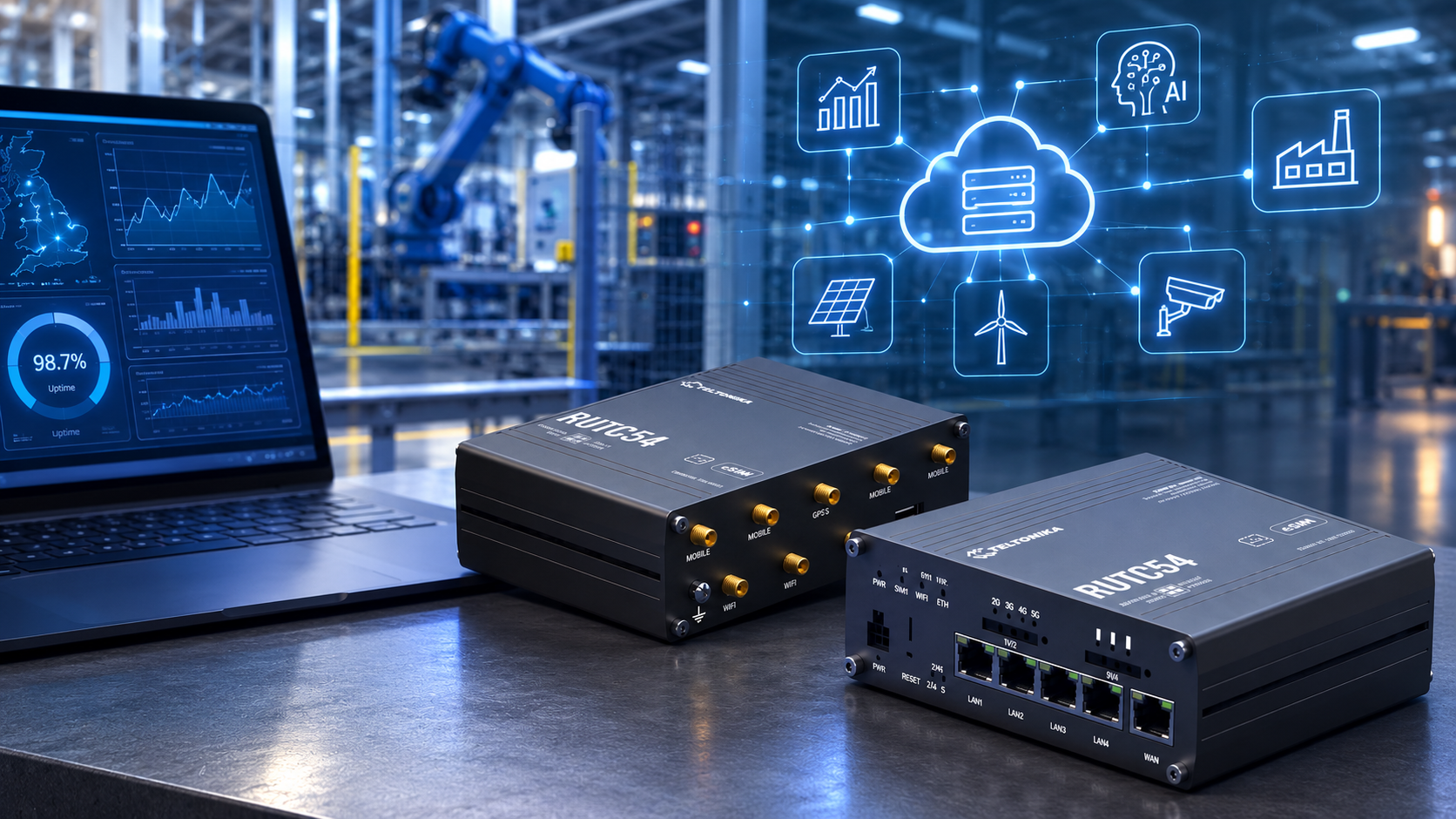
The disruptor. Teltonika’s newly launched RUTC54 5G edge router brings Docker down to its price point, pairing Sub-6 GHz 5G and Wi-Fi 6 with on-device containers managed through its remote management system. It is not the most powerful edge device on this page, and it does not try to be. Its significance is that container support, until recently a premium feature, is now arriving in the volume market. Our sister coverage has the full breakdown of the Teltonika RUTC54 and what its launch signals.
Milesight
Worth a mention as a neat example of the flow-based model reaching the mid-market. The Milesight UR75 is a compact 5G industrial router that runs Node-RED natively, so protocol conversion and edge logic sit on the same DIN-rail unit as the cellular backhaul, with a Python environment available alongside for heavier customisation.
The direction of travel
Four currents are shaping where this goes next.
Convergence. Router, gateway and computer are collapsing into a single class of programmable edge device. The buying question is shifting from “which type of box” to “how much compute, and which programming model.” A container-capable cellular router now overlaps heavily with what used to be three separate purchases.
Containers as default. What was a premium differentiator two years ago is becoming an expected line on a datasheet. The RUTC54 is the clearest evidence yet that the feature is moving downmarket, and where Teltonika ships in volume, expectations follow.
Two drivers pulling together. Economics and resilience point the same way. Cloud egress and bandwidth cost money, so filtering at the edge pays for itself, and local processing keeps a site working when the link fails. That combination is why edge compute has moved from optional to assumed.
Radios and intelligence. 5G standalone is maturing into something you can design around, and RedCap is arriving to fill the mid-tier between low-power networks and full-fat 5G, pushing more capable radios into cheaper devices. At the same time, lightweight inference is creeping onto higher-spec boxes, so the far edge is starting to make decisions rather than just forward data.
The quiet truth under all of it is that the real battleground is not the spec sheet. It is management at scale: deploying and updating containers or flows across thousands of sites without anyone driving to a substation. Fleet tooling, not raw processing power, is where this market will be won.
What it means for UK deployers
For operators in utilities, water, transport, retail and manufacturing, the practical upshot is fewer boxes per site and more logic that can be changed from a desk. The consolidation argument, one managed device instead of a router plus a single-board computer plus a gateway, is now credible at industrial-router prices rather than only premium ones. The sensible caution is to match the tool to the task: a Node-RED router is ideal for protocol conversion and light logic, while heavy analytics or vision still belongs on an edge computer. Buy for the workload, not the brochure.
Related reading
- The Case for Industrial Edge Computing: InHand versus Moxa versus Advantech
- Teltonika RUTC54: Docker on a 5G edge router
IoT UK is an independent technology publication. It is not affiliated with the former government-funded IoTUK programme, Digital Catapult or Innovate UK; the name is used in a descriptive sense.