
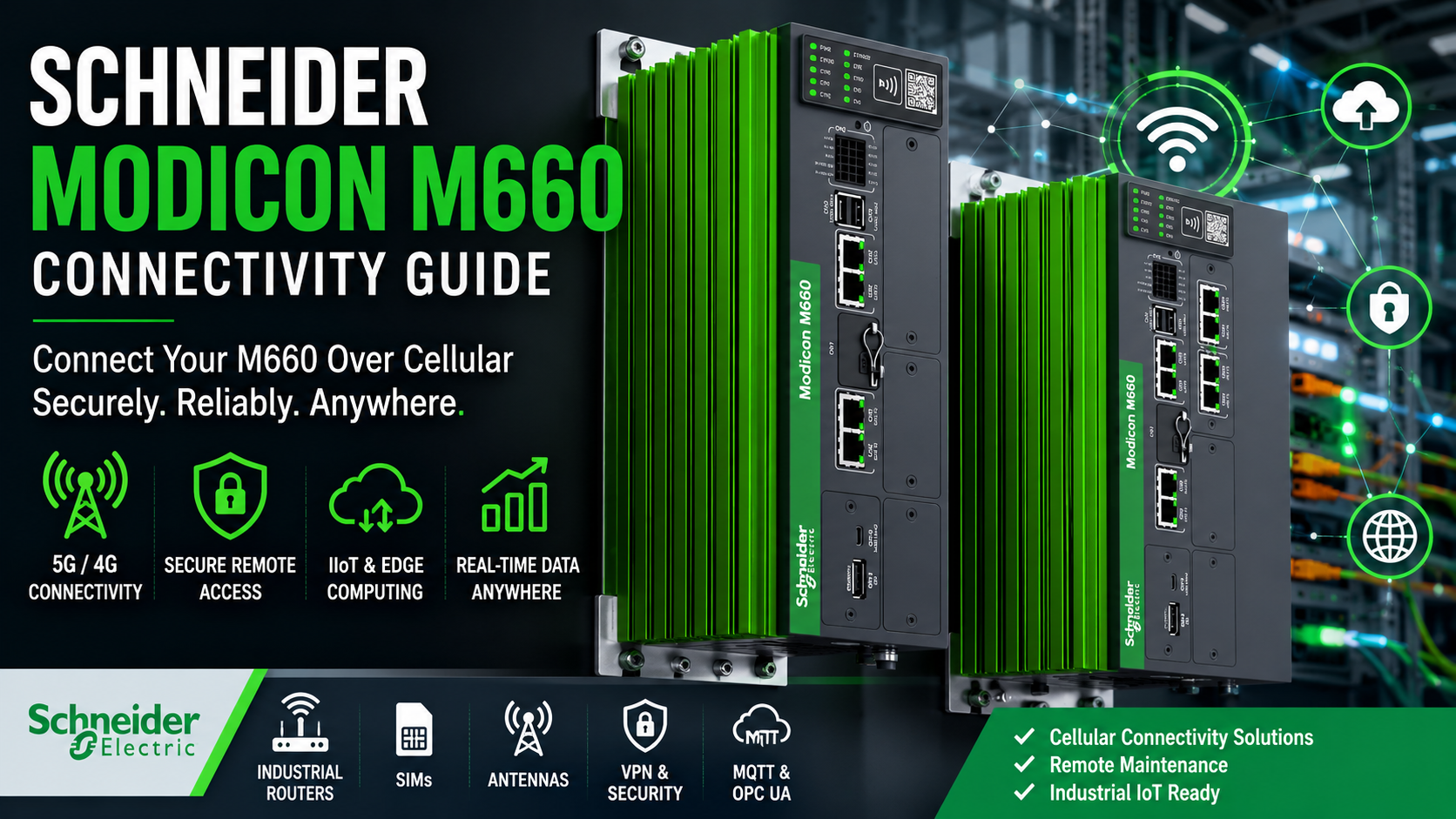
The Schneider Modicon M660 is not a PLC
Most engineers searching for the M660 expect to find a PLC. What Schneider Electric has actually built is something considerably more ambitious – an industrial PC, motion controller, safety controller and edge computing platform that happen to share a single enclosure.
Schneider positions the M660 as the successor to its PacDrive platform. The target audience is OEM machine builders working on packaging lines, robotics, semiconductor equipment, CNC machinery and high-speed conveyor systems – applications where a single controller might coordinate hundreds of servo axes simultaneously.
Under the bonnet, the M660 runs on an Intel multicore processor with a 64-bit runtime. It supports programming in ladder logic, structured text, C and C++, and can run Windows or Linux applications alongside the automation environment. It is, in practical terms, a proper industrial computer that also does real-time machine control.
What the M660 includes
Depending on configuration, the M660 combines:
- Real-time motion controller for high-speed synchronised servo drives
- Industrial PC with multicore processor and 64-bit runtime
- PLC runtime supporting IEC 61131-3 languages plus C/C++
- Functional safety controller integrated into the same hardware
- Edge computing platform supporting AI inference and local analytics
The connectivity side is equally capable. The M660 provides multiple Gigabit Ethernet ports and supports EtherNet/IP, PROFINET, EtherCAT for motion, OPC UA, Modbus TCP and MQTT through edge applications.
What it does not include
No cellular modem. No SIM slot. No integrated 4G or 5G radio.
This is not an oversight. It is the correct architectural decision for a machine controller designed to sit inside a panel or on a factory floor, connected to an industrial Ethernet network.
Cellular connectivity is handled upstream:
Internet / VPN
      |
 4G/5G Router
      |
Industrial Ethernet
      |
Schneider M660
The M660 sees an Ethernet connection. The router handles the SIM card, cellular radio, VPN, firewall, NAT and remote access. This separation is considered best practice in industrial networking because the two layers evolve at very different rates. A production machine might use the same M660 for fifteen years. The cellular router could move from 4G to 5G to whatever follows without touching the automation program.
Do you need 5G, or is 4G enough?
This is one of the most common questions in industrial cellular connectivity, and the honest answer is: for most M660 deployments, 4G LTE is entirely sufficient.
The M660 is a machine controller, not a video streaming platform. The data it generates – SCADA polling, OPC UA telemetry, Modbus register reads, alarm notifications, remote engineering sessions – is modest in bandwidth terms. A typical SCADA connection to a single machine runs comfortably on a few hundred kilobits per second. Even a demanding remote desktop session for commissioning rarely pushes beyond 2-4 Mbps. 4G LTE Cat 4, which delivers up to 150 Mbps download in real-world conditions, provides considerably more headroom than most M660 applications ever use.
Where 5G becomes genuinely relevant for M660 deployments:
- High-volume machine data to cloud – where the M660 edge platform is streaming large volumes of processed data continuously, rather than periodic telemetry
- Machine vision integration – if high-resolution camera feeds are routed over the same cellular connection
- Digital twin synchronisation – real-time mirroring of machine state for simulation and predictive maintenance at scale
- Multiple devices sharing one WAN connection – where the router is feeding several PLCs, HMIs and edge devices simultaneously and bandwidth headroom matters
- Future-proofing – if the machine installation is long-term and 4G coverage in that area is likely to degrade as operators retire it in favour of 5G infrastructure
For the majority of M660 installations – remote monitoring, SCADA connectivity, remote engineering access, alarm forwarding – a well-specified 4G router will perform identically to a 5G router in practice, at a lower hardware cost. The network latency that matters in industrial applications is typically the round-trip to the SCADA server or VPN endpoint, not the cellular radio speed.
The practical advice: choose 4G if you know the application bandwidth requirements are modest and 4G coverage at the installation site is solid. Choose 5G if bandwidth requirements are high, coverage maps show better 5G than 4G at that location, or the machine installation is long-term and you want the router generation to remain relevant for the life of the project.
Suitable industrial routers
All three routers below are industrial-grade, DIN-rail mountable, dual-SIM, VPN-capable and suitable for panel installation alongside an M660. The right choice depends on application bandwidth, budget and how much edge intelligence you need in the router itself.
Milesight UR32 Pro – 4G LTE Cat 4
The UR32 Pro is a compact industrial 4G router that covers the majority of M660 connectivity requirements without the cost of a 5G platform. It runs 4G LTE Cat 4 delivering up to 150 Mbps download and 50 Mbps upload – more than adequate for SCADA, OPC UA, remote access and alarm forwarding. Dual Mini SIM slots with automatic carrier failover keep the connection live if one network goes down. An RS485 serial port with Modbus RTU/TCP gateway support means it can also pick up data from serial instruments in the panel alongside the M660. VPN support covers OpenVPN, IPsec, WireGuard, ZeroTier, GRE and DMVPN. The Python SDK enables custom edge logic on the router itself.
Operating temperature is -40 to +70°C. Power input is 9-48V DC. It manages centrally via the Milesight Development Platform.
Best for: standard M660 remote monitoring, SCADA and remote access applications where 4G coverage is available and bandwidth requirements are modest.
Milesight UR75 – 5G Sub-6 GHz
The UR75 is Milesight’s flagship industrial router, built around a quad-core ARM Cortex-A55 processor with 1 GB RAM and a 5G Sub-6 GHz cellular module supporting both NSA and SA modes. It falls back automatically to 4G LTE and WCDMA if 5G is unavailable at the installation site. Download speeds reach up to 4.67 Gbps with dual carrier aggregation. Five Gigabit Ethernet ports, RS232 and RS485 serial, dual SIM failover, Wi-Fi 6 dual-band, integrated GPS and a digital I/O interface are all included in the base specification. An M.2 NVMe slot is available for local data storage. Node-RED runs natively on the UR75, which means lightweight data processing, protocol translation and conditional forwarding can happen inside the router before data reaches the cloud or SCADA platform.
Operating temperature is -40 to +70°C. IP30 metal housing. DIN-rail mountable. Managed via Milesight Development Platform and MilesightVPN.
Best for: M660 deployments with high data volumes, machine vision integration, digital twin feeds, or installations where 5G coverage is better than 4G and bandwidth headroom matters over the life of the project.
Teltonika RUTM52 – 5G Sub-6 GHz
The RUTM52 is Teltonika’s industrial 5G router, offering dual SIM with separate modem paths, MWAN3 multi-WAN failover, WireGuard and OpenVPN, and Teltonika RMS for remote fleet management. RS485 with Modbus TCP support is included. For Teltonika-familiar integrators who already use RMS across other site equipment, the RUTM52 fits naturally into an existing management workflow alongside the M660.
Best for: integrators already using Teltonika RMS across their estate, or sites where dual-operator redundancy at modem level is a hard requirement.
Real-world deployment scenarios
Packaging line: remote maintenance over 4G
A machine builder supplies high-speed secondary packaging lines to food manufacturers across the UK and Europe. Each machine runs an M660 coordinating twelve servo axes. The machines are installed at customer sites where the builder has no guaranteed access to the customer’s IT network.
A Milesight UR32 Pro sits in each panel, connected to the M660 via Ethernet. Dual SIM cards from two separate UK networks provide failover. A WireGuard tunnel back to a central VPS gives the builder’s engineering team a fixed entry point for remote diagnostics and program updates. SCADA data is published over MQTT to the builder’s cloud platform. The cellular connection runs at well under 1 Mbps under normal operation. 4G Cat 4 is more than sufficient.
Robotics integrator: SCADA and OPC UA over 5G
A robotics integrator builds automated welding cells for the automotive supply chain. Each cell is an M660 controlling six-axis robots, vision systems and conveyor infeed. The end customer’s MES platform polls the cell every ten seconds over OPC UA, and machine vision data is periodically transferred for quality analysis.
The combined data load, including OPC UA polling, vision image transfers and remote access headroom, justifies a Milesight UR75. The 5G connection provides comfortable headroom for all traffic types on a single WAN link. Node-RED on the UR75 handles local data aggregation before forwarding to the MES, reducing the volume of traffic on the cellular link. The digital twin feed runs as a secondary MQTT stream.
Semiconductor equipment: secure remote commissioning
A semiconductor equipment manufacturer ships M660-based systems globally. Commissioning engineers cannot always be on-site. The priority is secure, reliable remote access for PLC program deployment and fault diagnosis – not high bandwidth.
A Milesight UR32 Pro with a private APN SIM removes the machine from the public internet entirely. The APN creates a private tunnel between the machine and the manufacturer’s office network. No public IP. No Shodan exposure. Remote engineers connect through the private APN as if they were on the local network. 4G Cat 4 with 150 Mbps headroom is several times more than needed for remote desktop and PLC program transfers.
SIM card considerations
The SIM card behind an M660 deployment is not a consumer SIM.
Industrial deployments typically require:
- A fixed IP address so the controller or VPN endpoint can be addressed directly
- A private APN to isolate machine traffic from the public internet
- Multi-network roaming to maintain connectivity in industrial environments with variable indoor coverage
- A data plan matched to actual usage – SCADA polling and OPC UA sessions have a different traffic profile to general internet browsing
Using a consumer SIM on a CGNAT connection to reach a machine controller is a common mistake. Behind CGNAT, the machine has no routable public IP and is effectively unreachable for inbound connections. An outbound-initiated VPN tunnel to a fixed endpoint solves the routing problem but adds a dependency on a VPS or cloud service maintaining that endpoint. A fixed IP SIM or private APN is the cleaner solution.
Security
The M660 includes TPM security hardware and is designed to IEC 62443 principles. That is a reasonable starting point, but the router upstream carries equal responsibility for the security of the installation.
Key steps for secure M660 cellular deployments:
- Use a VPN for all remote access – never expose the controller directly to the internet
- Use a private APN rather than a public IP where the application allows it
- Disable unused router services and close unused ports
- Enable firewall rules that restrict traffic to known endpoints
- Apply MFA to any remote access portal
- Check Shodan periodically if public IP addresses are in use on any machine in your estate
Machines visible on Shodan are a documented problem in industrial automation. A well-configured router with a private APN sidesteps the exposure entirely.
The edge computing angle
Schneider is actively positioning the M660 as an edge computing platform, not just a machine controller. It can run local AI inference, feed digital twin models, publish MQTT telemetry to cloud platforms and act as an Industry 4.0 gateway – processing data locally and transmitting results rather than raw signals.
For a controller coordinating hundreds of servo axes and sensors, local processing before transmission is the practical approach. It reduces the bandwidth load on the cellular connection considerably, and means the machine continues to function normally if the cellular link is temporarily unavailable. Only the cloud visibility is affected, not the machine itself.
A broader pattern
The M660 is one of the clearer examples of a shift happening across the whole automation industry. Controllers from Siemens, Rockwell, Beckhoff and others are following the same trajectory – more processing power, integrated edge capability, OPC UA and MQTT as standard, and an expectation that wide-area connectivity will be handled by a dedicated networking layer upstream.
That networking layer – router, SIM, antenna, VPN – is where a lot of decisions get made late and badly. Getting it right at the architecture stage avoids significant cost and delay during commissioning and ongoing support.
A more detailed guide to cellular connectivity for Schneider M660 deployments, covering router selection in depth, SIM specifications, VPN architecture, antenna placement and remote access options, is available on IoTPortal. [LINK TO IOTPORTAL PIECE ONCE LIVE]