
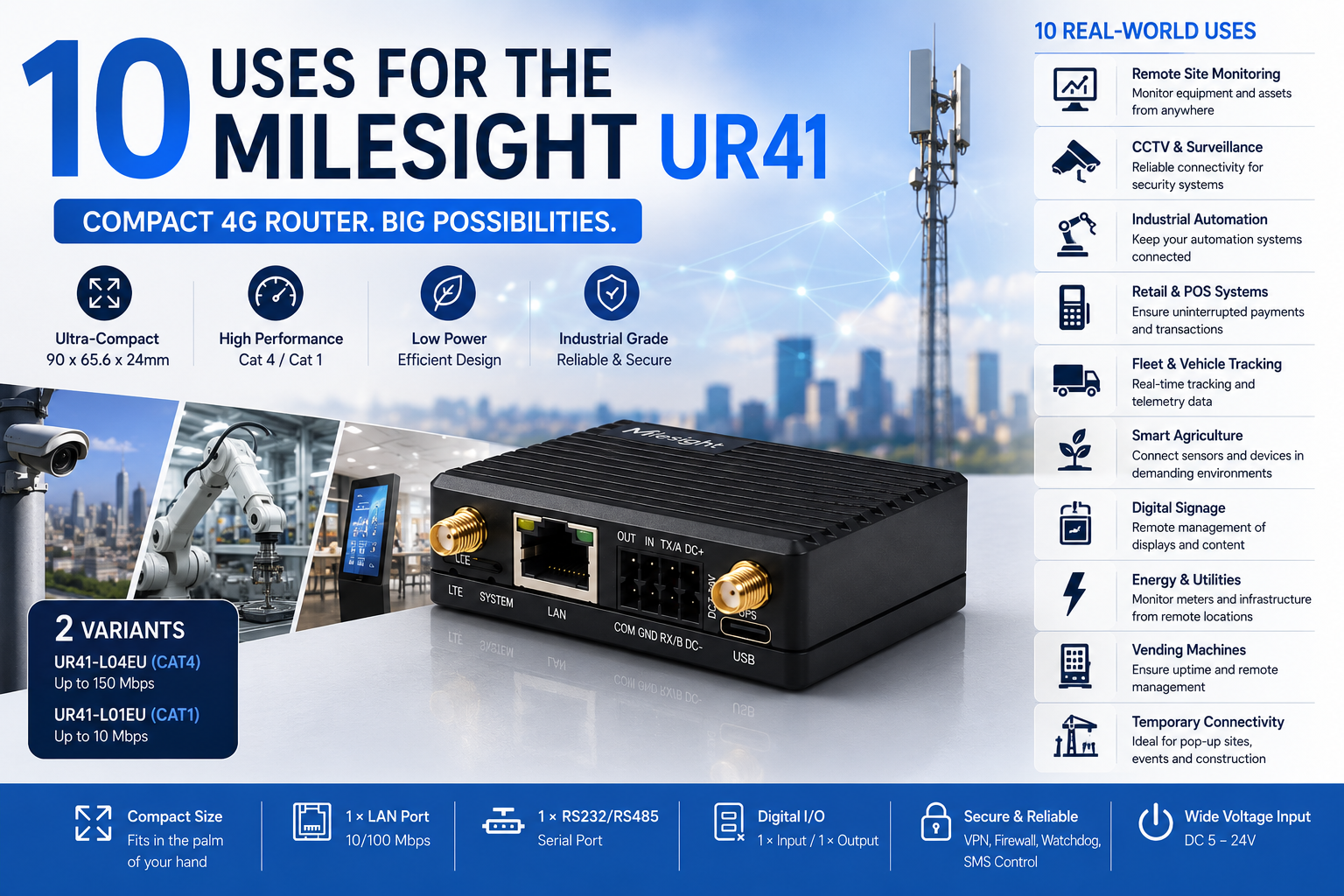
It fits in the palm of your hand, draws 6.3 mA on standby and speaks Modbus and DLMS out of the box. Ten deployments where the UR41 is the right router, and which of the two models each one calls for.
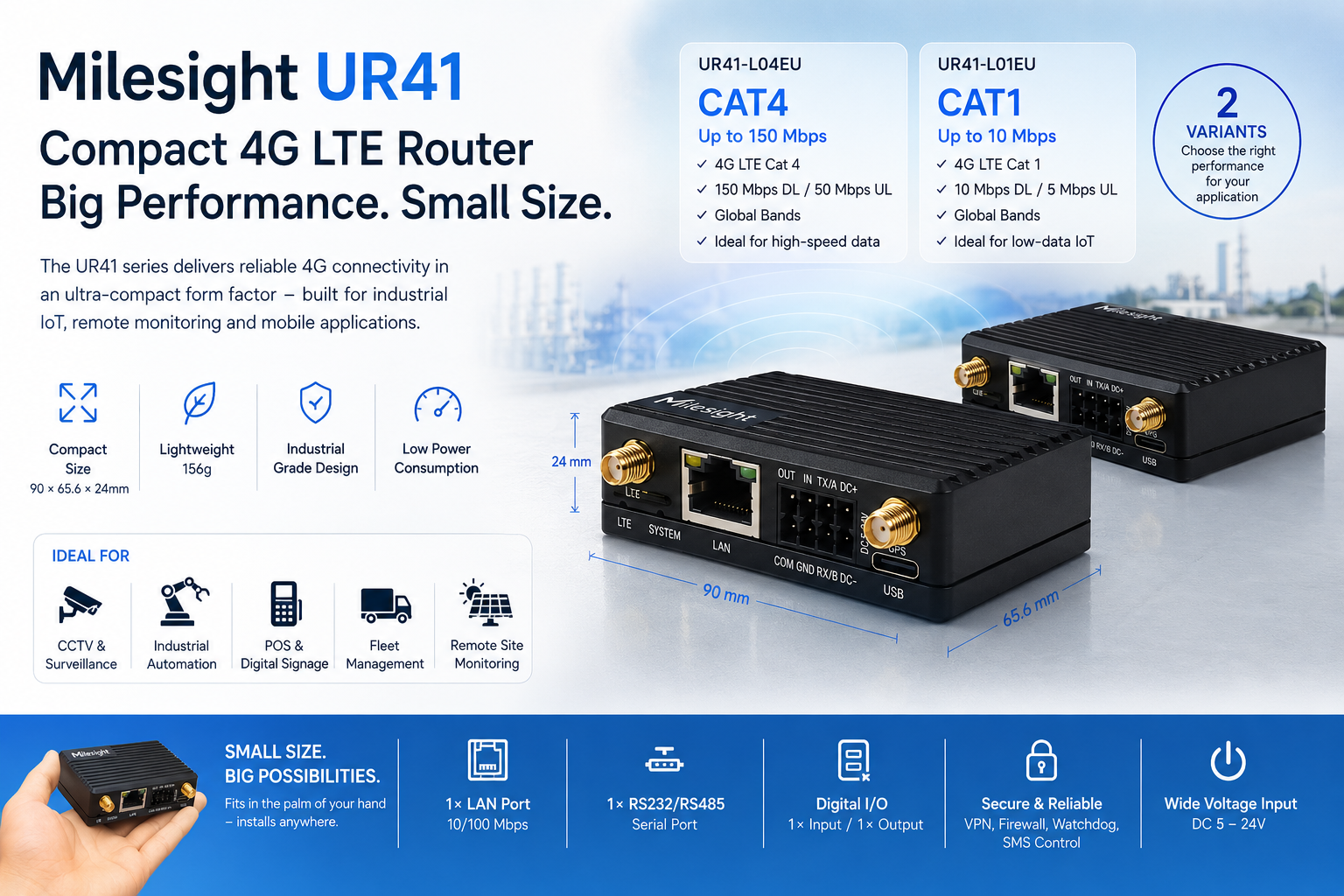
Most cellular routers are sold on throughput. The Milesight UR41 is not. It is a 70 x 55 x 22 mm metal box weighing 103 g, with a single 4G modem, one 10/100 Ethernet port, one software-switchable serial port and a pair of galvanically isolated digital I/O terminals.
That specification tells you exactly who it is for. This is a router for embedded work: cabinets, enclosures, meter boards, plant rooms and pole-mounted assets where the constraints are space, power budget and the need to talk to a serial device. Very few routers do that job at this size. Most that fit in the space have no serial port. Most with a serial port are three times the volume.
There are two models in the same enclosure. Choosing between them is the first decision, and it is not a budget decision.
Read this before the list: Cat 4 or Cat 1
LTE category describes what a modem is capable of. Cat 1 tops out around 10 Mbps down and 5 Mbps up. Cat 4 reaches 150 Mbps down and 50 Mbps up. Those numbers look decisive and for most of what follows they are irrelevant. A meter reading is a few hundred bytes. A Modbus poll is smaller. A site reporting every fifteen minutes will never trouble a Cat 1 modem.
What actually changes between the models is what travels alongside the category.
The UR41 is the Cat 4 model. It alone has a GNSS receiver and Multi-APN. The UR41L is the Cat 1 model. It has neither, and in exchange it draws less power: 70 mA idle and 157 mA on the data link, against 78 mA and 226 mA. Standby is identical at 6.3 mA.
So the question is never which one is better. It is whether the application needs to know where it is, whether it needs two APNs open at once, and whether anything on the link will ever move more than a trickle of data. Each entry below carries its verdict.
Multi-APN is the feature people miss. An APN is the doorway from the radio network into a particular IP network. Hold two open at once and your process traffic can sit on a private APN with a fixed IP while the router stays reachable for firmware and monitoring over a public one. Hold one open and you must choose between a router you can reach and traffic that stays off the public internet. It sits under highlight features rather than the model comparison table, so it is easy to miss that only the UR41 has it.
1. Smart meter backhaul over DLMS
The UR41 supports DLMS client mode over its serial port. Electricity and gas meters running IEC 62056 over RS232 or RS485 connect directly, with no protocol converter sitting between the meter and the router. One less box in the cabinet, one less thing to fail, and on a rollout of several hundred sites that saving compounds.
Almost nothing else in this form factor speaks DLMS natively. That is the whole argument for the router here.
Model: UR41L. Meter reads are tiny and the meter does not move. Step up to the UR41 only if your supplier insists on a private APN for meter data and a separate path for router management.
2. Distribution substations and RTU connectivity
Secondary substations, ring main units and pole-top reclosers need a cellular uplink and a serial connection to a protection relay or RTU. The UR41 handles Modbus gateway duty natively, translating Modbus RTU to Modbus TCP, and offers transparent serial in TCP client, TCP server, UDP server and MQTT client modes. The digital input is a dry contact readable over Modbus, MQTT, SMS, email or CLI, so a door contact or alarm relay rides alongside the process data without an I/O module.
Model: UR41. Not for the throughput. DNOs routinely separate operational traffic on a private APN from device management, and Multi-APN is the only way to serve both from one SIM. The UR41L cannot, and no discount changes that.
3. Solar and battery-powered remote monitoring
This is where the family separates itself from the field. Standby draw is 6.3 mA at 12 V on both models. Standby is also genuinely useful here: the router wakes on a schedule, by SMS, or on the digital input. A float switch or a tilt sensor on the DI brings a sleeping site online only when something has actually happened.
Power comes in at 5 to 24 V DC through the terminal block with surge and reverse polarity protection, or at 5 V over USB Type-C. The wide DC range sits comfortably on a 12 V leisure battery or a 24 V industrial rail.
Model: UR41L, emphatically. This is the application where Cat 1 is not a compromise but the correct answer. Lower idle and data-link current on a panel that has to survive a British December is worth more than throughput nobody will use.
The power figure that matters. Standby current is the number to design around, not idle. A site that reports once an hour spends over 99 percent of its life asleep. At 6.3 mA the router is not the thing draining your battery. Your sensor probably is.
4. EV charge point communications
Charge points need a backhaul for OCPP traffic, session authorisation and remote firmware. The UR41 is small enough to sit inside the charger enclosure rather than beside it, and -40 to +60 degrees C covers a British winter with room to spare. The Ethernet port takes the charge controller with 1.5 kV RMS isolation. The serial port picks up an energy meter on the same run.
Model: UR41. Two reasons. Payment and session traffic belongs on a private APN while the charge point management system reaches the router elsewhere, which needs Multi-APN. And firmware images for a modern charger are large enough that Cat 1 turns a five-minute update into an hour.
5. Vending machines and unattended retail
Milesight names vending machines explicitly in its own documentation. Card readers and telemetry boards commonly present a serial interface, and the UR41 gives them a VPN-protected route back to the operator. The hardware watchdog restarts the unit if the cellular link or the system hangs. An unattended machine that reboots itself at 3 am is a machine you do not send an engineer to.
Model: UR41L. A card authorisation is a handful of packets. Stock telemetry is a nightly summary. There is nothing here for a Cat 4 modem to do.
6. Water and wastewater telemetry
Pumping stations, CSO monitors and reservoir level sensors are almost always Modbus, almost always remote and almost always short of power. The digital output is a wet contact rated to 0.3 A at 30 V DC, triggered by the digital input, by SMS, by CLI, over Modbus or over MQTT. Enough for a simple remote control function at a site that does not justify a PLC. Not enough to switch a pump directly, so size an interposing relay.
Model: UR41L for most sites. UR41 where the water company mandates a private APN, which several now do. Ask before you specify, because retrofitting the answer means replacing the router.
7. Legacy PLC and machine connectivity
There is an enormous installed base of industrial equipment whose only external interface is RS232 or RS485. The UR41 sits in front of it and presents the machine to a SCADA system or a cloud platform as though it had been born with an Ethernet port. The serial port is software switchable, runs from 300 bps to 230400 bps, and carries a 120 ohm terminating resistor on a switch for RS485 runs.
This is unglamorous work and it is the single most common reason people buy small serial routers.
Model: UR41L by default. Choose the UR41 if engineers will open remote VPN sessions to program the PLC. Pushing a project file down a Cat 1 uplink is a slow and unhappy experience.
8. Mobile plant and asset positioning
Generators, welfare units, compressors and trailer-mounted equipment. The GNSS receiver uses GPS, GLONASS, BeiDou, Galileo and QZSS, with 2.5 m CEP accuracy in open air, on its own dedicated SMA connector. Position data is available over the serial port, MQTT, TCP or UDP, using NMEA0183 or PMTK. Combine that with a digital input wired to the ignition or a door and you have tracking and utilisation without a separate telematics unit.
Model: UR41, and only the UR41. The receiver is not fitted to the UR41L. This is the one application on the list where the decision makes itself.
9. Environmental and air quality monitoring
Roadside air quality cabinets, noise monitors and weather stations share a profile: low data volume, awkward siting, mains power that may or may not exist. The IP30 metal enclosure needs an outer cabinet, but at 103 g it DIN-rail mounts inside almost anything.
Model: UR41L, unless the network is split by APN. Local authority and highways deployments increasingly are, because the data goes to one platform and the estate management to another. That is a UR41 job.
10. Temporary and pop-up connectivity
A single Ethernet port limits this one, but for a ticket terminal, a site office laptop or a single IP camera at a construction compound, the UR41 with a switch behind it is a tidy answer. IP passthrough hands the cellular IP address straight to the downstream device where that is what you want. The USB-C port will run the router off a power bank while you commission it.
Model: UR41. The moment a camera is involved, Cat 1 is finished. This is the one entry where throughput, not features, decides it.
Be honest about the ceiling, though. There is no Wi-Fi anywhere in the range and one Ethernet port means one wired device unless you add a switch. This is not a site router.
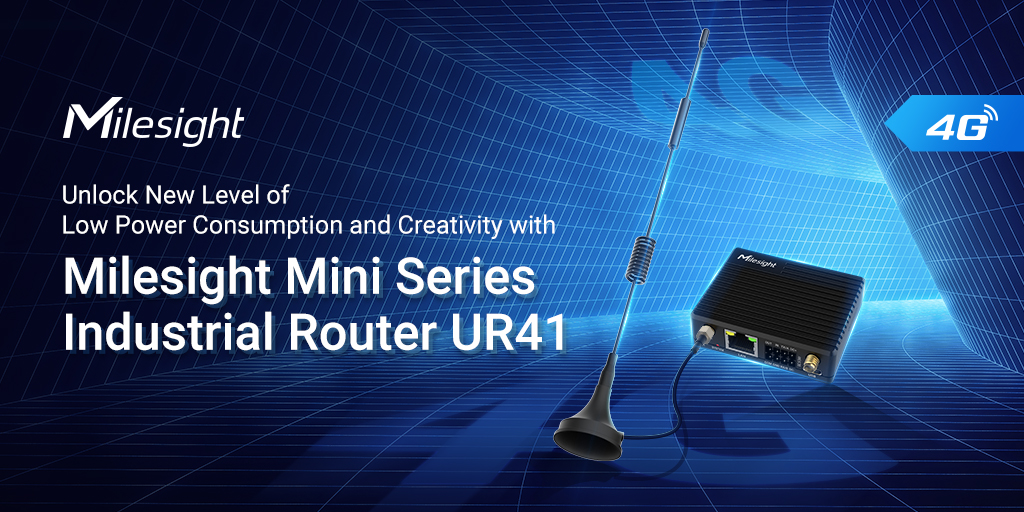
Ten deployments, two models. Which one you need depends on the application, not the price.
The verdicts on one page
Read down the right-hand column. The pattern is that Cat 4 is bought for GNSS and Multi-APN, almost never for speed.
| Application | Model | Because |
|---|---|---|
| Smart metering, DLMS | UR41L | Tiny payloads, fixed asset |
| Substations and RTUs | UR41 | Private APN plus management path |
| Solar and battery monitoring | UR41L | Lowest idle and data-link current |
| EV charge points | UR41 | Multi-APN, and large firmware images |
| Vending and unattended retail | UR41L | Nothing for a Cat 4 modem to do |
| Water and wastewater | UR41L or UR41 | UR41 where a private APN is mandated |
| Legacy PLC and machines | UR41L or UR41 | UR41 for remote PLC programming sessions |
| Mobile plant positioning | UR41 | GNSS is not fitted to the UR41L |
| Environmental monitoring | UR41L or UR41 | UR41 where data and estate split by APN |
| Temporary and pop-up, cameras | UR41 | Throughput, the only entry where it decides |
Do not buy the UR41 for its 2G and 3G fallback, at least not in Britain. The Cat 4 model adds WCDMA and GSM fallback that the UR41L lacks. Every UK mobile network operator has now completed its 3G switch-off, and 2G is following: EE begins closing its network from May 2029, Vodafone during 2030. A fallback path to networks being decommissioned is not a resilience feature. It is a liability with a date on it. On an export product the calculation is different.
One SIM slot is less of a limitation than it looks
The instinct on seeing a single SIM tray is to worry about network failover. That instinct is a decade out of date.
A multi-network SIM carries more than one operator profile and will attach to whichever radio access network is available at the site. A roaming SIM does much the same by treating every host network as a visited network. Either way, one slot gives you access to several mobile networks, and the router does not need a second tray to benefit. This is the normal way to specify IoT SIM cards for fixed assets, and it is why so many single-SIM routers ship into utility and metering work without anyone blinking. If you are sizing a tariff and a network profile for a UK deployment, SIMwise is a sensible starting point.
Be precise about what this buys you. A multi-network SIM gives network diversity. It does not give radio diversity. If the modem hangs, the antenna cable is damaged or the power fails, a second operator profile is no help. Reselection is an attach cycle rather than an instant cutover, so expect tens of seconds. For telemetry on a fifteen-minute schedule that is invisible. For a live SCADA session it is not.
The other half of reliable connectivity gets specified last and causes most of the site visits. A high specification IoT antenna on the SMA connector will do more for link stability at a marginal site than any amount of SIM cleverness. The router ships with a magnetic antenna in the box. That is fine on a bench and rarely the right answer inside a metal cabinet.
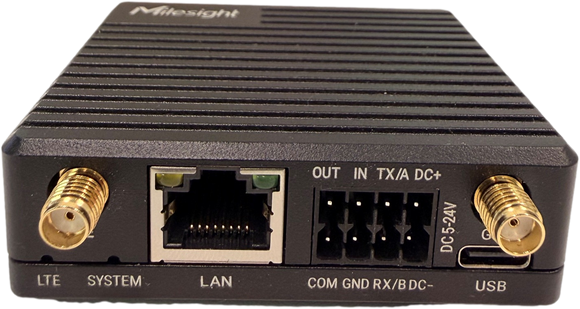
One SMA for cellular, one for GNSS on the UR41. The 8-pin terminal block carries serial, digital I/O and power on a single connector.
What you are actually buying
Figures below are taken from the manufacturer datasheet.
| Attribute | UR41 | UR41L |
|---|---|---|
| Cellular | 4G LTE Cat 4, WCDMA, GSM | 4G LTE Cat 1 |
| Multi-APN | Yes | No |
| GNSS | GPS, GLONASS, BeiDou, Galileo, QZSS. 2.5 m CEP, dedicated SMA | Not fitted |
| Processor | ARM Cortex-A7, 528 MHz, 128 MB DDR3 RAM, 128 MB flash | |
| SIM | 1 x Nano SIM (4FF). No hot swapping | |
| Ethernet | 1 x RJ45 10/100 Mbps, 1.5 kV RMS isolation | |
| Serial | 1 x RS232 or RS485, software switchable. 300 bps to 230400 bps. 120 ohm terminator switch | |
| Serial modes | Transparent (TCP client/server, UDP server, MQTT client), Modbus TCP/RTU client, Modbus gateway, DLMS client | |
| Digital I/O | 1 x DI (dry contact) + 1 x DO (wet contact, 0.3 A at 30 V DC), galvanically isolated | |
| Power input | 5 to 24 V DC terminal block with surge and reverse polarity protection, or 5 V / 1 A USB Type-C | |
| Power draw at 12 V | Standby 6.3 mA, idle 78 mA, data link 226 mA | Standby 6.3 mA, idle 70 mA, data link 157 mA |
| Power management | Standby mode. Wake by schedule, SMS or DI | |
| VPN | IPsec, OpenVPN, GRE, L2TP, PPTP, DMVPN, WireGuard, ZeroTier | |
| Management | Web, CLI, SMS, SNMP v1/v2c/v3, TR069, Milesight Development Platform, MilesightVPN | |
| Enclosure | Metal, IP30, -40 to +60 degrees C, 70 x 55 x 22 mm, 103 g | |
| Approvals | CE, FCC, RoHS | CE, RoHS |
Two things the datasheet says quietly. The SIM does not support hot swapping, so power the unit down before you touch the tray. And UKCA is not listed among the approvals for either model, so confirm the current position with your supplier if that matters to your project.
On WireGuard
Both models carry WireGuard and ZeroTier, which is unusual at this size and often omitted from reseller listings. Milesight publishes a configuration walkthrough in its support knowledge base.
For a fleet of low-power devices this matters more than it looks. WireGuard reconnects faster after a sleep cycle than IPsec and costs less in handshake traffic, which is exactly the sort of thing that shows up on the bill when you multiply it by a thousand sites.
Where neither model is the answer
No Wi-Fi. One Ethernet port. Cat 4 is ample for telemetry and thin for video at any scale beyond a single camera.
The single SIM is not the constraint people assume. The single radio is. Where a site cannot tolerate an attach cycle, or where the failure you are designing against is the router itself rather than the network, the answer is a second device on an independent cellular path, not a cleverer SIM in one box. The UR41 is a component in that kind of design, not a substitute for it.
The short version
Buy this family when the thing you need to connect has a serial port, the enclosure is small and the power budget is tight. Very little else does that job at 70 x 55 x 22 mm.
Then choose on application, not on price. The UR41 if the asset moves, or the network is split by APN, or a camera is on the end of the cable. The UR41L for everything else, where it is not the compromise but the better router, because it does the same work on less power.
Then spend what you saved on the antenna and the SIM, because that is where reliability actually comes from.
Related reading
- LTE Cat 1 vs Cat 4: which one your IoT deployment actually needs
- Modbus RTU to Modbus TCP: what the gateway actually does
- Sizing solar and battery for a remote cellular monitoring site
- DLMS/COSEM explained for people who are not metering engineers
- Private APNs, fixed IPs and why your router cannot reach both worlds
- The UK 2G switch-off and what it means for legacy IoT estates
All specifications taken from the Milesight UR41(L) datasheet and user guide. Power consumption figures are manufacturer laboratory measurements and are stated as guideline values only. Firmware feature sets change between releases, so check the release notes for the build you are shipping.
LTE category throughput figures are 3GPP category maxima, not device measurements, and real-world rates will be lower. UK 2G and 3G switch-off dates are from Ofcom and operator announcements and are subject to change.
Last reviewed: 10 July 2026.