
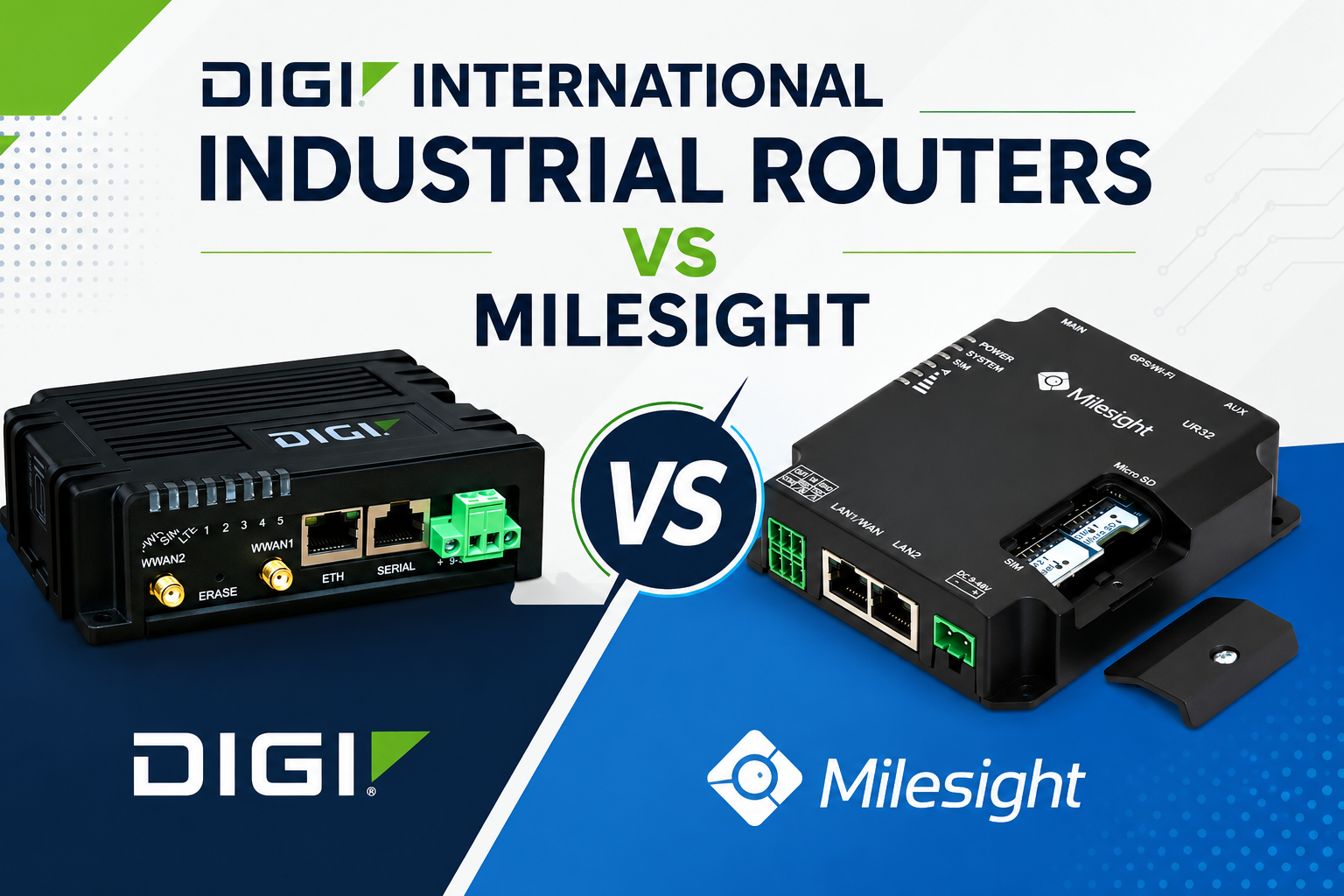
Digi International Industrial Routers: What They Offer and How They Compare to Milesight
In this article
Digi International is one of the longest-standing names in industrial cellular connectivity. The company has been building M2M and IoT hardware since 1985 – long before most of the market had a name for what it was doing. Its IX-series industrial routers are a credible option for demanding environments, and they come with a mature software platform that many enterprise buyers value.
This post looks specifically at Digi’s industrial router range. If you’re evaluating Digi against alternatives – particularly Milesight – this covers the hardware, the platform, and the practical trade-offs worth understanding before you commit.
We’re covering routers only here. Digi does considerably more than this as a business; a separate post covers the broader Digi ecosystem, including Opengear, Particle, SmartSense, and their embedded module lines.
Who is Digi International?
Digi International was founded in 1985 in Minnesota, initially building serial communications boards for industrial PCs. Over four decades it evolved into a publicly traded IoT company – listed on Nasdaq as DGII – with around 550 employees and annual revenue of approximately $424 million as of 2024. Headquarters are in Hopkins, Minnesota, with offices across Europe (including the UK), Asia-Pacific, and North America.
The company’s industrial router line sits within a broader product portfolio that includes embedded wireless modules (the XBee family), infrastructure management hardware, and several managed service subsidiaries. For the purposes of this post, we’re focused on one area: the IX-series cellular routers designed for industrial field deployments.
Worth noting: Digi acquired Opengear (out-of-band network management) and operates SmartSense (condition monitoring as a service) and Ventus (managed connectivity) as separate brands under the same corporate umbrella. These are not the same product as an IX-series router, though Digi’s sales teams often position them together.
The Digi IX-series: what’s in the range
Digi’s current industrial router line is built around the IX platform, which replaced the older WR-series (now end-of-life). There are four active models at time of writing, spanning entry-level 4G through to 5G with integrated edge computing.
Digi IX10
The entry point in the range. Single Ethernet port, one serial port (RS-232/485), dual SIM, C1D2 rated. Aimed at light industrial applications, digital signage, ATMs, and kiosks. Cost-effective but limited on port count.
Digi IX20
Dual Ethernet, single RS-232 serial port, dual SIM. FirstNet-capable models available for first responder use. Global band support from a single part number. Digi SureLink and TrustFence included as standard.
Digi IX30
The mid-range industrial workhorse. Adds dedicated GNSS (GPS, GLONASS, BeiDou, Galileo), Modbus bridging, I/O ports, ATEX rating, NEMA TS2 temperature certification, and edge computing via containerised applications. DIN rail or shelf mount. C1D2 and ATEX rated.
Digi IX40
5G with integrated edge computing. Adds SFP port for fibre uplink, supports CBRS and private 5G networks. Industry 4.0-oriented. Containerised application hosting, dual SIM, GNSS, C1D2 rated. The highest-capability unit in the range.
A fifth unit, the Digi IX25, was announced as new at time of research. It sits between the IX20 and IX40 – a 5G unit with Wi-Fi 6E, four Gigabit Ethernet ports, serial, I/O, GNSS, and support for 5G RedCap, CBRS, Anterix spectrum, and FirstNet. ATEX and C1D2 rated. TAA-compliant construction. This will be the flagship general-purpose 5G unit when it reaches full availability.
WR-series users: The WR31 and earlier WR-series units are now end-of-life. Digi provides a migration tool for moving configurations from WR to IX-series devices. If you’re running legacy WR hardware, the ix30 is the natural like-for-like replacement in terms of port configuration and certifications.
Digi’s platform: SureLink, Remote Manager, TrustFence
The IX-series hardware ships as part of what Digi calls Digi 360 – a bundled combination of device, cloud management, warranty, and support. The three software capabilities worth understanding are:
Digi SureLink
Digi’s patented mechanism for maintaining persistent cellular connectivity. SureLink continuously monitors the WAN connection and automatically takes corrective action – switching SIMs, redialling, or rebooting the cellular module – if the connection drops or degrades. This runs at the firmware level and operates independently of the hosted application. For deployments where uptime is non-negotiable, SureLink is a meaningful differentiator from routers that rely on basic ping-based watchdogs.
Digi Remote Manager
Cloud-based device management platform covering configuration, firmware updates, monitoring, alerting, and scripting across device fleets. Supports mass configuration rollouts, meaning a single template can be pushed to hundreds of devices simultaneously. The platform holds SOC 2 Type 2 certification, which matters for regulated industries. Remote Manager is included with all IX-series devices purchased under the Digi 360 programme.
Digi TrustFence
Digi’s security framework, built into the firmware. Covers device identity (X.509 certificates), encrypted communications, secure boot, and ongoing vulnerability monitoring. IX-series devices are also FIPS 140-3 certified, which is a US government cryptographic standard relevant for federal, utilities, and critical infrastructure deployments. VPN (OpenVPN, IPsec), firewall, and authentication features are included in the base firmware – no separate licensing.
Digi Containers
Available on IX30, IX40, and IX25, this allows containerised applications (Docker-based) to run directly on the router hardware. This enables edge processing, local logic, and protocol translation without a separate edge computing appliance. It’s an increasingly relevant capability for Industry 4.0 applications where processing at the source reduces latency and cloud dependency.
Where Digi performs well
Digi has genuine strengths in specific deployment contexts. These are worth stating plainly rather than dismissing them.
ATEX and C1D2 certification. Multiple IX-series units carry Class 1 Division 2 (C1D2) and ATEX ratings for use in potentially explosive atmospheres. This is a hard requirement for oil and gas, chemical processing, and mining applications. Not every industrial router manufacturer holds these certifications, and the process to obtain them is rigorous. If your deployment site has an Ex zone classification, the IX30 or IX40 are on a short list of options.
FirstNet support. Certain IX-series models are FirstNet Capable, meaning they’ve been certified to operate on AT&T’s FirstNet dedicated public safety network. This matters for emergency services, critical infrastructure operators, and US government deployments. It’s an access-controlled certification – not simply a marketing claim.
Long-established carrier certifications. Digi has been qualifying hardware against major carrier networks for decades. For enterprise buyers who need carrier-approved devices, particularly in North America, Digi’s certification history is extensive.
Digi Remote Manager at scale. For large fleet deployments – hundreds or thousands of devices – Digi Remote Manager is a capable platform. It handles mass configuration, FOTA, and monitoring across heterogeneous fleets. It’s a mature product, not a bolted-on afterthought.
North American market positioning. Digi is the dominant incumbent in several North American verticals: utilities, traffic management, public sector. If you’re integrating with existing Digi-managed infrastructure or working with a North American systems integrator, compatibility with the Digi ecosystem matters.
Where Digi has limitations
For European and UK buyers specifically, there are practical considerations that don’t always surface in Digi’s marketing materials.
Pricing structure. Digi IX-series hardware sits at the upper end of the industrial router market. The Digi 360 bundle – hardware plus Remote Manager subscription plus warranty and support – is positioned as an enterprise package, and the pricing reflects this. For projects where per-unit cost is a significant constraint, the IX-series is rarely the most competitive option.
US-centric design assumptions. The FirstNet capability and C1D2 ratings are valuable in North America. In UK and European deployments, the equivalent certifications are ATEX (which the IX30 and IX40 do carry) and CE. The IX-series holds CE marking, but the product range, documentation, and support organisation are primarily oriented around the US market.
LoRaWAN ecosystem. Digi offers LoRaWAN capability via its XBee gateway products, but these are separate product lines, not integrated into the IX-series routers. If your deployment requires combined cellular backhaul and LoRaWAN in a single device, the Digi IX-series doesn’t provide this natively.
Operating temperature range. The IX-series units are rated to -40°C to +70°C [VERIFY against current datasheets per model], which is standard for the industrial grade. This is comparable to most competitors at this tier.
UK support and stock. Digi does have a UK office, but stock availability and pre-sales technical support can vary depending on the distribution channel. Lead times for specific models are worth confirming before specifying into a project.
Digi vs Milesight: head-to-head comparison
Milesight’s UR-series industrial routers are the most direct comparison point. Both families target industrial cellular deployments, both carry dual SIM, and both include a cloud management platform. The differences are in platform integration, ecosystem breadth, pricing, and where each is strongest geographically.
| Criteria | Digi IX-series | Milesight UR-series |
|---|---|---|
| Connectivity generations | 4G LTE (IX10, IX20, IX30), 5G (IX25, IX40) | 4G LTE across UR32, UR35; 5G on UR75 – full range available now |
| Dual SIM | Yes, all models | Yes, all models – active/passive failover standard |
| LoRaWAN integration | No – separate XBee gateway product required | Native LoRaWAN on selected UR-series variants; UG65/UG67 gateways integrate tightly with same DeviceHub platform |
| Cloud management platform | Digi Remote Manager (subscription, bundled in Digi 360) | Milesight DeviceHub – included, no per-device subscription fee for core management |
| Edge computing | Digi Containers on IX30/IX40/IX25 (Docker-based) | Python scripting environment on UR-series; containerisation available on select models |
| Operating temperature | -40°C to +70°C [VERIFY per model] | -40°C to +70°C standard across UR range |
| ATEX certification | IX30 and IX40 carry ATEX rating | Not standard on UR-series [VERIFY] – factor for Ex zone deployments |
| CE / UK CA marking | Yes | Yes – CE, FCC, RoHS, REACH across range |
| Enclosure / DIN rail | DIN rail or shelf mount, metal enclosure | Steel enclosure standard; DIN rail mount; IP30 or IP65 variants depending on model |
| VPN support | OpenVPN, IPsec – licence-free | OpenVPN, IPsec, WireGuard, GRE – all licence-free |
| GNSS / GPS | Dedicated GNSS receiver on IX30 and above | Available on selected UR-series models |
| Pricing | Upper tier – enterprise positioning | Mid-market – competitive per-unit cost with equivalent specification |
| UK stock and support | Available via distribution; primarily US-oriented organisation | IoT UK holds UK stock; direct pre-sales technical support available |
| LoRa Alliance membership | No | Yes |
| WireGuard VPN | Not supported on IX-series [VERIFY] | Supported as standard |
On the Milesight DeviceHub advantage: Digi Remote Manager is a capable platform, but it comes attached to a subscription model as part of the Digi 360 bundle. Milesight’s DeviceHub provides remote configuration, FOTA, monitoring, and alerting without requiring a per-device subscription for core functionality. For buyers managing smaller fleets or working within tighter operational budgets, this is a practical cost difference – not a feature difference.
Where Digi has a genuine edge
For UK and European industrial buyers, two Digi advantages are worth acknowledging honestly. First, if your deployment site carries an ATEX zone classification – oil and gas facilities, chemical plants, grain handling, or similar – the Digi IX30 and IX40 are tested and certified for those environments, and this certification carries weight with site safety teams. Second, if you’re integrating into an existing Digi-managed infrastructure estate, the Remote Manager platform and device consistency make staying within the Digi ecosystem a reasonable decision.
Outside these specific scenarios, the IX-series is harder to justify on a cost-per-feature basis for most UK industrial applications.
Where Milesight has a practical advantage for most UK deployments
For the majority of UK industrial connectivity projects – cellular backhaul for remote monitoring, dual SIM failover for critical assets, LoRaWAN-plus-cellular hybrid networks, or smart city infrastructure – Milesight’s UR-series delivers equivalent or better specification at a lower unit cost, with no platform subscription overhead.
The addition of WireGuard VPN support is meaningful: WireGuard is now the preferred tunnelling protocol for many industrial security architectures due to its lower overhead and stronger cryptographic foundation compared to legacy IPsec implementations. Milesight includes it as standard; Digi does not [VERIFY current firmware].
The broader Milesight ecosystem is also a practical advantage where LoRaWAN is involved. Being able to specify Milesight UR-series cellular routers alongside Milesight UG65 LoRaWAN gateways and Milesight sensors – all managed under a single DeviceHub instance – simplifies both procurement and ongoing management. Digi requires separate product families and a separate management approach to achieve the same outcome.
The honest verdict
Digi International builds solid industrial routers. The IX-series is well-engineered, the SureLink connection management is genuinely effective, and the Remote Manager platform suits large enterprise deployments. For North American buyers, or for UK projects with explicit ATEX or FirstNet requirements, Digi is a legitimate first choice.
For most UK and European industrial deployments, however, Milesight’s UR-series offers equivalent ruggedness, a broader VPN stack, native LoRaWAN ecosystem compatibility, no subscription overhead on the management platform, and a more competitive per-unit price. When specifying hardware for utilities monitoring, smart metering backhaul, remote plant connectivity, or agricultural IoT, Milesight consistently reaches the shortlist first on both technical and commercial grounds.
If you’re running a large, Digi-invested infrastructure estate or working in classified hazardous areas, talk to us about the IX30 or IX40. If you’re starting fresh or expanding an existing network, the Milesight UR-series is where we’d point you first.
Not sure which industrial router fits your project?
We stock Milesight hardware in the UK and offer free pre-sales technical support. Tell us what you’re building and we’ll help you specify the right kit.
Talk to Peter Green