
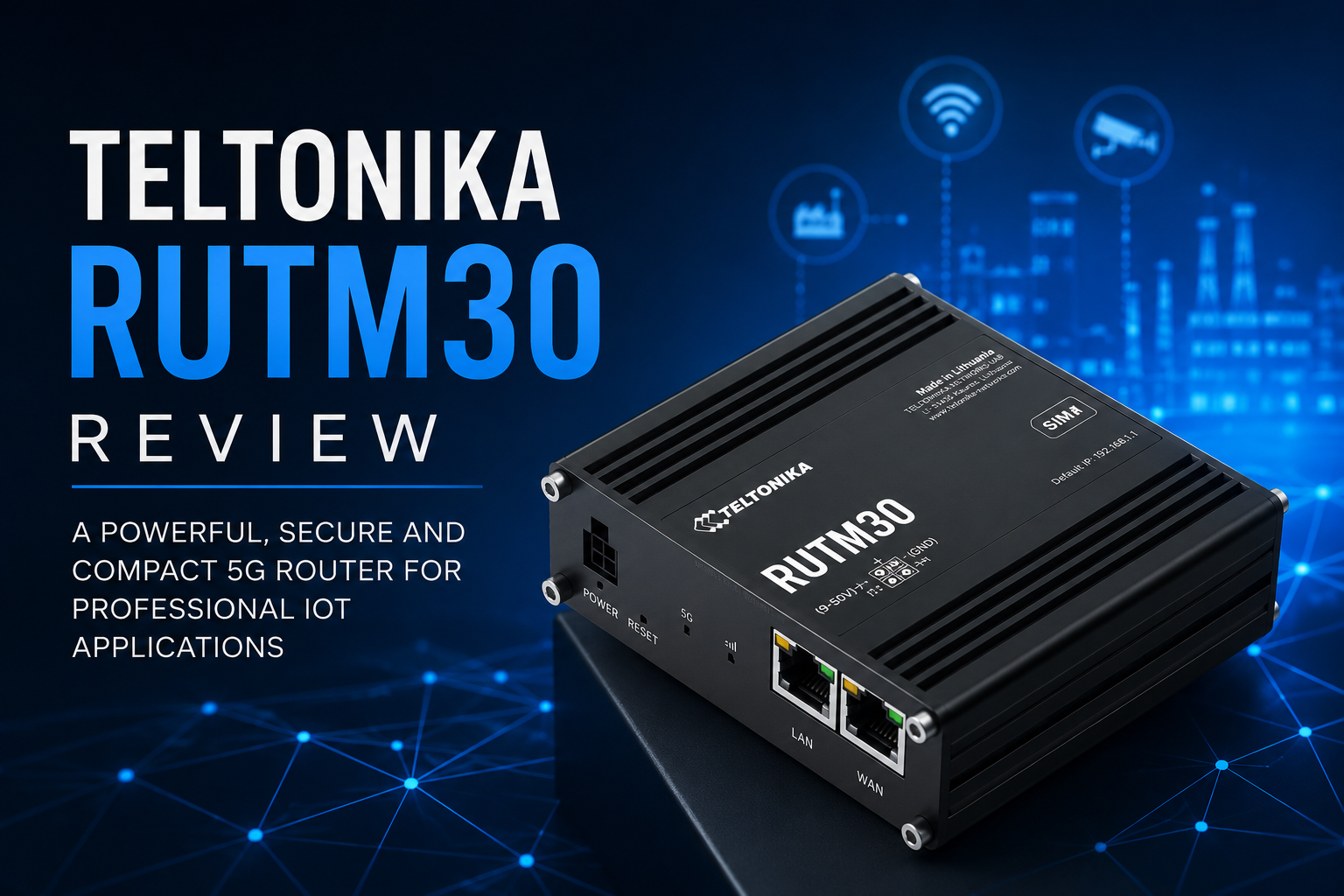
Teltonika RUTM30 Review: What CAT19 4G and 5G Really Mean for IoT Deployments
The RUTM30 is a compact 5G router with a CAT19 4G fallback, eSIM support, and a software stack that IoT engineers will recognise immediately. Here is a close look at what it does, who it is for, and why the network tier question matters more than most buyers realise.
There is a pattern in how IoT connectivity evolves. A new radio standard arrives, the marketing catches up fast, and for a while it can be hard to separate what is genuinely useful in a deployment from what is just headline figures on a datasheet. 5G is in that phase right now – at least in the industrial and IoT space.
The Teltonika RUTM30 sits at an interesting intersection. It is a 5G Sub-6 GHz router. It also carries a CAT19 4G LTE modem as its fallback path. In a large part of the UK – and most of Western Europe – that CAT19 layer is doing the real work day to day, and that is not a criticism. Understanding why is the whole point of this review.
The hardware in brief
The RUTM30 is a compact aluminium unit – 100 x 30 x 93.7 mm, around 320g. It is built for field installation: wide DC input from 9 to 50V, passive PoE-in on Mode B, reverse polarity protection, and a rated operating temperature range of -40°C to +75°C. This is not a home router in an industrial casing. The design is genuinely aimed at cabinet, DIN rail, and vehicle-mount scenarios.
Key Specifications at a Glance
Understanding CAT19 – and why it matters more than the 5G headline
The RUTM30 is marketed as a 5G router. That is accurate. But in most UK IoT deployments right now, the 5G SA (Standalone) network is simply not available at the site in question. Coverage is concentrated in city centres and dense urban areas. For a router installed at a water treatment works, a substation, a CCTV mast in a rural area, or a remote plant room, the operative question is not “how fast is the 5G?” – it is “how well does the 4G perform?”
This is where CAT19 becomes important to understand properly. LTE Category 19 is an advanced carrier aggregation category – it can aggregate up to five component carriers and supports 4×4 MIMO, delivering theoretical peak downloads of 1.6 Gbps. In practice, real-world throughput on a well-sited UK 4G network with a CAT19 modem will typically land somewhere between 80 and 300 Mbps depending on signal conditions, band availability, and network load. That is substantially better than the 150 Mbps ceiling of CAT4 devices – the category that dominated industrial IoT a few years ago.
For most IoT applications, the throughput gap between CAT4 and CAT19 is academic. SCADA polling, sensor telemetry, and control traffic are low-bandwidth by nature. Where CAT19 makes a real difference is in two specific scenarios: high-definition video surveillance over cellular where you may be pushing 4-8 Mbps per camera across multiple streams, and applications where the backhaul also carries general IT traffic from a remote site – edge servers, staff devices, operational systems. In those cases, the extra headroom from carrier aggregation is genuinely useful.
The 5G capability matters most if you are future-proofing. A site that installs the RUTM30 today on 4G will move to 5G SA coverage without a hardware change as the network rolls out. That is a reasonable argument for the spec premium if the deployment lifecycle is five years or more.
The SIM story: dual physical + eSIM
The RUTM30 carries two physical nano SIM slots and an embedded eSIM supporting up to seven profiles. This is a meaningful configuration for IoT deployments, and it is worth unpacking how it works in practice.
The two physical SIMs allow you to run two different operators simultaneously – or more accurately, to configure automatic switching between them based on defined triggers. Those triggers in RutOS are comprehensive: weak signal, data limit reached, SMS limit reached, roaming detected, no network found, network denied, or data connection failure. This is proper multi-network failover, not just manual SIM selection.
The eSIM adds a third layer. This is a consumer-type eSIM that supports remote profile download and removal. It is not the same as an M2M eSIM (SGP.02) or an industrial IoT eSIM built to the eUICC SGP.32 standard – which is the architecture designed specifically for IoT devices with remote SIM provisioning via a SIM manager platform. The RUTM30’s eSIM is a consumer eUICC, which means it supports consumer operator profiles and the standard SGP.22 download flow.
For most UK deployments, the practical setup is: SIM slot 1 carries a fixed-IP IoT SIM on your primary operator, SIM slot 2 carries a roaming or multi-network SIM from a different provider as backup, and the eSIM sits unused as a third option for future flexibility. That covers the vast majority of scenarios without any complexity.
Antennas: what to use and why it matters
The RUTM30 has four SMA antenna connectors for the mobile modem – reflecting the 4×4 MIMO capability on both 5G and the CAT19 LTE path. There are also two RP-SMA connectors for Wi-Fi.
In a factory or indoor deployment, the bundled stub antennas will often do the job. In any installation where the unit is inside a metal cabinet, behind a wall, or at a distance from the nearest cell site, external antennas make a measurable difference to throughput and reliability. For the cellular ports, a directional panel or MIMO LTE/5G antenna mounted externally with low-loss coax back to the router is the standard approach. Four-port MIMO antennas designed for LTE and 5G Sub-6 are available from multiple manufacturers and designed specifically for this role.
The key practical point: all four cellular antenna ports should be populated. Running a CAT19 modem with only two of the four antenna connections made will cap throughput and undermine the carrier aggregation performance that justifies the CAT19 spec in the first place. This is one of the most common installation errors in the field.
Use cases: where the RUTM30 fits
SCADA and industrial telemetry
RutOS natively supports Modbus TCP, DNP3, OPC UA, and DLMS/COSEM. The RUTM30 can act as a cellular backhaul for SCADA RTUs with built-in protocol awareness. Pair with a VPN tunnel – WireGuard or IPsec – to a VPS or cloud endpoint to create a private routable path between field devices and your control systems.
Remote CCTV backhaul
High-definition IP cameras at construction sites, utilities, and transport infrastructure are one of the main drivers for CAT19 and 5G hardware. The RUTM30 provides enough bandwidth headroom to carry multiple HD streams with room for management traffic alongside.
Edge connectivity for IoT data platforms
The RUTM30 connects field sensors and edge gateways to cloud IoT platforms via MQTT, HTTP, or VPN. For deployments using ThingsBoard for SCADA and IoT data management, the RUTM30 is a natural fit as the cellular backhaul device – providing a stable, managed connection back to a hosted or self-managed ThingsBoard instance.
Vehicle and mobile deployments
The wide voltage input (9-50V), operating temperature range, and compact form factor make the RUTM30 suitable for vehicle installations – buses, rail, fleet vehicles. Wi-Fi passenger access sits alongside the cellular WAN, and RMS allows centralised monitoring across a fleet without site visits.
Pop-up and temporary connectivity
Events, construction sites, and temporary facilities benefit from a router that can be rapidly deployed, remotely managed from day one, and reconfigured or moved without a truck roll. The eSIM profile capability adds flexibility for different operator contracts across different sites or regions.
Energy and smart grid
DNP3 and IEC 61850 support, combined with dual-SIM failover and fixed-IP SIM compatibility, makes the RUTM30 a reasonable choice for substation communications, BESS monitoring, and smart metering backhaul. The wide DC input means direct connection to 12V or 24V site power without an additional converter.
RutOS and remote management
The operating system is RutOS – Teltonika’s Linux-based firmware, derived from OpenWRT. It is a mature platform at this point, and for IoT engineers it is well understood. The VPN stack covers OpenVPN, WireGuard, IPsec, GRE, L2TP, ZeroTier, Tailscale, DMVPN, and SSTP. The security features include a configurable firewall, DDoS prevention, port scan protection, and VLAN separation. The industrial protocol support – Modbus TCP/RTU, MQTT, OPC UA, DNP3, DLMS/COSEM – is handled as a native RutOS feature rather than a bolt-on.
Teltonika’s Remote Management System (RMS) is the central management plane for deployed devices. It handles zero-touch deployment, remote configuration, firmware updates, and monitoring across a fleet. For anyone managing more than a handful of units across multiple sites, it is an essential tool rather than an optional extra. Devices on dynamic IP or private APN SIMs – which are not directly addressable from the internet – are still fully manageable through RMS because the device initiates the outbound connection to the platform.
The Web API (currently in beta) allows programmatic access to device configuration and status data, which is increasingly relevant as IoT deployments add application logic at the edge and need to pull router state into higher-level orchestration systems.
How does the RUTM30 compare to adjacent Teltonika hardware?
| Feature | RUTM30 | RUTX50 | RUTM52 |
|---|---|---|---|
| 5G | Yes (Sub-6) | Yes (Sub-6, 5x antenna) | Yes (dual modem) |
| 4G fallback | CAT19 | CAT20 | Dual CAT20 |
| SIM | 2x physical + eSIM | 2x physical | 2x physical (dual modem) |
| Ethernet ports | 2x GbE (1 WAN, 1 LAN) | 5x GbE | 5x GbE |
| Wi-Fi | Wi-Fi 5 dual-band | Wi-Fi 5 dual-band | Wi-Fi 5 dual-band |
| Form factor | Ultra-compact | Standard desktop | Standard desktop |
| Best for | Compact installs, vehicles, single-device uplinks | Multi-port LAN requirements | Mission-critical dual-modem uptime |
The RUTX50 is the obvious comparison. It offers more Ethernet ports, which matters when you need to connect multiple wired devices at the same site – IP cameras, PLCs, workstations – rather than routing a single upstream connection. The RUTM30’s single LAN port is a constraint if you need to connect more than one wired device without adding a switch.
The RUTM52 is a different proposition – a dual-modem router where two independent cellular modems run simultaneously, each on its own SIM and optionally its own network operator. For applications where true active-active cellular redundancy is required, the RUTM52 is the right tool. The RUTM30’s dual-SIM failover is sequential – one active at a time – which covers the vast majority of scenarios but is not the same as simultaneous dual-modem operation.
The 5G vs RedCap question
There is a question worth raising for anyone speccing cellular connectivity for IoT right now: is full 5G the right category for your application, or does it make more sense to consider 5G RedCap?
5G NR-Light, commercially known as RedCap (Reduced Capability), is a 3GPP Release 17 specification designed to bring 5G connectivity to IoT devices at lower cost and lower power consumption than full 5G NR. It targets the space between LTE CAT-M/NB-IoT at the low end and full 5G NR at the high end – industrial sensors, smart meters, wearables, surveillance cameras. A device like the RUTM30 operates at the full 5G NR level, which brings higher throughput capability but also higher modem cost and power draw.
For applications that genuinely need the bandwidth – multi-camera surveillance, high-volume edge computing uplinks, real-time video analytics – full 5G is justified. For applications moving smaller payloads where the main benefit of 5G is lower latency rather than raw speed, RedCap may turn out to be the more practical long-term architecture as hardware becomes available. This is an evolving space – the 5G RedCap ecosystem is developing rapidly, and Release 18 introduces eRedCap (enhanced RedCap) as a further evolution designed to push capability upward while maintaining the cost and efficiency benefits of the original spec.
For now, the RUTM30 is the right answer for most deployments that want future-proof 5G capability today, with an excellent 4G CAT19 layer doing the work in the meantime.
Installation notes
A few practical points that come up repeatedly in field deployments of this class of hardware:
Power: the 9-50V DC input is genuinely broad. Most industrial cabinet environments run 24V DC or 48V DC, and both work directly. Passive PoE on the LAN1 port (Mode B) allows the router to be powered over a standard PoE injector in locations where running a separate power cable is impractical.
APN configuration: if you are using a private APN or fixed-IP SIM, the APN credentials need to be set manually in RutOS. RutOS includes an APN database that covers most major UK operators for standard consumer and IoT tariffs – it will detect the network and populate the APN automatically in most cases, but private APNs always require manual configuration.
VPN setup: for SCADA and remote monitoring applications, WireGuard is increasingly the preferred VPN protocol – lower overhead than OpenVPN and significantly simpler to configure than IPsec. The RUTM30 supports WireGuard natively. If your control system or data platform sits on a cloud VPS, setting up a WireGuard server there and connecting the RUTM30 as a client is a clean, low-maintenance architecture that works well with dynamic or private-APN SIMs where the router IP is not publicly accessible.
Signal diagnostics: RutOS exposes detailed signal metrics – RSSI, RSRP, RSRQ, SINR, connected band, cell ID, carrier aggregation status. These are visible in the WebUI and also accessible via the API and through RMS. Running through these metrics during commissioning takes a few minutes and often reveals whether an external antenna would materially improve performance at a given site.
Where the eSIM fits in the broader IoT SIM picture
The RUTM30’s embedded eSIM is a consumer eUICC (embedded Universal Integrated Circuit Card). This is worth placing in context, because the IoT SIM landscape has multiple parallel specifications that are easy to conflate.
The consumer eSIM standard (SGP.22) is designed for smartphones and consumer devices. It allows users to download operator profiles remotely via a standardised flow. The RUTM30 supports up to seven stored profiles on the eSIM, with the ability to switch between them.
The M2M eSIM standard (SGP.02) is an older architecture designed for machine-to-machine deployments where SIM profiles are managed by an enterprise subscription manager. It is common in automotive and utility deployments.
The IoT eSIM standard (SGP.32, also known as IoT-eUICC) is the most recent specification, designed specifically for IoT devices that need lightweight remote provisioning without the complexity of the M2M model. It is not what the RUTM30 uses – the RUTM30’s eSIM is the consumer type – but it is the architecture that is appearing in next-generation IoT-specific hardware.
For most current deployments, the consumer eSIM in the RUTM30 provides a genuinely useful third SIM option. The ability to download an operator profile over the air without physical access to the device is valuable in remote installations, and seven stored profiles is enough flexibility for any realistic deployment scenario.
Verdict
The RUTM30 is a well-executed compact 5G router aimed squarely at professional IoT and M2M deployments. The CAT19 LTE fallback is the practical workhorse for most UK sites today, and it performs well. The 5G capability is genuine future-proofing rather than marketing. The triple-SIM architecture – two physical slots plus eSIM – gives deployment engineers meaningful flexibility in SIM strategy. RutOS is a mature, capable platform, and the industrial protocol support, comprehensive VPN stack, and RMS integration make it a complete solution rather than just a modem with a web interface.
The single LAN port is the main constraint relative to larger Teltonika hardware, and anyone needing to connect multiple wired devices should look at the RUTX50 instead. For compact, single-uplink deployments – cabinets, vehicles, temporary sites, single-device backhaul – the RUTM30 is a strong choice at a sensible price point for what it delivers.
View the RUTM30 at Router Store