
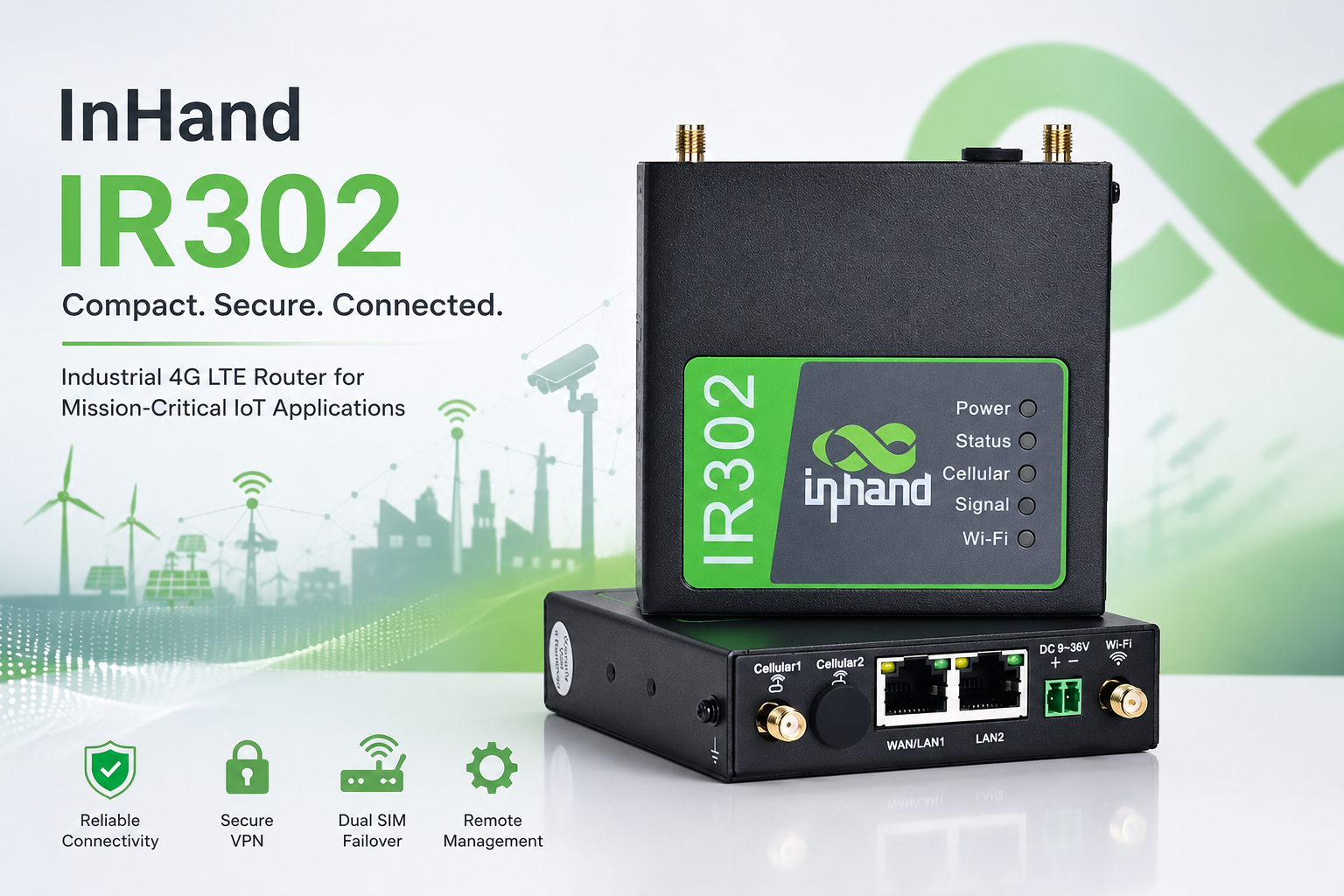

InHand IR302 at a glance
The InHand IR302 is a compact industrial 4G router built for the kind of jobs that do not need much bandwidth but do need to stay online for years without a site visit. Telemetry cabinets, EV charge points, ATMs, remote pumps and PLCs all fit its profile. It pairs LTE Cat 4 with dual SIM, a serial port, a full VPN suite and cloud management, in a full-metal fanless case the size of a paperback. This guide covers what the IR302 does, where it fits, how InHand Device Manager keeps it maintainable, and how it sits alongside the rest of the InHand router range.
The variant most relevant to the UK is the IR302-FQ58-WLAN-S. It carries the Europe and APAC LTE module, adds 2.4 GHz Wi-Fi and an RS232/RS485 serial port, and it is CE and UKCA certified. In the UK it is stocked by The Router Store at £95 excl VAT, with UK-based technical support behind it.
What is the InHand IR302?
The IR302 is an industrial-grade cellular router. Industrial-grade means a metal enclosure, no fan, a wide 9 to 36 V DC input, surge and reverse-polarity protection, and an extended operating range down to -40 degrees C. It runs InHand’s own OS with the routing, VPN, firewall and cloud features you expect on a managed device. It is not a consumer hotspot. It is a fit-and-forget field router.
At the centre is a 580 MHz processor with 128 MB of RAM and 32 MB of flash. That is modest, and deliberately so. The IR302 routes traffic, runs VPN tunnels and bridges serial data. It is not an edge compute platform, and it does not try to be. For heavier work you step up the range, which we cover further down.
Key specifications
- Cellular: 4G LTE Cat 4, up to 150 Mbps down and 50 Mbps up, with 3G and 2G fallback.
- Bands (FQ58): 4G FDD B1/B3/B5/B8 and TDD B38/B40/B41 (plus B34/B39); 3G B1/B5/B8; 2G B3/B8.
- SIM: two Nano-SIM slots with dual-SIM backup, ICCID binding and RSRP threshold switching.
- Wi-Fi: 2.4 GHz 802.11 b/g/n, AP, STA or AP+STA, up to 32 clients.
- Ethernet: 2 x 10/100 Mbps, one WAN/LAN switchable and one LAN.
- Serial: 1 x RS232/RS485 combo with DTU (TCP/UDP/MQTT) and Modbus RTU to Modbus TCP bridging.
- VPN: IPsec, OpenVPN, WireGuard, ZeroTier, GRE, L2TP and PPTP.
- Security: SPI firewall, ACL, IP-MAC binding, DoS protection, 802.1X, CA certificates.
- Power: 9 to 36 V DC, reverse-polarity and surge protection, under 10 W peak.
- Build: full metal, fanless, IP30, DIN rail or wall mount, -40 to +75 degrees C extended.
- Cloud: InHand Device Manager and InConnect, plus SNMP, SSH and an HTTP API.
- Certification: CE and UKCA. MTBF over 100,000 hours. 1 year warranty.
Why the IR302 is a strong choice
Three things make the IR302 stand out at its price. First, the serial port is a real protocol gateway, not a token feature. The RS232/RS485 port runs InHand’s DTU, so a Modbus RTU meter or PLC on the serial line can be presented to your platform as Modbus TCP, or streamed over MQTT to a broker, with no separate gateway box. For anyone connecting legacy serial equipment over cellular, that saves a device and a power outlet.
Second, the VPN suite is unusually complete for a compact router. IPsec, OpenVPN, WireGuard and ZeroTier are all present, so the IR302 drops into most existing remote-access setups without forcing a change of tunnel. WireGuard in particular keeps overheads low on a metered SIM.
Third, it is properly resilient. Two SIMs give mobile network diversity, and the switching logic is rule-based rather than crude polling: you set an RSRP signal threshold, a packet-loss trigger and a maximum dial-attempt limit. Combined with the wide-voltage surge-protected power input and the fanless metal build, it survives roadside and cabinet conditions that would trouble office kit.
What is the IR302 used for?
SCADA and PLC remote access
This is the IR302’s core job. A Modbus RTU PLC or RTU on the serial line reaches the control room as Modbus TCP, wrapped in an IPsec or WireGuard tunnel so the data crosses the mobile network encrypted. Engineers maintain the PLC remotely instead of driving to site. The compact case fits inside an existing control cabinet on a short length of DIN rail.
Utility and metering telemetry
Distribution monitoring, remote pumping stations, flow meters and smart metering concentrators need a small router that survives a cabinet with no cooling. The IR302 backhauls meter data over MQTT or a VPN, and dual SIM keeps the link up when one network drops in a rural location. The 580 MHz platform is plenty for periodic telemetry payloads.
EV charge point connectivity
Charge points need reliable backhaul for OCPP messaging, remote billing and firmware updates. The IR302 provides the mobile link in a DIN-rail format that fits the charger enclosure, and Device Manager cuts truck rolls across a distributed estate by flagging faults before a driver reports one. Dual SIM covers the case where a single operator has poor coverage at a given bay.
Unattended retail, ATMs and kiosks
ATMs, vending machines and ticketing terminals must stay online for payments. The IR302 gives these self-service terminals a resilient cellular connection, with a firewall and VLANs to isolate the payment device from other traffic, and VRRP hot standby to keep the site trading through a single-network outage. IP-MAC binding locks the LAN to known devices.
Environmental and infrastructure monitoring
Water and air quality stations, flood sensors and streetlighting controllers sit in exposed roadside and field cabinets. The wide-temperature fanless design and surge-protected power suit these outdoor enclosures. Serial and Ethernet DTU modes backhaul sensor data to a central platform, with alarms raised through the cloud.
Construction sites and temporary networks
Site offices and welfare units need connectivity fast, with no fixed line to wait for. The IR302 goes into a cabinet or onto a DIN rail and connects over 4G in minutes, then relocates cleanly as the site moves. Dual SIM covers patchy coverage on a new plot.
InHand Device Manager: managing a fleet from a browser
Hardware is only half the story on unattended sites. What keeps a cellular estate affordable is remote management, and this is where InHand Device Manager earns its place. Device Manager is InHand’s cloud platform for routers and gateways, reached at iot.inhandnetworks.com. It uses an MQTT-based architecture, which suits exactly the low-bandwidth, high-latency links that cellular field sites run on. The IR302 belongs to the supported IR300 device family.
Enrollment is simple. You register a Device Manager account, then in the IR302 web interface under Services you set the service to Device Manager and enter your account email. The router pushes itself to the cloud and appears as an online device. From there the platform gives you a set of tools that remove most reasons to visit a site:
- Remote web access: open the router’s own web interface through the portal and change its configuration as if you were stood in front of it. This is the single most useful feature for ad-hoc fixes.
- Batch configuration and firmware: push a config or a firmware image to many devices at once, with task tracking so you can see progress and failures across the fleet.
- Monitoring and a GIS map: live device status, traffic and signal, plotted on a map so you can see where a problem device physically sits.
- Event alerts: pushes for online and offline events, traffic thresholds, dual-SIM switching, link backup and port state. A dual-SIM switch alert is an early warning that a primary network is degrading at a site.
- Signal analysis: RSRP, RSRQ, SINR and band reported to the cloud, so you can diagnose a weak-signal site without dispatching an engineer with a laptop.
- Grouping and role-based access: group devices by customer or region, and give staff scoped permissions. CA certificates, encryption and access control secure the platform end to end.
Full detail on the platform is on the InHand Device Manager page. For inbound VPN and direct device access from your own systems, pair the IR302 with a fixed IP SIM card, since a standard SIM sits behind carrier-grade NAT. Our guide to VPNs on cellular routers explains the options.
Where the IR302 sits in the InHand range
InHand splits its cellular products into industrial routers (the DIN-rail IR line) and cellular routers (the desktop and portable CR line), with a separate outdoor ODU line. The IR302 is the entry point of the industrial line. Here is how the range compares.
| Model | Class | Cellular | Wi-Fi | Standout | Best for |
|---|---|---|---|---|---|
| IR302 | Industrial, DIN | 4G Cat 4 | Wi-Fi 4, 2.4 GHz | Compact, RS232/RS485, dual SIM | Cabinets, telemetry, kiosks, EV points |
| IR315 | Industrial, DIN | 4G Cat 1/4/6 or 5G by SKU | Wi-Fi 4, 300 Mbps | 5 Ethernet ports, optional GNSS and serial/IO | Multi-device sites, VLANs, small LANs |
| IR624 | Industrial, DIN | 5G SA/NSA to 3.4 Gbps, or 4G | Wi-Fi 5, dual-band | Gigabit Ethernet, high performance | High-bandwidth 5G edge, video, robots |
| CR202-Lite | Cellular, portable | 4G | Wi-Fi 4 | 3000 mAh battery, pocket size | Temporary and on-the-move connectivity |
| CR602 | Cellular, desktop | 5G | Dual-band | Carrier-certified business 5G | Retail, branch and SME primary or failover |
| ODU2002 | Outdoor ODU | 5G to 4.76 Gbps + LTE Cat 19 | Wi-Fi 4, 2.4 GHz AP | IP67, 6 high-gain external antennas, PoE | Weak-signal outdoor reception feeding a building |
IR315: the multi-port step up
The IR315 keeps the same rugged design but adds five Ethernet ports with VLAN support, faster 300 Mbps Wi-Fi, and optional GNSS. Cellular runs from Cat 1 up to 5G depending on the SKU. Choose it over the IR302 when you need to wire several devices at the site, segment them into VLANs, or add GPS positioning.
IR624: the high-performance 5G option
The IR624 is the flagship of the industrial line. It brings 5G NR up to 3.4 Gbps, four gigabit Ethernet ports, dual-band Wi-Fi 5, and both RS232 and RS485 serial. It is the router for bandwidth-heavy edge work such as machine vision, industrial robots or 5G factory automation, where the IR302’s Cat 4 link and 100 Mbps ports would be the bottleneck. The Europe 5G SKU is the IR624-NRF4.
CR202-Lite and CR602: the cellular router line
InHand’s CR series are cellular routers rather than DIN-rail industrial units. The CR202-Lite is a portable 4G router with a built-in 3000 mAh battery, suited to temporary sites and mobile use. The CR602 is a desktop 5G business router for shops, branches and SME offices, used as a primary link or a broadband failover. Both are managed through InHand’s InCloud Manager platform.
ODU2002 and ODU12: outdoor 5G
For outdoor coverage, the ODU2002 is an IP67 5G unit with six high-gain external antennas that pull in a signal in weak-coverage areas and feed it indoors over PoE. The newer ODU12 takes a different approach with fully integrated antennas, Wi-Fi 7 and a discreet one-piece IP65 case for sites where appearance matters. Both suit 5G fixed wireless access where fixed-line broadband is poor.
Buying the IR302 in the UK
UK availability and support are where the IR302 becomes an easy recommendation rather than an import gamble. The FQ58 variant is CE and UKCA certified, so it is approved for UK sale and use, and the certificate documentation is available for a compliance file. The Router Store stocks it at £95 excl VAT with next-working-day delivery on orders placed by 3:00 PM, and provides UK-based technical support if you need help with dual-SIM rules, DTU setup or a VPN tunnel. You can buy the connectivity from the same place: browse In-Hand Networks routers, fixed IP SIM cards and IoT SIM cards, or call 0300 124 6181 to talk through a deployment.
Frequently asked questions
Is the InHand IR302 available and supported in the UK?
Yes. The IR302-FQ58-WLAN-S is CE and UKCA certified and stocked in the UK by The Router Store at £95 excl VAT, with UK-based technical support and next-working-day delivery on orders placed by 3:00 PM.
Does the IR302 support Modbus and serial equipment?
Yes. It has an RS232/RS485 combo serial port with DTU transparent transmission over TCP, UDP or MQTT, and it bridges Modbus RTU to Modbus TCP so serial field devices appear as Modbus TCP to your SCADA or platform.
What is the difference between the IR302, IR315 and IR624?
The IR302 is the compact 4G entry model with two Ethernet ports. The IR315 adds five Ethernet ports, VLANs, faster Wi-Fi and optional GNSS or 5G. The IR624 is the high-performance model with 5G up to 3.4 Gbps, gigabit Ethernet and Wi-Fi 5. Pick the IR302 for telemetry and single-device sites, the IR315 for multi-device LANs, and the IR624 for high-bandwidth 5G edge work.
How is the IR302 managed remotely?
Through InHand Device Manager, a cloud platform for batch configuration, firmware upgrades, monitoring and remote web access to each router’s interface. SNMP, SSH and an HTTP API are also supported. A fixed IP SIM makes inbound VPN and direct access simpler.
1 thought on “InHand IR302: the compact industrial 4G router, and why it works well in the UK”