
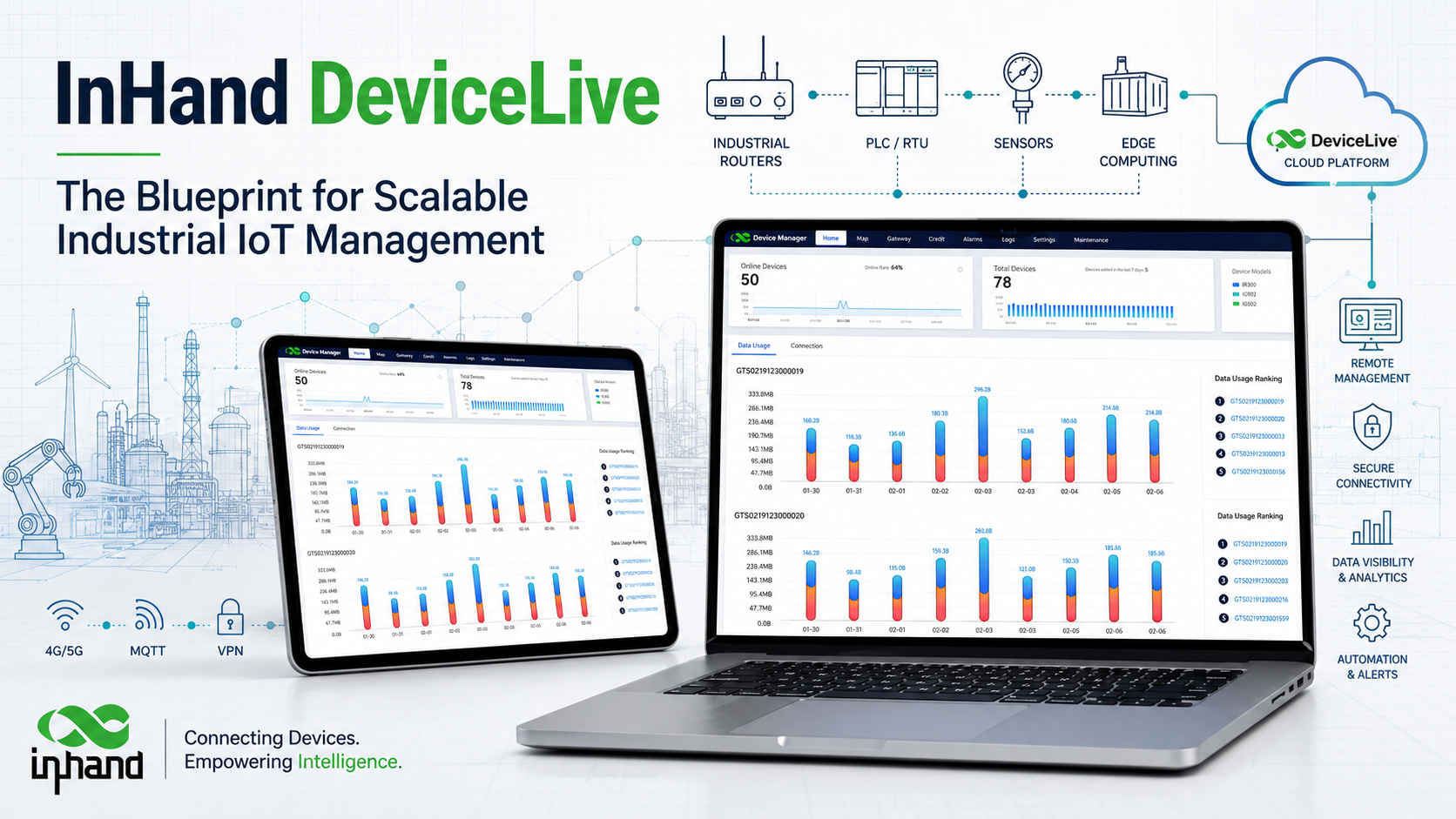
In the rapidly evolving landscape of Industrial IoT (IIoT), the hardware—the routers, gateways, and edge computers—is only the starting point. The true competitive advantage for integrators, network architects, and IT managers is not just the ability to connect a device, but the ability to manage, secure, and scale that connection across hundreds or thousands of distributed sites.

As deployment footprints expand, traditional manual management becomes a bottleneck. Technicians cannot be dispatched to remote substations, retail kiosks, or mobile vehicle fleets every time a firmware update is needed or a signal threshold is breached. This is where InHand Networks’ DeviceLive platform becomes essential. By providing a centralized, cloud-based command center for the entire InHand ecosystem, DeviceLive transforms reactive maintenance into proactive fleet management.
This guide provides an in-depth look at how DeviceLive functions, why it is a game-changer for industrial operators, and how it integrates with the latest InHand hardware to ensure your network remains resilient, secure, and efficient.
What is DeviceLive? A New Paradigm for Fleet Control
DeviceLive is a comprehensive cloud-based IoT management platform designed specifically to bridge the gap between physical industrial hardware and centralized IT operations. Unlike basic web GUIs that require direct access to individual devices, DeviceLive provides a “single-pane-of-glass” view of your entire deployment.
At its core, the platform is designed to eliminate the “truck roll”—the costly and time-consuming practice of sending personnel on-site for routine tasks. By migrating infrastructure management to the cloud, DeviceLive enables IT teams to monitor, configure, and troubleshoot devices from anywhere in the world.
The Core Philosophy: Simplicity at Scale
The architecture of DeviceLive is built on the premise that managing 10,000 devices should be as intuitive as managing ten. It achieves this through:
- Zero-Touch Deployment: Devices can be shipped directly to a site, powered on, and automatically configured via the cloud, bypassing the need for pre-staging or on-site manual CLI entry.
- Automated Maintenance: Batch configuration and firmware upgrades ensure consistency across your fleet, eliminating the risk of human error in individual device updates.
- Real-Time Visibility: Comprehensive monitoring provides deep insights into network health, cellular signal strength, latency, and data consumption.
Key Features: A Deep Dive into Functionality
To understand why DeviceLive has become a staple for industrial integrators, we must look at the specific features that reduce operational overhead and improve uptime.
1. Unified Monitoring and Remote Control
DeviceLive provides visual charts and dashboards that turn raw data into actionable intelligence. Administrators can track interface connection status, link stability, and traffic consumption patterns. Should a device fall offline, the platform supports multiple alert strategies—via SMS, email, or app notifications—ensuring the team is informed before the end user even notices a disruption.
2. Remote Diagnostics and Troubleshooting
When a remote site reports an issue, the speed of resolution is critical. DeviceLive offers a robust suite of remote diagnostic tools:
- Ping and Traceroute: Verify the path of data to pinpoint where a connection might be failing.
- Packet Capture: Essential for deep-level network analysis when standard troubleshooting fails.
- Remote Terminal Maintenance: For advanced configurations, engineers can establish secure, temporary channels to access the command line or local machine interfaces directly, all within a controlled, encrypted environment.
3. Multi-Dimensional Security Policies
Security is not an afterthought in an IIoT environment. DeviceLive enforces strict security standards, including:
- Multi-Role Permissions: Ensure that junior technicians have limited access while senior engineers retain full control.
- Data Encryption: All communication between the device and the cloud is encrypted to protect sensitive telemetry data.
- MFA (Multi-Factor Authentication): Adding an extra layer of identity verification to prevent unauthorized access to the network dashboard.
4. Edge Application Management
With the rise of edge computing, managing the applications running on the hardware is just as important as managing the hardware itself. DeviceLive enables the development and deployment of edge apps, container management, and firmware lifecycles, allowing you to push updates to edge AI models or data collection scripts without needing to build custom Over-the-Air (OTA) services.
Comprehensive Compatible InHand Hardware List
DeviceLive is designed to manage a broad spectrum of the InHand portfolio. Below is a detailed look at the core device series compatible with the platform.
| Product Series | Key Models | Description |
| Industrial Routers | IR302, IR305, IR315 | Compact, ruggedized LTE routers ideal for high-volume deployments like ATMs, POS systems, and smart metering. |
| Edge Computers | EC3320, EC300 | High-performance edge AI hardware equipped with NPU capabilities for real-time vision, defect detection, and complex data analytics. |
| 5G/Mobile Routers | CR602, VG710 | High-bandwidth 5G connectivity solutions for mobile, portable, and vehicular applications requiring high data throughput and Wi-Fi 7. |
| Industrial Gateways | IG601, IG902 | Intelligent gateways focused on protocol conversion, connecting legacy serial/industrial field devices to modern IP networks. |
| Managed Switches | ISW Series | Industrial-grade Ethernet switches that provide visibility and control into the wired layer of your industrial infrastructure. |
Spotlight on Key Devices
- The Workhorse: InHand IR302 Industrial Router – A staple for stable, cost-effective connectivity. It features a rugged metal housing, DIN-rail mounting, and wide temperature operating ranges, built for unattended sites.
- The Portable Powerhouse: InHand CR602 5G Router – Combines 5G NR, Wi-Fi 7, and a 10,000mAh battery for field portability, ideal for construction site offices or event production.
- The Intelligence at the Edge: InHand EC3320 AI Edge Computer – Bridges the gap between edge AI processing and cloud-based fleet management, supporting advanced data processing directly at the source.
Real-World Impact: Efficiency and ROI
Why should your business transition to an integrated cloud management model? The answer is found in the operational economics of your network.
- Minimized Downtime: The combination of automated failover (dual-SIM) and proactive alert systems means your network is often healed before it ever goes down.
- Scalability: When you are managing thousands of units, a 1% reduction in manual effort is a massive gain in profitability. Zero-touch deployment means you can expand your network footprint without expanding your IT staff.
- Regulatory Compliance: For sectors like energy or critical infrastructure, having a clear audit trail of device status, firmware versions, and security patches is a requirement. DeviceLive creates an automated, immutable record of these changes.
Final Thoughts: The Path Forward
In the world of connectivity, hardware is the body, but cloud management is the brain. As we move toward a future defined by 5G and edge AI, the importance of a platform like DeviceLive cannot be overstated. It is no longer enough to provide a stable connection; you must provide a manageable, secure, and scalable network environment.
By standardizing on InHand hardware and leveraging DeviceLive, you are not just buying routers; you are building a flexible, intelligent foundation for your business’s digital transformation. Whether you are an industrial integrator looking to improve your service-level agreements (SLAs) or an enterprise IT lead managing a distributed branch network, this ecosystem provides the tools required to keep your business connected, secure, and ahead of the curve.