
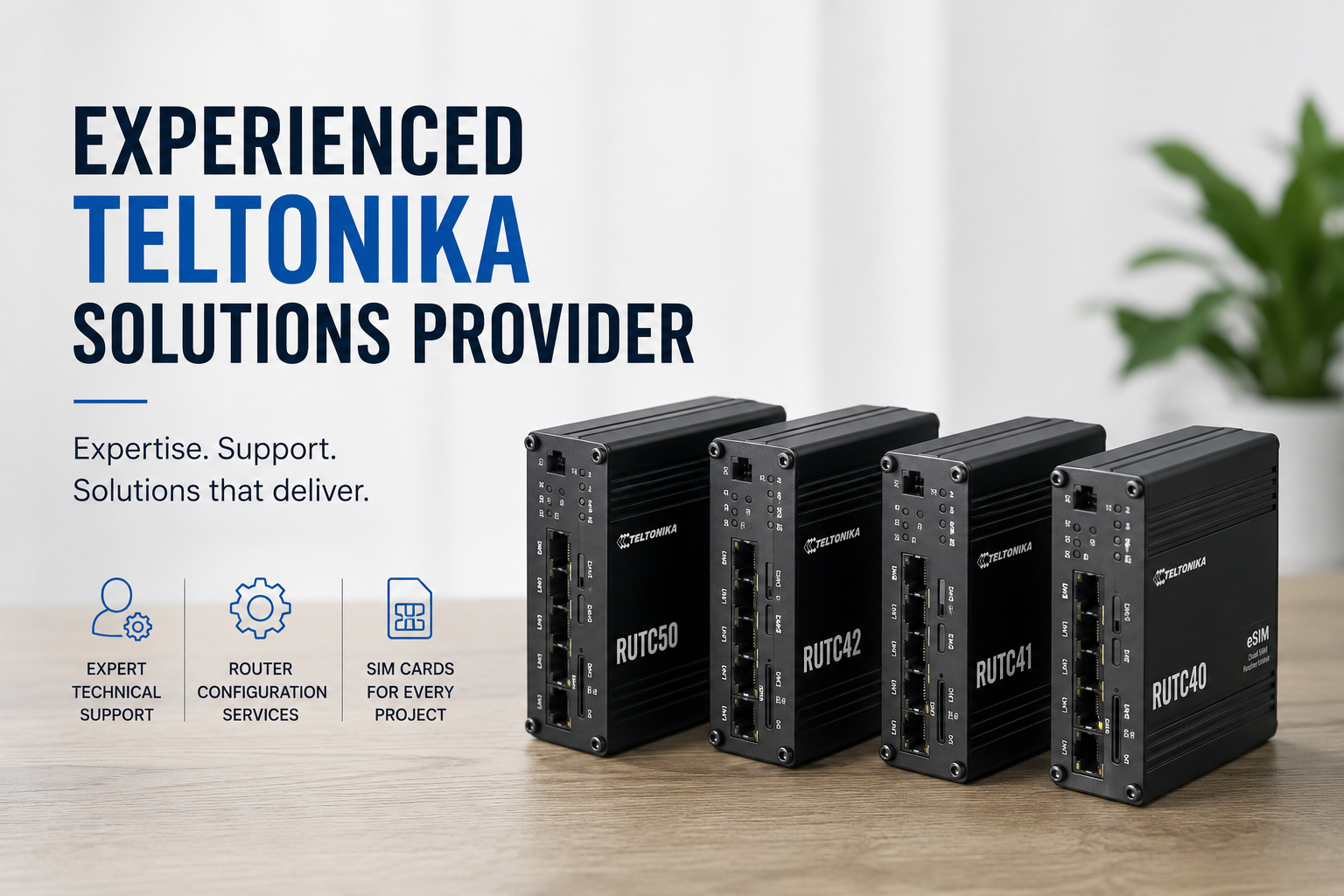
If you have spent any time researching industrial networking equipment, you will almost certainly have come across Teltonika.
Over the last two decades, the company has built a reputation for producing reliable industrial routers, gateways, switches and remote management platforms that are used across thousands of applications worldwide. From remote CCTV and manufacturing to renewable energy, utilities, transport and retail, Teltonika equipment has become a trusted choice for organisations that need dependable connectivity.
Today, purchasing a Teltonika router has never been easier.
There are more suppliers, more online retailers and more purchasing options than ever before. Whether you are buying a single router for a proof of concept or several hundred devices for a nationwide rollout, there is no shortage of companies able to supply the hardware.
On the surface, that sounds like a positive development.
Greater availability means better stock levels, competitive pricing and more choice.
However, it also changes something important.
The challenge is no longer finding a Teltonika router. It is finding the right company to buy it from.
For many businesses, the supplier they choose will have a greater influence on the success of their project than the router itself.
The Router Is Only One Part of the Solution
A Teltonika router bought from one supplier is exactly the same device as the one bought from another.
The processor is the same.
The firmware is the same.
The wireless modem is the same.
The warranty is the same.
The difference lies in everything that surrounds the hardware.
Industrial connectivity projects are rarely as simple as plugging a router into the mains and inserting a SIM card.
Customers often need advice on questions such as:
- Which router is the most appropriate for the application?
- Is 4G sufficient or would 5G provide tangible benefits?
- Would a dual SIM router improve resilience?
- Which mobile network offers the best coverage?
- Is a roaming IoT SIM the better option?
- Is a fixed public IP required?
- Would a private APN improve security?
- Which antenna should be installed?
- How should remote access be configured?
- Is VPN access more appropriate than port forwarding?
- How will devices be managed once they are deployed?
These are not product questions.
They are solution design questions.
The answers often determine whether a deployment is reliable for years or becomes an ongoing source of frustration.
Why Expertise Matters
Industrial networking is very different from buying consumer technology.
A home broadband router is expected to provide internet access for a handful of devices.
An industrial router may be responsible for connecting a production line, monitoring a pumping station, managing payment terminals, providing connectivity to a CCTV tower or supporting critical infrastructure in locations where there is no engineer on site.
Downtime has consequences.
That is why experience matters.
A specialist supplier has usually encountered the same challenges many times before.
They understand how different mobile networks perform.
They know which antennas work in difficult environments.
They have seen the effects of poor signal, incorrect configuration and unsuitable SIM cards.
Most importantly, they know how to avoid those problems before the equipment leaves the warehouse.
Not Every Installation Looks the Same
It is easy to assume that industrial routers are used in broadly similar ways.
The reality could not be more different.
Consider a few examples.
A construction site may need temporary broadband, Wi-Fi for site offices, CCTV connectivity and resilient mobile coverage that can move from one location to another.
A utility company may require secure VPN connectivity into remote telemetry equipment with automatic failover and strict cyber security requirements.
A retailer might simply need resilient connectivity for payment terminals.
A manufacturer could require secure remote access to PLCs, industrial protocols and multiple VLANs across a production facility.
An EV charging operator may be deploying hundreds of connected chargers that need centralised management and remote diagnostics.
Every one of these projects could use a Teltonika router.
None of them should be configured in exactly the same way.
The Cheapest Router Is Not Always the Lowest Cost Option
Price is naturally important.
Every business has budgets to manage.
However, focusing only on the purchase price of the router often proves to be a false economy.
Imagine buying a router from the lowest-priced supplier, only to discover that you also need:
- An external antenna
- A longer low-loss cable
- A roaming IoT SIM
- A fixed IP address
- VPN configuration
- RMS licences
- Technical support to resolve connectivity issues
The initial saving disappears very quickly.
Even worse, if the wrong router has been selected or the antenna is unsuitable, an engineer may need to revisit the site.
The cost of a single unnecessary site visit often exceeds any saving made on the original purchase.
Experienced buyers understand that the total cost of ownership is far more important than the price on the invoice.
Connectivity Is About More Than the Router
One of the most overlooked aspects of industrial networking is the mobile connectivity itself.
The router is only one component.
The SIM card, network choice and connectivity platform are equally important.
Questions worth asking include:
- Is a single network SIM suitable?
- Would a multi-network SIM provide better resilience?
- Will CGNAT affect remote access?
- Is a fixed public IP necessary?
- Would a private APN improve security?
- What data allowance is realistic for the application?
These decisions influence reliability, performance and long-term operating costs.
Choosing the right connectivity from the beginning often prevents problems that are difficult to resolve later.
Never Underestimate the Importance of the Antenna
Ask experienced engineers what causes the biggest connectivity problems and many will give the same answer.
Poor antenna selection.
Industrial routers are frequently installed inside electrical cabinets, plant rooms, control panels or metal enclosures.
Even the best router cannot compensate for poor RF performance.
The right antenna depends on many factors including:
- Building construction
- Distance from the serving mast
- Available frequency bands
- Mounting position
- Cable length
- Environmental conditions
- MIMO requirements
In many cases, replacing an unsuitable antenna delivers a greater improvement than replacing the router itself.
Security Should Be Built Into Every Deployment
As industrial systems become increasingly connected, cyber security has become just as important as connectivity.
Unfortunately, many installations still rely on exposed public IP addresses and open ports.
Modern deployments should consider:
- VPN-first remote access
- Strong authentication
- Firewall configuration
- Firmware management
- Secure user accounts
- Encrypted communications
- Remote monitoring
Security is no longer an optional extra.
It is a fundamental part of any industrial networking project.
Configuration Services Can Save Hours of Work
Many businesses do not have the time or resources to configure every router from scratch.
Professional configuration services can include:
- Firmware updates
- APN configuration
- SIM installation
- Wi-Fi setup
- Secure passwords
- VPN configuration
- Firewall rules
- LAN addressing
- RMS registration
- Customer-specific settings
Receiving equipment that is ready to install reduces commissioning time and allows engineers to concentrate on the installation itself rather than basic configuration.
For larger deployments, this can save many days of engineering effort.
Questions Worth Asking Before Choosing a Supplier
Before placing an order, it is worth asking a few simple questions.
How long have they worked with Teltonika products?
Can they recommend the correct router rather than simply the most expensive one?
Do they supply industrial IoT SIM cards?
Can they advise on antenna selection?
Do they offer configuration services?
Can they help with VPNs and secure remote access?
Do they provide technical support after the sale?
Have they worked with businesses in your industry before?
The answers will quickly reveal whether you are dealing with a company that understands industrial connectivity or one that simply fulfils orders.
What Does an Excellent Teltonika Solutions Provider Look Like?
Rather than discussing theory, it is useful to look at the characteristics of a specialist supplier.
A good example is Routerstore.
For businesses evaluating potential suppliers, it demonstrates many of the qualities worth looking for.
Nearly Two Decades of Teltonika Experience
Routerstore has been supplying Teltonika products since the launch of the original RUT100 in 2007.
During that time, the industrial networking landscape has changed dramatically.
The market has evolved from GPRS and early 3G connectivity through to today’s advanced LTE, LTE Advanced and 5G technologies.
That experience cannot be learned from a product catalogue.
It comes from supporting real customers across thousands of deployments, solving real connectivity problems and understanding how industrial networking has evolved over nearly twenty years.
A Complete Connectivity Partner
Routerstore does far more than supply routers.
Customers can source complete connectivity solutions from one specialist supplier, including:
- Teltonika industrial routers and gateways
- Industrial IoT SIM cards
- Multi-network connectivity
- Fixed IP services
- Private APN solutions
- Industrial antennas
- Mounting accessories
- Power supplies
- VPN solutions
- Remote management services
This means every part of the solution has been designed to work together.
Practical Technical Expertise
Industrial networking is rarely straightforward.
Customers regularly require advice on subjects including:
- Mobile network selection
- Signal optimisation
- Antenna positioning
- VPN technologies
- WireGuard
- IPsec
- Firewall configuration
- RMS deployment
- Secure remote access
- Industrial networking best practice
Having access to engineers who understand these subjects can make the difference between a project that simply works and one that requires repeated troubleshooting.
Configuration Before Dispatch
Many customers choose to receive equipment that is already configured.
Routerstore provides configuration services that allow routers to arrive ready for deployment, reducing installation time and helping projects go live more quickly.
For installers managing multiple sites, this can provide significant savings in both time and engineering costs.
Support Beyond the Sale
Perhaps the greatest benefit of working with an experienced specialist is continuity.
As projects expand, new sites are added or requirements change, customers have access to engineers who already understand their deployment.
That relationship often proves far more valuable than the original hardware purchase.
The Right Supplier Can Be the Difference Between Success and Frustration
Teltonika continues to produce some of the best industrial networking products available today.
Choosing the right hardware remains important.
Choosing the right supplier is equally important.
The best suppliers do far more than process orders.
They understand industrial networking, mobile connectivity, antennas, security, remote management and the practical challenges of deploying reliable IoT solutions in the real world.
Whether you are purchasing one router or planning a nationwide deployment, taking the time to choose an experienced Teltonika solutions provider is an investment that will continue to pay dividends long after the equipment has been installed.
Because at the end of the day, anyone can supply the same router.
The real value comes from the knowledge, experience and support that stand behind it.