
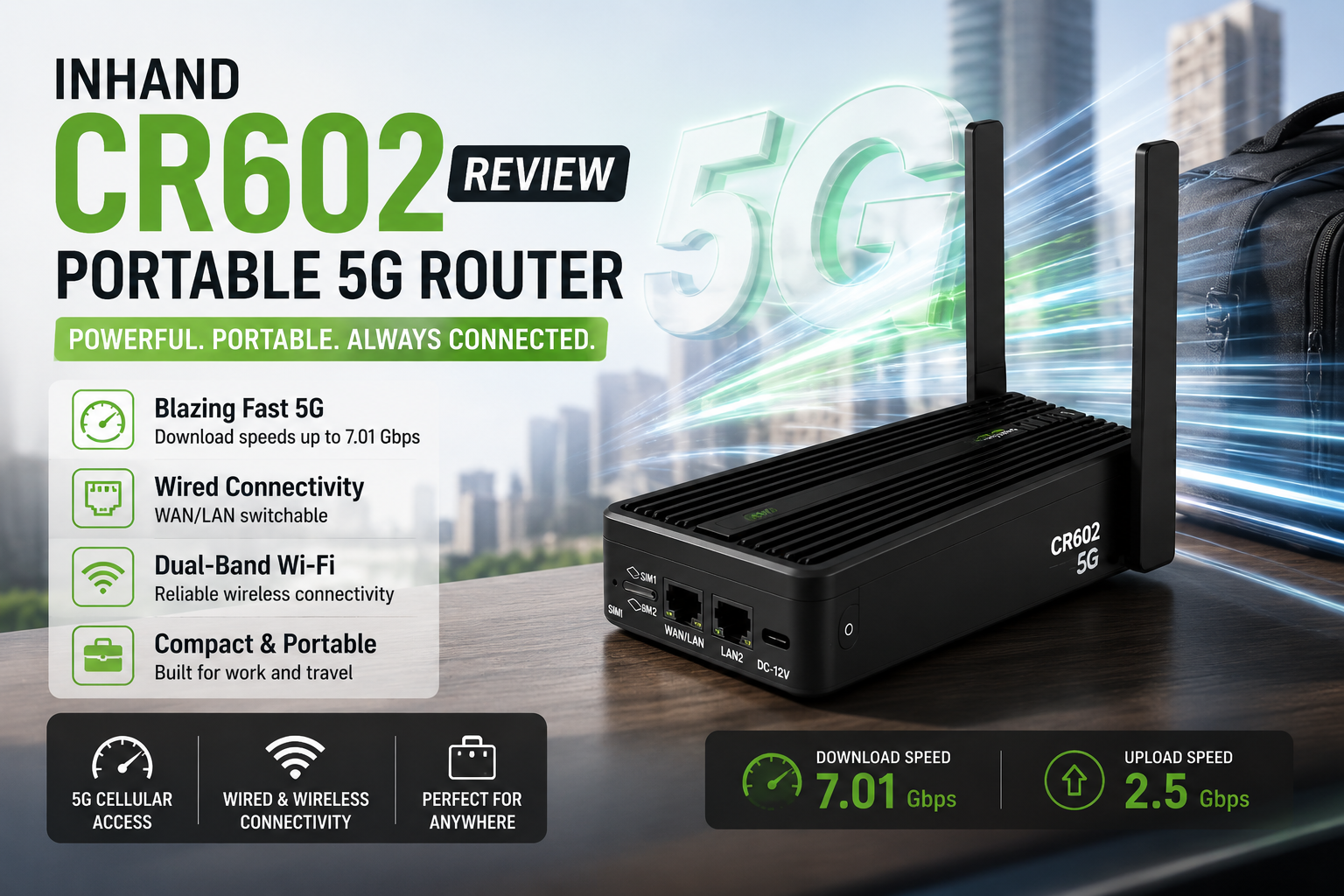
The InHand CR602 is a good portable 5G router with an eSIM asterisk
Wi-Fi 7, dual 2.5 Gigabit Ethernet, two nano SIMs and an eSIM in something the size of a paperback. The hardware is genuinely capable. The eSIM, though, is not the eSIM a lot of buyers think they are getting, and the certification list should stop UK buyers in their tracks.
Every few months a portable 5G router turns up that is a bit better than the last one, and the marketing copy reaches for the same three words. Fast. Flexible. Future-proof.
The InHand CR602 is better than most, and I want to be clear about that up front. It is a properly specified bit of kit. But there are three things in the datasheet that InHand does not draw your attention to, and one of them will determine whether you can legally sell this thing in Britain at all.
Let us start with what it actually is.
What the CR602 is
It is a portable indoor 5G router with a battery. It takes a cellular connection and turns it into Wi-Fi and wired Ethernet for a small office, a temporary site or a pop-up.
Where it separates itself from the MiFi pack is the networking. Two 2.5 Gigabit Ethernet ports, both switchable between WAN and LAN. VLANs, DHCP snooping, static routing, policy routing, traffic shaping, a three-layer firewall, SNAT and DNAT, IPsec and L2TP VPN. Cloud management through InCloud Manager with zero-touch deployment and batch upgrades.
That is a router feature set, not a hotspot feature set. A consumer MiFi does not give you an uplink priority table you can drag rows around in.
Verified specification
| Item | Specification |
|---|---|
| Cellular | 5G NR Sub-6, SA and NSA, LTE fallback. Peak modem rate up to 7.01 Gbps down / 2.5 Gbps up |
| Device throughput | 1 Gbps |
| Wi-Fi | Wi-Fi 7 (802.11be), 2.4 GHz and 5.8 GHz, up to 3000 Mbps, AP and Client dual mode |
| Ethernet | 2 × 2.5 Gbps, WAN/LAN switchable, dual-LAN capable |
| SIM | 2 × Nano SIM + 1 × eSIM |
| Antennas | 2 × external cellular, 6 × internal cellular, 3 × internal Wi-Fi |
| Users | 128 device total, 32 over Wi-Fi |
| VPN | IPsec, L2TP |
| Management | InCloud Manager |
| Battery | 10,000 mAh optional, up to 15 hours |
| Power | USB Type-C, fast charge 5 V/3 A, 9 V/3 A, 12 V/2.5 A |
| Dimensions | 167 × 102 × 36.5 mm, plastic, fanless |
| Environment | -10 °C to +40 °C operating, IP30, desktop or wall mount |
| Certification | FCC, IC, PTCRB, Verizon, AT&T, FirstNet, T-Mobile |
| Warranty | 3 years (battery 1 year) |
Three things worth reading twice
1. That certification list has no CE and no UKCA on it
InHand lists FCC, IC, PTCRB, Verizon, AT&T, FirstNet and T-Mobile. Every one of those is North American. There is no CE marking and no UKCA marking on the published specification, and no European operator approvals.
The FirstNet certification is the tell. FirstNet is the US public safety network. This product has been engineered, certified and taken to market for North America first.
That does not mean a UK variant will never exist. It means that as things stand today, if you are a UK reseller or integrator, this is not a product you can simply buy and ship. Ask InHand directly for the EU/UK SKU and its declaration of conformity before you commit to anything.
2. It is Wi-Fi 7 without the 6 GHz band
Wi-Fi 7’s headline capability is 320 MHz channels, and 320 MHz channels live in the 6 GHz band. The CR602 runs 2.4 GHz and 5.8 GHz only.
So you get Wi-Fi 7’s other improvements, 4K-QAM and the efficiency gains, on 2.4 and 5 GHz spectrum. That is a real upgrade over Wi-Fi 6. It is not the Wi-Fi 7 the marketing image in your head is showing you.
The 3000 Mbps figure is the aggregate PHY rate across both bands. Actual device throughput is 1 Gbps. Which brings us neatly to the next one.
3. 7.01 Gbps is a modem number, not a router number
The 7.01 Gbps peak is what the modem chipset can theoretically achieve under laboratory conditions with carrier aggregation across spectrum no UK operator will give you. InHand’s own specification lists device throughput at 1 Gbps.
1 Gbps is still excellent. It is also seven times smaller than the number on the front of the brochure. Plan your capacity against the 1 Gbps figure and the 32 Wi-Fi client ceiling, not the 7.01.
The triple SIM architecture, and what it actually buys you
Two nano SIM slots plus an eSIM. InHand supports multi-SIM switching and automatic redial, so the practical benefit is straightforward.
You might put an EE SIM in slot one and a Vodafone SIM in slot two, with a third profile sitting on the eSIM. If EE has a bad afternoon, the device moves. For a temporary office or a business continuity link, that is exactly the behaviour you want.
The subtler benefit is procurement flexibility. A customer-owned SIM in slot one, a managed IoT SIM in slot two, no screwdriver required to change your mind later.
Multi-SIM failover and eSIM remote provisioning are two entirely different mechanisms that solve two entirely different problems. Failover switches between profiles that are already on the device. Remote provisioning puts new profiles onto the device without anyone touching it. The CR602 does the first well. The second is where it gets complicated.
The eSIM explainer, because “eSIM” means four different things
An eSIM is not a small SIM. That is the single most common misunderstanding in this business, and vendors are not in a hurry to correct it.
The physical component is an eUICC, an embedded Universal Integrated Circuit Card. It is soldered to the board. What makes it interesting is not its size but its capacity to hold multiple operator profiles and to have new ones downloaded to it over the air.
So far, so good. The complication is that there are three separate GSMA specifications governing how those profiles get onto the chip, and they are not interchangeable.
SGP.02
The original M2M specification. Push model, SMS-triggered, heavy server-side infrastructure. Widely deployed, increasingly legacy.
SGP.22
The consumer specification. Written for phones and tablets. Assumes a person with a screen and a QR code is present at activation. This is what most routers shipping with “eSIM” actually use.
SGP.32
The IoT specification, published 2023. Introduces the eIM and IPA so an unattended device with no user interface can have its profile changed remotely, at fleet scale.
Why SGP.22 is the wrong tool for an unattended fleet
SGP.22 works beautifully on a phone. You scan a QR code, you tap accept, you are on a new network. The whole flow assumes a Local Profile Assistant, a screen and a human being.
Now put that device on a pole in Northumberland. There is no screen. There is nobody there. The flow breaks down, and you are back to sending an engineer in a van, which is the exact cost that eSIM was sold to you as eliminating.
SGP.32 fixes this. It replaces the LPA with an IoT Profile Assistant, and it introduces the eSIM IoT Manager (eIM), a backend that can push profile operations to devices asynchronously. The eIM assumes user intent rather than waiting for it. Profiles get downloaded, enabled, disabled and deleted across an entire estate without anyone leaving the office.
It also brings a rollback mechanism. If a new profile fails to attach within a defined window, the IPA reverts to the last working one. Anyone who has ever bricked a remote site with a bad APN change will understand why that matters.
So which one is in the CR602?
The honest answer
InHand does not say. The specification reads “2 × Nano SIM, 1 × eSIM” and stops there. There is no mention of SGP.32, no mention of SGP.31, no mention of eIM, no mention of IPAd or IPAe, and no reference to IoT remote SIM provisioning anywhere in the published product documentation.
Absence of a claim is not proof of absence. But vendors who have done the SGP.32 work tend to say so loudly, because it is expensive and it is a differentiator. Until InHand states otherwise, the safe working assumption is that this is a consumer-style SGP.22 implementation.
For the CR602’s actual target market, that is fine. This is a portable router. There is a person holding it. There is a web interface at 192.168.2.1 and somebody to log into it. SGP.22 is the appropriate specification for a device that has a human attached.
The problem only appears if you read “eSIM” on a portable router datasheet and extrapolate it to a fleet of 5,000 unattended assets. Different device class, different specification, different conversation entirely.
If you are specifying for scale, ask the vendor these four questions and do not accept “it has eSIM” as an answer to any of them:
- Which GSMA specification does the eUICC implement, SGP.02, SGP.22 or SGP.32?
- If SGP.32, is the IPA on the device (IPAd) or in the eUICC (IPAe)?
- Which eIM platforms has it been tested against?
- Is full remote profile download supported, or only preloaded profiles that can be switched between?
That last one catches people out constantly. A device that ships with three profiles already on it and lets you toggle between them is not doing remote SIM provisioning. It is doing a multi-IMSI impression of it.
The SIM matters more than the router
Here is the thing that fifteen years of watching deployments go wrong has taught me. The router is rarely the weak link. The SIM usually is.
A single-network SIM connects to one operator. When that operator has a bad day, and they all have bad days, your site is dark. It does not matter that you paid for Wi-Fi 7 and 2.5 Gigabit Ethernet. The uplink is gone.
A roaming SIM behaves differently. It can attach to multiple networks, so when one degrades, the device has somewhere else to go. Combine that with the CR602’s two physical slots and you have genuine diversity rather than the illusion of it.
Coverage
Attaches to whichever network is actually usable at that location, rather than whichever one you guessed at from a coverage map.
Resilience
Single-operator outages stop being single points of failure. The device moves.
Portability
The same SIM works in Manchester and Munich. One SKU, one contract, no logistics.
The pairing that actually makes sense here is a roaming SIM in slot one and a fixed-network SIM in slot two. Multi-network resilience as the primary, a known-quantity fallback behind it. Leave the eSIM for whatever the customer brings to the party.
Where it fits, and where it does not
The temperature rating is doing quiet work in this section. -10 °C to +40 °C, IP30, plastic enclosure, fanless. IP30 means it is protected against solid objects over 2.5 mm and nothing at all against water.
Good fits
Temporary offices
Serviced space, project offices, anywhere the fibre order has a twelve-week lead time. Power it, SIM it, done in ten minutes.
Business continuity
The box in the comms cupboard that keeps VoIP and cloud apps alive when the leased line goes. Wired WAN primary, cellular backup, via the uplink priority table.
Site office and cabins
Inside the cabin, not on the outside of it. Site Wi-Fi, printers, cloud apps, a laptop or twelve.
Pop-up retail and events
Card terminals, ticket scanning, EPOS. The optional battery covers you until the generator arrives.
Field engineering
A private, VPN-terminated network in a bag, instead of trusting the customer’s guest Wi-Fi with your diagnostics traffic.
Demo and proof of concept
Cloud-managed, quick to stage, easy to reclaim. Three-year warranty on the unit helps here.
Poor fits
- Outdoor mounting. IP30 and a plastic case. It is an indoor product.
- Vehicles. No DC input, no ignition sensing, no vibration rating, no M12 connectors, and a +40 °C ceiling that a parked van in July will laugh at.
- Unattended industrial deployment. No DIN rail, no serial ports, no Modbus or DNP3, no wide temperature range. InHand make an IR-series for that, and it exists for a reason.
- Anything over 32 Wi-Fi clients. The 128 figure is the device total across all interfaces. Wi-Fi caps at 32.
- Large unattended fleets needing remote profile changes. See the SGP.32 discussion above.
Verdict
The CR602 is a well-specified portable 5G router with a real networking stack behind it, and InHand have built it for a market that genuinely exists. Wi-Fi 7 on 2.4 and 5 GHz, two 2.5 Gigabit ports that are both switchable, cloud management with zero-touch deployment and a three-year warranty is a serious package for temporary offices, continuity links and field engineering.
The reservations are all about expectation management rather than engineering. 7.01 Gbps is a modem figure and 1 Gbps is the router figure. Wi-Fi 7 without 6 GHz is Wi-Fi 7 with an asterisk. 128 users means 32 on Wi-Fi. And the eSIM is almost certainly SGP.22, which is correct for this device class but wrong for the fleet deployment some buyers will imagine it enables.
For UK buyers, the certification list is the real gate. FCC, IC, PTCRB and three American carriers, with no CE or UKCA in sight. Get that answered before anything else.
Pair it with a multi-network roaming SIM and the CR602 becomes a properly resilient portable connectivity platform. Pair it with a single-network SIM and you have bought a very fast single point of failure.
Further reading
Specifications verified against InHand’s published CR602 product documentation, July 2026. IoT UK has no commercial relationship with InHand Networks. Specifications and certifications change. Confirm current details with the vendor before purchase.
1 thought on “InHand CR602 Review: Portable 5G”