
Comms365: the portfolio, the acquisition, and where it actually fits
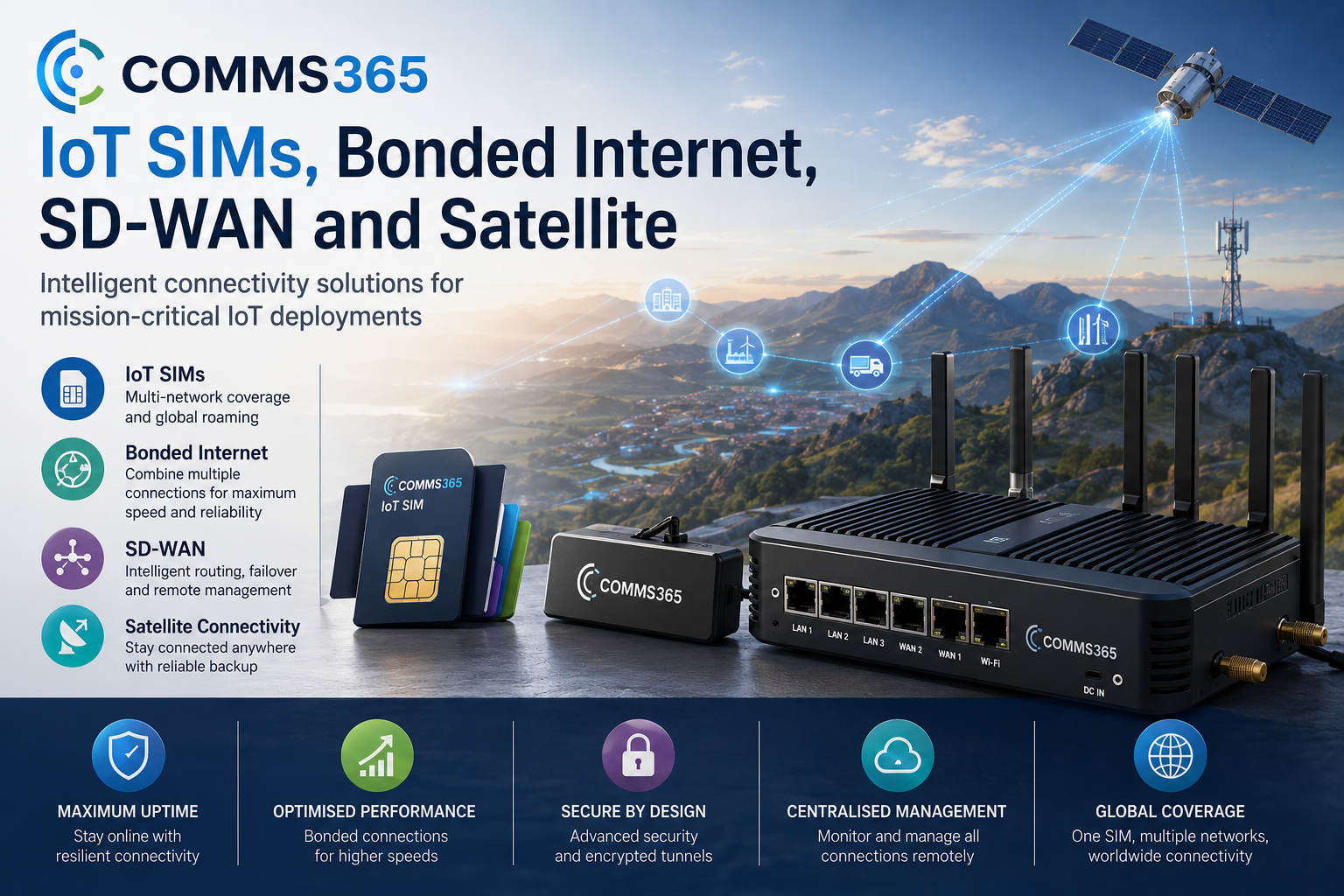
A Milton Keynes connectivity provider with its own core network, four multi-network SIM propositions, bonded internet, SD-WAN, a LEO satellite portfolio and one of the few UK eSIM offerings that says SGP.32 out loud. As of February 2026 it is also owned by Wireless Logic, which changes the conversation.
On this page
There are a lot of companies in Britain that will sell you a SIM card. There are considerably fewer that own the network the SIM connects into, and fewer still that can bond that connection with a satellite link, wrap it in SD-WAN, and hand you a fixed public IP at the end of it.
Comms365 is in that smaller group. This profile covers what they actually do, what changed in February 2026, and which problems they are the right answer to.
Start here: Comms365 is now part of Wireless Logic
On 20 February 2026, Wireless Logic acquired Comms365. Co-founder and CEO Mike van Bunnens has stepped away following a handover period. John Whitty, previously chairman for three years, is now CEO. Co-founder and CTO Shaun Nicholls remains in post.
Wireless Logic have said Comms365 will continue to operate as a standalone business, with no immediate changes to customer contracts, partner relationships or day-to-day operations.
I want to be careful here, because “no immediate changes” is a sentence that has been said after every acquisition in the history of this industry, and it is usually true right up until the moment it isn’t.
What you should understand is the shape of the thing. Wireless Logic has been on a sustained acquisition run for years, buying Zipit Wireless in the US and Arqia in Brazil, among a string of others. This is a business assembling international scale, and scale is the deciding variable in IoT connectivity. Comms365 is a customer base and a technical team being folded into that.
The overlap is significant. Wireless Logic already sells IoT SIMs, global eSIMs, security and connectivity management platforms. There is not a glaring hole in their portfolio that Comms365 fills. Which tells you this deal was primarily about the customer base rather than the technology.
What that means if you are specifying Comms365 today
- The bonded internet and Continuum platform are the genuinely differentiated assets. Wireless Logic did not have that. It is the part of Comms365 least likely to be rationalised.
- The plain IoT SIM business overlaps heavily with the parent. Over a multi-year horizon, that is where consolidation pressure lands. Ask about contract length and portability.
- The core network is an asset, not a duplication. Cisco NCS core in London and Leeds, with direct interconnects into the mobile operators. That does not get switched off casually.
- Technical continuity looks reasonable. The CTO and co-founder stayed. In an acquisition, that is the single most useful signal about whether the engineering culture survives.
None of this is a reason not to buy from them. It is a reason to read the contract properly, which you should have been doing anyway. If you want the wider context on why the UK IoT connectivity market is consolidating this hard, that is a longer conversation and one worth having.
Who Comms365 are
| Fact | Detail |
|---|---|
| Founded | 2008 |
| Base | Milton Keynes, UK |
| Ownership | Wireless Logic (acquired February 2026), operating standalone |
| Leadership | John Whitty (CEO), Shaun Nicholls (co-founder, CTO) |
| Network | Own Cisco NCS core, datacentres in London and Leeds, direct MNO interconnects |
| Model | Direct and channel. Partner programme with dealer and reseller tiers |
| Coverage | UK, EU, USA, parts of Asia |
| Named customers | Moonpig, The Entertainer, BT, Morrison Utility Services, Conex Banninger |
The important line in that table is the network one. Comms365 are an operator, not a reseller with a good portal. They have their own carrier-grade core with direct interconnects into the UK mobile networks, which is why they can offer things a box-shifter cannot: real fixed public IPs, private APNs, BGP, direct NNIs, managed RADIUS and LNS for service providers with their own assets.
That distinction matters more than most buyers realise. When something breaks at 3am, there is a meaningful difference between a supplier who can look at the session on their own core and a supplier who can open a ticket with someone who can.
4G and 5G IoT SIMs
The foundation of the portfolio. Cellular data SIMs across all four UK networks and across EU countries, sold for primary connectivity rather than just telemetry.
Fixed IP
Optional on all SIMs. Public or private, fixed or dynamic. The thing that makes IP whitelisting and remote management possible.
Private APN
DDoS protection included as standard on private APN SIMs. Aggregated data pools and VPN options available.
Tariff range
From 1MB to 1TB+ per month. No data limits, no minimum order quantity, no traffic shaping.
Bespoke routing
BGP, direct NNIs, managed RADIUS and LNS for service providers running their own network assets.
The no-minimum-order-quantity point deserves a mention. A lot of IoT SIM providers will not talk to you below a few hundred connections. If you are prototyping, or running a small but valuable estate, that is a real barrier and Comms365 do not put it in front of you.
Almost every advanced service on this page exists because of one underlying problem: cellular and satellite connections do not natively give you a stable, routable public address. Once you have one, VPNs work, CCTV is reachable, NMS platforms can poll, SaaS whitelisting works and compliance teams stop asking difficult questions. Most of what Comms365 sell is, at some level, the delivery of a proper IP address to a place that should not be able to have one. Further reading: what a fixed IP SIM actually gives you.
Multi-network SIMs
This is where it gets interesting, and where the marketing across the whole industry gets loosest.
Comms365 offer four separate multi-network IoT and M2M SIM solutions, each with different features and commercials. They enable unsteered, seamless roaming across 400+ operators globally, including all four UK networks and approximately 90 operators within EU28 countries.
The word doing the heavy lifting there is unsteered.
Steered versus unsteered, and why you should care
A steered roaming SIM has a preferred network baked into it. The device will attach to that operator’s network wherever it can, because that is where the commercial relationship is best for the SIM provider. It will only move if the preferred network is genuinely unavailable.
An unsteered SIM attaches to whichever network the device can actually see best at that location. No preference, no steering table pushing it back towards a network that happens to have a weak signal in that particular field.
For an asset that never moves, on a site you have surveyed, steering is largely academic. For anything mobile, or anything installed where you could not do a survey, unsteered behaviour is the difference between a working deployment and a truck roll. This is the single most useful question to ask any roaming SIM provider, and a surprising number of them will not give you a straight answer.
Local internet breakout
The other feature worth flagging. Comms365 offer local internet breakout across UK/EU, USA and Asia.
Without local breakout, a device roaming in Singapore on a UK-issued SIM sends its traffic all the way back to a UK gateway before it reaches the internet, then all the way back again. You pay for that in latency and, frequently, in a support call about why the application feels slow. Local breakout drops the traffic onto the internet close to where the device is.
If you are running anything latency-sensitive across borders, this is not a nice-to-have. Compare the approaches at multinetworksim.com, and read the wider case for multi-network resilience before you commit to a single-operator contract.
eSIM: they say SGP.32, and that is unusual
The line that made me sit up
Comms365 state they can provide both SGP.22 and SGP.32, from QR code provisioning through to remotely pushed profiles.
Very few UK providers name the specification. Most write “eSIM technology” and hope you do not ask which one. Naming both, and describing the difference in behaviour correctly, is a signal that somebody in the building understands the standard rather than just the brochure.
Here is why that sentence carries weight.
An eSIM is not a small SIM. The physical component is an eUICC, soldered to the board, and what makes it useful is that it can hold multiple operator profiles and have new ones downloaded over the air. But there are three separate GSMA specifications governing how those profiles arrive, and they are not interchangeable.
SGP.02
The original M2M specification. Push model, SMS-triggered, heavy server-side infrastructure. Widely deployed, increasingly legacy.
SGP.22
The consumer specification. QR codes, a screen, a person. Fine for a router someone is holding. Useless on a pole.
SGP.32
The IoT specification. Introduces the eIM and IPA so an unattended device with no interface can have its profile changed remotely, at fleet scale.
SGP.22 assumes a Local Profile Assistant, a screen and a human being. Put that device on a mast in Northumberland and the whole flow collapses, and you are back to sending a van, which is the exact cost eSIM was sold to you as eliminating.
SGP.32 replaces the LPA with an IoT Profile Assistant and adds the eSIM IoT Manager, a backend that pushes profile operations to devices asynchronously. The eIM assumes user intent rather than waiting for it. It also brings a rollback mechanism, so a profile that fails to attach reverts to the last working one, which anyone who has bricked a remote site with a bad APN change will appreciate.
Kigen’s guidance on this is worth repeating: do not assume a provider saying “SGP.32” means full remote profile download and lifecycle support. Some implementations only offer preloaded profiles you can toggle between, which is a multi-IMSI impression of remote provisioning rather than the real thing. Ask specifically whether full remote download is supported, which eIM platform sits behind it, and whether the IPA is on the device (IPAd) or in the eUICC (IPAe).
One wrinkle worth naming: Wireless Logic, the new parent, is itself an SGP.32 and eSIM orchestration provider with its own RSP infrastructure. Over time, it would be surprising if the two eSIM stacks did not converge. Whether that is good or bad for you depends entirely on which one you are on today.
Bonded internet: the genuinely differentiated bit
If Comms365 have a signature product, this is it. Bonding combines multiple connections from different sources and technologies into a single aggregated pipe, using software-defined networking, delivering greater throughput and much better resilience than any one of them alone.
The important distinction, and the one people get wrong: bonding is not failover. Failover means one link is idle until the other dies. Bonding means every link is carrying traffic all the time, and losing one degrades performance rather than dropping the session. For a VoIP call or a live video feed, that difference is the whole ballgame.
| Platform | Connections | Notes |
|---|---|---|
| SD-ONE | Up to 3 | Designed for instant connectivity. Combines ADSL, FTTC, 4G, 5G and effectively any mix. Positioned for pre-Ethernet and temporary deployments. QoS standard. |
| Continuum | Up to 5 | Next-generation secure bonded platform. Algorithms tuned for multiple 5G connections or FTTP and Ethernet. Three hardware models at 500Mbps, 1Gbps and 2Gbps. Connections can be added later. |
The pre-Ethernet use case is the one that sells itself. Your leased line has a twelve-week lead time and your warehouse opens on Monday. SD-ONE goes in, bonds whatever is available, and you are trading. The Moonpig case study is instructive here: they kept the bonded service in place even after the fixed line was installed, which tells you something about how the economics look once you have lived with it.
Comms365 have been doing this since around 2014, which made them one of the first SD-WAN providers in the UK. Thousands of deployments. This is not a product they bolted on last year because the market asked for it.
5G FWA and Connectivity as a Service
Comms365 launched the first unlimited 4G fixed IP SIM product, and later the first unlimited 5G fixed IP service. That heritage shows in how the CaaS proposition is put together.
CaaS is a managed internet service with unlimited data and fixed public IP addresses over 4G and 5G. Monthly subscription, no upfront costs, rapid deployment, managed end to end. It is 5G fixed wireless access sold as an outcome rather than as a bag of parts.
The honest framing on FWA: it is not a fibre substitute in every scenario, and anyone telling you otherwise is selling something. It is excellent where fibre is absent, delayed, or where you need a second physically diverse path that does not share a duct with the first one. Comms365’s own material is refreshingly clear that neither fixed line nor cellular is the right answer in 99% of scenarios, and that blended designs usually win. That is a more honest position than most of the market takes.
The connectivity layer is only half the story. On the hardware side, the standards are moving underneath everyone: 5G RedCap is bringing 5G economics down to mid-tier IoT devices that could never justify a full 5G modem, and the Release 19 generation behind it pushes further still. If you are specifying a five-year deployment today, the module roadmap matters as much as the SIM contract.
SD-WAN
Software-defined WAN for connecting multiple sites securely, with AES-256 encryption and QoS included as standard rather than as an upsell.
The pitch against traditional MPLS is the usual one, and it is broadly correct: network expansion and change are fast and simple compared to provisioning MPLS circuits, and you get real-time central management across sites. The Conex Banninger case study is the reference point Comms365 lean on, replacing a nine-year-old European WAN suffering slow performance, capacity limits and high operating costs.
Where this becomes more than a commodity is the combination. SD-WAN over bonded links, over cellular, over satellite, with QoS applied across the lot and a fixed IP at each end, all from one supplier with one support number. Assembling that from four vendors is possible. It is also how you end up in a three-way finger-pointing exercise at 3am.
Satellite: sat365 and Continuum Constellation are not the same thing
Most coverage conflates these two. They are different products solving different problems, and understanding the split tells you a lot about how Comms365 think.
sat365
Launched in 2026, sat365 is Comms365’s partner-ready LEO satellite portfolio. It brings together LEO satellite access, managed service options, proactive monitoring, UK NOC support, service assurance and flexible engagement models.
The point of it is that partners kept asking for satellite and discovering that reselling satellite access is easy while supporting satellite is hard. sat365 is the service wrap, not the dish. Partners choose their engagement model: a hands-off dealer model that introduces satellite with optional overlay services like fixed IP, or a hands-on reseller model with SD-WAN, core integration, SLAs and white-label options.
Tremayne Hatton joined as Head of Pre-Sales and Product Management in 2026 and built it. Will Kennedy, CRO, has been fairly blunt in public that LEO has moved from niche to serious commercial opportunity, and that partners need more than access.
We have covered this in depth separately: see our full SAT365 service breakdown.
Continuum Constellation
A different animal. Constellation is a managed overlay platform that sits behind an existing Starlink connection and turns it into a business-grade WAN.
It exists because of one specific, unglamorous problem: Starlink does not give you a real fixed public IP. Starlink users get CGNAT addresses. Starlink offers a “persistent IP”, which is a dynamic address that usually stays the same until it does not, with no guarantee and no IP blocks like a /30 or /29 for hosting multiple services. When it changes, your old address is gone.
For a household, irrelevant. For a business, that breaks site-to-site VPNs, makes hosting internal services impossible, breaks NMS polling in PRTG or SolarWinds or Zabbix, and creates compliance headaches in any regulated sector.
Fixed public IPs
Routed through SDN behind the Starlink link. VPNs, CCTV remote access, SaaS whitelisting and compliance all become possible.
5G failover and bonding
Automatic WAN redundancy. Satellite and cellular together rather than satellite alone.
QoS and traffic shaping
Prioritise Teams, VoIP, live video and telemetry over general traffic.
Remote terminal control
Reboot, monitor and troubleshoot Starlink terminals from anywhere. Central command hub for multi-site fleets.
Data usage management
Monitor thresholds across all sites with alerting, before priority data runs out and you get throttled.
White label
ISPs and MSPs can badge it. Includes hardware, setup, 24/7 monitoring and UK technical support.
Under Starlink’s usage terms, once your priority data is consumed, speeds drop to 1Mbps down and 0.5Mbps up unless you buy more. That is not an outage, so your monitoring will not alarm on it, but it will destroy any business application running over the link. This is precisely why Constellation’s usage alerting exists, and it is the single most compelling argument for the product.
The neat part is that Constellation is a retrofit. Partners can add it to Starlink deployments that already exist and already work badly, which is a much easier sale than ripping anything out.
Fixed line and LPWAN
Two parts of the portfolio that get less attention but round out the picture.
Fixed line. Full national and international ISP capability on their own carrier-grade core. FTTx, SOGEA, Ethernet, ADSL, FTTC and MPLS. The pitch is not that fixed line is exciting, it is that a blended design needs someone who can supply both halves and make them work together.
LPWAN. Comms365 invested in Everynet and launched a LoRaWAN network in the UK in 2017, alongside NB-IoT and LTE-M support. For low-power sensing at scale, where a cellular SIM per device makes no economic sense, this matters. It also makes them one of relatively few UK providers who can have a genuinely technology-agnostic conversation rather than steering everything towards the thing they happen to sell.
Applications and verticals
Comms365 market across a spread of sectors. Stripped of the marketing language, the underlying problems are variations on a small number of themes.
Construction
Site offices with no fibre and no realistic prospect of it. Bonded or satellite from day one, CCTV and access control riding on top, then the whole lot moves to the next site.
Retail and hospitality
EPOS, card payments, digital signage, guest Wi-Fi. Pre-Ethernet for new stores, cellular failover for existing ones. Downtime is measured directly in lost transactions.
Renewable energy
Solar farms, wind, BESS. Remote, unattended, no fixed line, and increasingly subject to SCADA and telemetry requirements that need a real IP address.
CCTV and security
The classic fixed IP use case. Cameras that need to be reachable inbound, with enough upstream to carry the streams and enough resilience that the feed does not vanish.
Healthcare
Patient-worn and at-home technology, digital signage in waiting areas, failover for GP surgeries, portable routers for community staff. Compliance means fixed IP is not optional.
Transport and logistics
Depots, vehicles, telemetry, distribution centres. Multi-network and local breakout earn their keep the moment anything crosses a border.
Utilities
Remote monitoring across estates that were never designed with connectivity in mind. Morrison Utility Services is a named customer.
Business continuity
Cuts across every vertical above. The second path that does not share infrastructure with the first, which is the only definition of diversity that survives a digger.
Where Comms365 fit
Strong fit
- Anything needing a real fixed public IP over cellular or satellite. This is the spine of the whole portfolio and they are genuinely good at it.
- Pre-Ethernet and rapid deployment. Site opens Monday, leased line arrives in the spring. Bonded is the answer and they have been doing it longer than nearly anyone.
- Blended multi-technology designs. Fixed line plus cellular plus satellite plus bonding plus SD-WAN, from one supplier, on one support contract.
- Business-grade Starlink. Constellation solves a specific, real, widely-experienced problem, and it retrofits.
- Channel partners wanting satellite without building the wrap. That is precisely what sat365 was designed for.
- Small and mid-sized estates. No minimum order quantity is a genuine differentiator.
Less obvious fit
- Very large single-technology SIM estates. At serious volume you are in a pricing conversation, and you should be talking to the parent as well as the subsidiary. Which is now the same conversation, which is rather the point.
- Deployments outside their footprint. UK, EU, USA and parts of Asia are covered. Beyond that, ask.
- Buyers who need long-horizon roadmap certainty. Not a criticism of the team, a consequence of the acquisition. Ask where the eSIM stack is going.
Comms365 are a network operator that behaves like an integrator. The bonded internet platform and the Constellation overlay are genuinely differentiated, built over a decade, and hard to replicate. The eSIM proposition is more honest than most because it names the specification. The multi-network SIMs are unsteered with local breakout, which is the right architecture.
The open question is what Wireless Logic ownership does to all of it over three to five years. The bonded and satellite assets look safe because the parent did not have them. The commodity SIM business is where the overlap sits. Read the contract, ask about portability, and note that the CTO stayed, which is the best signal you are going to get.
Understand the technology before you buy it
Every service on this page depends on a standard, a specification or an architecture that the marketing tends to skip over. These are the ones worth understanding before you sign anything.
More on IoT UK
Supplier profile compiled from Comms365’s published service documentation, Wireless Logic’s acquisition announcement and UK channel trade coverage, July 2026. IoT UK has no commercial relationship with Comms365 or Wireless Logic. Portfolios, ownership and specifications change. Confirm current details with the supplier before purchase.
1 thought on “Comms365: IoT SIMs, Bonded Internet, SD-WAN and Satellite”