
Teltonika RUT286
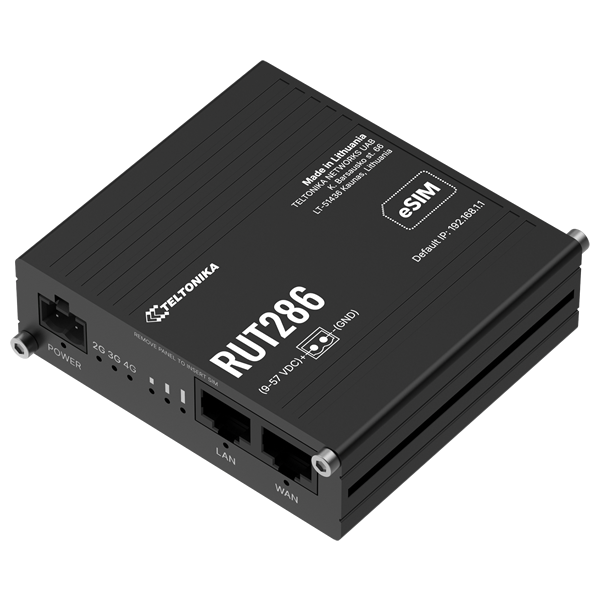
Teltonika has added the RUT286 to its industrial router range – a compact serial-port router built on the same proven form factor as the RUT206, but with a Telit global modem at its core. Full technical comparison, applications, and specification guidance.
Why the RUT286 Matters
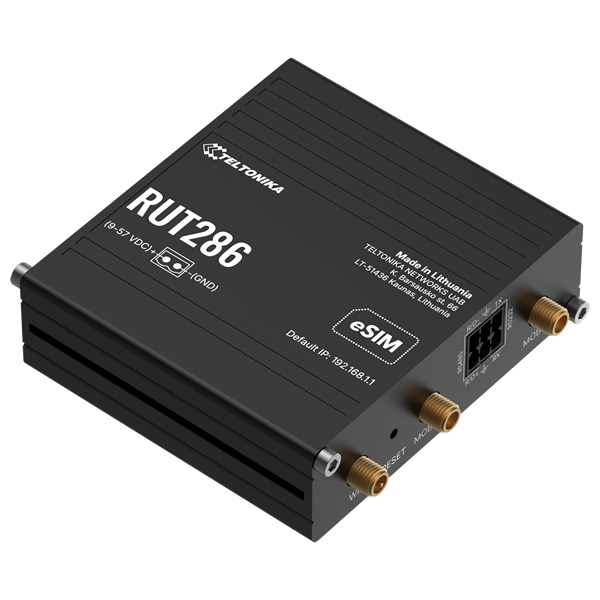
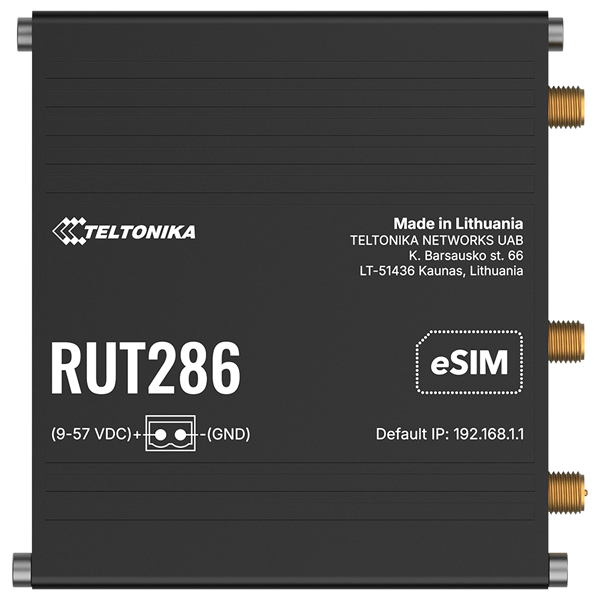
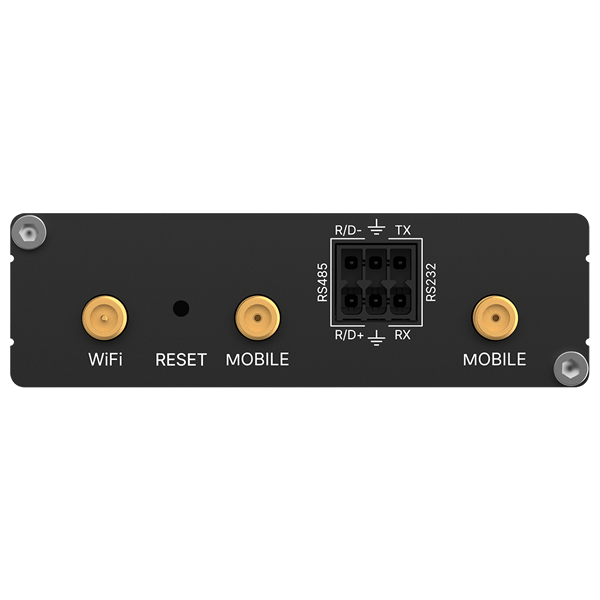
If you have been specifying the Teltonika RUT206 for industrial serial connectivity – SCADA, energy metering, remote RTU access, utilities telemetry – the RUT286 is the router you have been waiting for. Same compact DIN-rail footprint. Same RS232 and RS485 serial interfaces on a 6-pin terminal block. Same dual SIM, 2.4 GHz Wi-Fi, and dual Ethernet ports. Same operating range down to -40°C.
What changes is the modem. The RUT206 uses a regional LTE module that covers the core European bands well but falls short outside that geography. The RUT286 replaces it with a Telit LTE Cat 4 modem covering 18 LTE bands, 7 UMTS bands, and 4 GSM bands – a genuinely global cellular platform that ships as a single hardware SKU and works across UK, European, North American, Asia-Pacific, and Latin American networks without any modem variant ordering.
Beyond global band coverage, the Telit modem brings integrated eSIM support with up to 7 downloadable carrier profiles – meaning network switching becomes a software operation managed through Teltonika RMS rather than a site visit to swap a physical SIM card.
In short: the RUT286 is the RUT206 with a global modem and eSIM added. Everything else – the form factor, the serial interfaces, the industrial power input, the RutOS software stack – carries over unchanged. If you are already deploying the RUT206, the RUT286 is a direct hardware swap with no re-engineering required.
The RUT206: What It Is and Where It Has Been Deployed
The RUT206 is a compact industrial 4G LTE Cat 4 router designed specifically for deployments where Ethernet connectivity alone is not enough – where you need to reach legacy serial equipment that predates IP networking. Protection relays, PLCs, RTUs, energy meters, flow computers, HVAC controllers: these devices speak RS232 or RS485, and the RUT206 bridges that world to cellular IP.
Built into an anodised aluminium housing, it is DIN-rail mountable, rated to IP30, and capable of operating from -40°C to +75°C. That thermal range matters: it covers the full spectrum from UK outdoor cabinets in winter through to unventilated enclosures in summer, and it means the RUT206 can be specified wherever the equipment it is connecting to operates.
The hardware specification is deliberately focused. There are no superfluous ports – just the interfaces that a serial-connectivity deployment actually needs:
| Interface | Detail |
|---|---|
| Cellular | 4G LTE Cat 4 – 150 Mbps download / 50 Mbps upload; 3G and 2G fallback |
| SIM slots | 2 x Mini SIM (2FF) – dual SIM with automatic failover |
| Ethernet | 2 x RJ45, 10/100 Mbps (1 WAN + 1 LAN) |
| Wi-Fi | 802.11b/g/n, 2.4 GHz, AP and Station modes |
| Serial | RS232 (full duplex) + RS485 (half duplex, 2-wire) on 1 x 6-pin terminal block |
| Power input | 9-57 VDC 2-pin industrial socket; active PoE 802.3af Class 0 on LAN port; passive PoE (16-57 VDC) via spare pairs 4,5/7,8 |
| Storage | Micro SD (internal), FAT32/NTFS/ext2/ext3/ext4, up to 2 TB |
| Processor | Mediatek 580 MHz, MIPS 24KEc |
| RAM / Flash | 128 MB DDR2 / 32 MB |
| Operating temp | -40°C to +75°C |
| IP rating | IP30 |
| Certifications | CE, UKCA (RED Directive 2014/53/EU; RoHS 2011/65/EU) |
RUT206 LTE Band Coverage
The RUT206 modem’s LTE FDD band coverage is confirmed from the official Teltonika wiki quick start guide:
LTE TDD: B38, B40, B41 are listed (regional restrictions apply – B40 and B41 not supported in Europe/Oceania variants). 3G WCDMA: B1, B5, B8. 2G GSM: 900/1800 MHz.
The highlighted bands are the ones that matter for UK and European deployments. B3 (1800 MHz), B7 (2600 MHz), B8 (900 MHz), and B20 (800 MHz) are the core working bands across EE, Vodafone, O2, and Three in the UK. B1 (2100 MHz) handles urban density. B28 (700 MHz) provides the rural reach increasingly important as operators extend coverage on this spectrum. For UK-only deployments the RUT206’s modem is well-matched to domestic network infrastructure – seven bands is sufficient.
RUT206 Software and Industrial Protocol Support
The RUT206 runs RutOS – Teltonika’s OpenWrt-based operating system – and supports the full set of industrial protocols that serial-connectivity deployments need:
- Modbus TCP/RTU gateway – translate RS485 Modbus RTU traffic to Modbus TCP over the cellular link; both client and server roles
- DNP3 – outstation over TCP; used in utilities, water, and energy telemetry
- DLMS/COSEM – smart metering protocol for AMI and AMR deployments, accessible via TCP
- OPC UA – client and server for industrial automation and SCADA integration
- VPN suite – OpenVPN with 27 encryption methods; IPsec IKEv1/v2; WireGuard; GRE; PPTP; L2TP; Stunnel; ZeroTier; Tinc
- Remote management – Teltonika RMS, TR-069, SNMP v1/v2/v3, MQTT broker, JSON-RPC, SMS-based control
- FOTA – firmware over-the-air, schedulable from RMS without site visits
- Security – WPA3, 802.1x, RADIUS, TACACS+, configurable firewall, DDoS prevention (SYN flood, SSH attack, HTTP/HTTPS), port scan prevention, Let’s Encrypt and SCEP certificate management
- Dynamic routing – BGP, OSPF v2, RIP v1/v2, EIGRP, NHRP, policy-based routing
The RUT286: The Global Modem Variant
Teltonika positions the RUT286 as an industrial LTE Cat 4 router designed for global IoT and M2M applications. The description on the official product page is direct: reliable global connectivity via a standardised LTE platform utilising a Telit modem. That single sentence identifies the product’s primary differentiator.
The Telit modem is not just a rebranded module – it represents a deliberate platform shift. Teltonika has been standardising its newest industrial router generation on Telit cellular modules across multiple product lines, including the RUT281 (compact global router), RUT981 (mid-range global router), and RUT986 (industrial global router with GNSS and I/O). The RUT286 brings that same global modem platform to the compact serial-port form factor.
RUT286 LTE Band Coverage
The Telit modem in the RUT286 supports the following bands:
4G LTE FDD – 18 bands:
3G UMTS – 7 bands: B1, B2, B4, B5, B6, B8, B19
2G GSM – 4 bands: B2, B3, B5, B8
Where the RUT206 modem covers 7 LTE FDD bands, the RUT286’s Telit modem covers 18. What that means in practice:
- B3, B7, B8, B20, B28 – all major UK and European 4G carriers covered
- B2, B4, B5, B12, B13, B25, B26 – AT&T, Verizon, T-Mobile US, and regional US carriers
- B14 – US FirstNet public safety network
- B18, B19 – Japan (SoftBank, KDDI)
- B28 – APT 700 MHz, used across Australia, New Zealand, and growing deployments across Asia-Pacific and parts of Europe
eSIM: Remote SIM Provisioning Without Site Visits
The RUT286 carries an integrated eSIM capable of storing up to 7 carrier profiles alongside the two physical Mini SIM (2FF) slots. Those profiles are managed through Teltonika RMS – downloaded, switched, and retired remotely without any physical access to the device.
The eSIM supports bootstrap provisioning. A device can be shipped to site, powered on, and download its operational carrier profile automatically on first connection. There is no need to pre-insert a SIM card before dispatch.
For deployments at scale – energy metering networks, utilities infrastructure, distributed monitoring – this is a meaningful operational saving over the lifetime of the device. Field visits to swap SIM cards cost money. At 50 sites, or 500, the saving is not trivial.
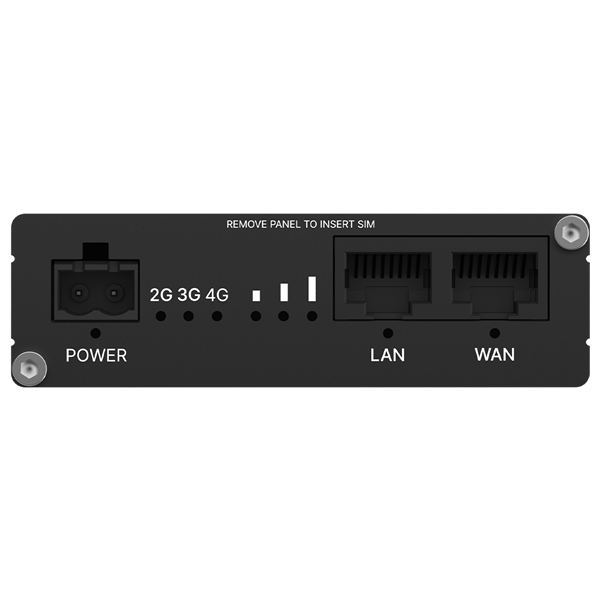
RUT206 vs RUT286: Full Specification Comparison
| Specification | RUT206 | RUT286 |
|---|---|---|
| Modem | Regional LTE Cat 4 | Telit LTE Cat 4 – single global SKU |
| LTE FDD bands | B1, B3, B5, B7, B8, B20, B28 (7 bands) | B1, B2, B3, B4, B5, B7, B8, B8_US, B9, B12, B13, B14, B18, B19, B20, B25, B26, B28 (18 bands) |
| 3G UMTS | B1, B5, B8 | B1, B2, B4, B5, B6, B8, B19 (7 bands) |
| 2G GSM | 900/1800 MHz | B2, B3, B5, B8 (4 bands) |
| LTE Cat 4 speeds | 150 Mbps / 50 Mbps | 150 Mbps / 50 Mbps |
| SIM slots | 2 x Mini SIM (2FF) | 2 x Mini SIM (2FF) + integrated eSIM (up to 7 profiles) |
| eSIM bootstrap | Not supported | Supported via Teltonika RMS |
| Ethernet | 2 x RJ45, 10/100 Mbps (1 WAN + 1 LAN) | 2 x RJ45, 10/100 Mbps (1 WAN + 1 LAN) |
| Wi-Fi | 802.11b/g/n, 2.4 GHz | 802.11b/g/n, 2.4 GHz |
| Serial interfaces | RS232 + RS485, 6-pin terminal block | RS232 + RS485, 6-pin terminal block |
| Power input | 9-57 VDC; active PoE 802.3af Class 0; passive PoE 16-57 VDC | 9-57 VDC; active PoE; passive PoE |
| Operating temp | -40°C to +75°C | -40°C to +70°C [VERIFY against RUT286 datasheet] |
| Micro SD | Internal, up to 2 TB | Internal, up to 2 TB |
| Industrial protocols | Modbus TCP/RTU, DNP3, DLMS/COSEM, OPC UA | Modbus TCP/RTU, DNP3, DLMS/COSEM, OPC UA |
| VPN support | OpenVPN, IPsec, WireGuard, GRE, ZeroTier, Stunnel, PPTP, L2TP, Tinc | OpenVPN, IPsec, WireGuard, GRE, ZeroTier, Stunnel, PPTP, L2TP, Tinc |
| Remote management | Teltonika RMS, TR-069, SNMP, MQTT, JSON-RPC, SMS | Teltonika RMS (incl. eSIM provisioning), TR-069, SNMP, MQTT, JSON-RPC, SMS |
| IP rating | IP30 | IP30 |
| Form factor | Compact aluminium, DIN-rail mountable | Compact aluminium, DIN-rail mountable |
| Certifications | CE, UKCA, FCC, RoHS | CE, UKCA, FCC, ISED [VERIFY full list against RUT286 datasheet] |
Items marked [VERIFY] should be confirmed against the official Teltonika RUT286 datasheet before publication or product listing. Band support confirmed against the Teltonika wiki interfaces page for both routers and verified against published Telit modem specifications for the global platform.
Applications: Problem, Solution, and Why These Routers Are the Right Fit
The RUT206 and RUT286 are not general-purpose routers with serial ports added as an afterthought. They are built for one specific engineering problem: connecting industrial equipment with serial interfaces to IP networks, over cellular, in environments that consumer or office hardware cannot survive. Understanding the problem each application presents makes the specification decision straightforward.
Utilities and Energy Metering
Electricity meters and RTUs speak Modbus RTU over RS485
Substations, transformer monitoring points, and smart meter head-ends use legacy serial protocols. There is no Ethernet port. Wired broadband is unavailable. The cabinet is locked, accessible for maintenance perhaps twice a year, and may be in a location with variable network coverage.
RS485 Modbus RTU gateway over dual-SIM cellular
The router connects to the meter or RTU via RS485, translates Modbus RTU to Modbus TCP, and tunnels data to the SCADA head-end over the cellular link. WireGuard or IPsec secures the tunnel. Dual SIM – running on two different operators – ensures the link stays up if one network has an outage or planned maintenance.
The RUT286’s eSIM is particularly relevant for metering deployments. Energy metering assets run for 10-15 years. The SIM contract you select at deployment may not be the right one in year seven. With the RUT286, changing carrier requires no site visit – just a profile swap through RMS.
Water and Wastewater Infrastructure
Remote pump stations and flow meters are distributed and unmanned
Water network assets – pumping stations, pressure reduction valves, flow measurement points – are geographically dispersed with no fixed-line connectivity. Monitoring and SCADA control depends on cellular uptime. The serial-interface controllers at these sites predate IP networking.
DNP3 outstation over LTE with local data logging on Micro SD
The router connects to the outstation via RS232 or RS485, communicates using DNP3, and maintains an always-on cellular link with 3G and 2G fallback. The internal Micro SD slot enables local logging during cellular outages – data is buffered and transmitted when connectivity returns, preventing gaps in the monitoring record.
Solar, Wind, and Battery Energy Storage
Inverters and BMS controllers report via Modbus on RS485
Renewable generation sites and battery storage installations are built on farmland, industrial estates, and commercial rooftops – far from broadband infrastructure. Inverter monitoring, battery state-of-health telemetry, and grid export management all depend on a reliable data link.
Wide-voltage DC power from the site bus with RS485 to the inverter
The router takes power directly from the site’s 12V, 24V, or 48V DC bus via the 9-57 VDC input – no separate PSU is needed. RS485 connects to the inverter string. PoE on the LAN port can power a connected IP camera for site security monitoring without additional wiring.
Building Automation and BMS Integration
Legacy BACnet and Modbus controllers have no built-in remote access
Older building management systems controlling HVAC, lighting, and access communicate via BACnet MS/TP or Modbus RTU on an RS485 bus. Engineers need remote access for diagnostics, configuration changes, and fault investigation without the cost of travelling to site every time.
Secure VPN tunnel for remote engineering access to serial equipment
The router establishes a persistent WireGuard or OpenVPN tunnel to the engineer’s laptop or office firewall. The RS485 port connects to the BMS controller. The engineer accesses the system exactly as if on-site – no changes to the existing control system required, and no open internet-facing ports on the router.
Industrial Automation and Remote PLC Access
Remote PLCs and control panels have serial ports but no cellular modem
Machinery at compressor stations, remote pump skids, and distributed industrial assets often has RS232 console and diagnostic ports. Getting access to these for configuration or fault-finding requires a physical visit – or a cellular router with serial capability installed in the control panel.
DIN-rail mounted RS232 console access over cellular
The router mounts on the DIN rail inside the control panel, takes power from the panel supply, and provides secure remote RS232 access over an encrypted cellular tunnel. The compact housing leaves room for other panel components. There is no need to modify the PLC or add external cabling.
Rail and Transport Infrastructure
Lineside equipment and level crossing controllers use serial interfaces
Rail signalling equipment, level crossing protection systems, and platform management controllers use serial communications to connect to central monitoring. These assets are widely distributed and located where network coverage may be marginal – requiring a router that maintains connection across 4G, 3G, and 2G as available.
Dual SIM failover with automatic multi-generation network selection
Two SIM cards from different operators ensures the best available signal is always used. Automatic fallback through 4G, 3G, and 2G means the connection is maintained in areas of limited coverage. The -40°C lower operating limit covers the full range of UK outdoor conditions, including exposed locations on embankments and in unheated lineside cabinets.
RUT206 or RUT286: Which One to Specify
For most new deployments, the RUT286 is the correct choice – not because the RUT206 is inadequate, but because the RUT286 offers the same hardware for a comparable price point with meaningfully better future-proofing. The global modem and eSIM are not features you will necessarily use from day one, but they remove constraints that could matter at year three or year eight of a deployment.
Specify the RUT286 when:
- The deployment will run for more than three years and SIM contract flexibility has operational value
- You are deploying across multiple countries and want a single hardware SKU with one configuration template
- Zero-touch provisioning is useful – eSIM bootstrap lets devices connect on first power-up without a pre-inserted physical SIM
- You want to be on the current hardware generation for the longest possible firmware support lifecycle
- Any element of the project will touch North American, Asia-Pacific, Middle Eastern, or Latin American networks
- Reducing stock complexity matters – one global SKU instead of regional variants
Specify the RUT206 when:
- You are extending an existing standardised RUT206 deployment and hardware consistency outweighs global modem benefits
- The RUT286 is not yet in your supply chain and delivery timescales are critical
- Your procurement framework has already qualified the RUT206 and re-qualification cost is not justified for a small additional order
Summary
The Teltonika RUT286 is a straightforward and well-executed product decision. Teltonika took a router that already worked well in the field – the RUT206 – and addressed its one meaningful limitation: regional modem lock-in. The result is a globally deployable industrial serial-connectivity router that simplifies procurement, reduces SKU complexity, and adds eSIM remote provisioning.
For engineers and procurement teams specifying industrial serial-port cellular routers, the RUT286 requires no fundamental re-evaluation of the platform. The RS232/RS485 interfaces, the industrial power input, the RutOS software stack, the DIN-rail form factor, the dual SIM failover – all of it carries over from the RUT206 unchanged. The Telit modem and the integrated eSIM are the additions.
If you are evaluating either router for a project, or want pre-sales technical guidance on hardware selection, SIM card matching, or antenna specification, get in touch. We supply both models alongside matched IoT SIM cards and provide technical support as standard.
Specifying the RUT286 or RUT206 for Your Project?
We can help with hardware selection, SIM card matching, antenna specification, and pre-deployment configuration advice. No obligation.
Get Technical Advice