
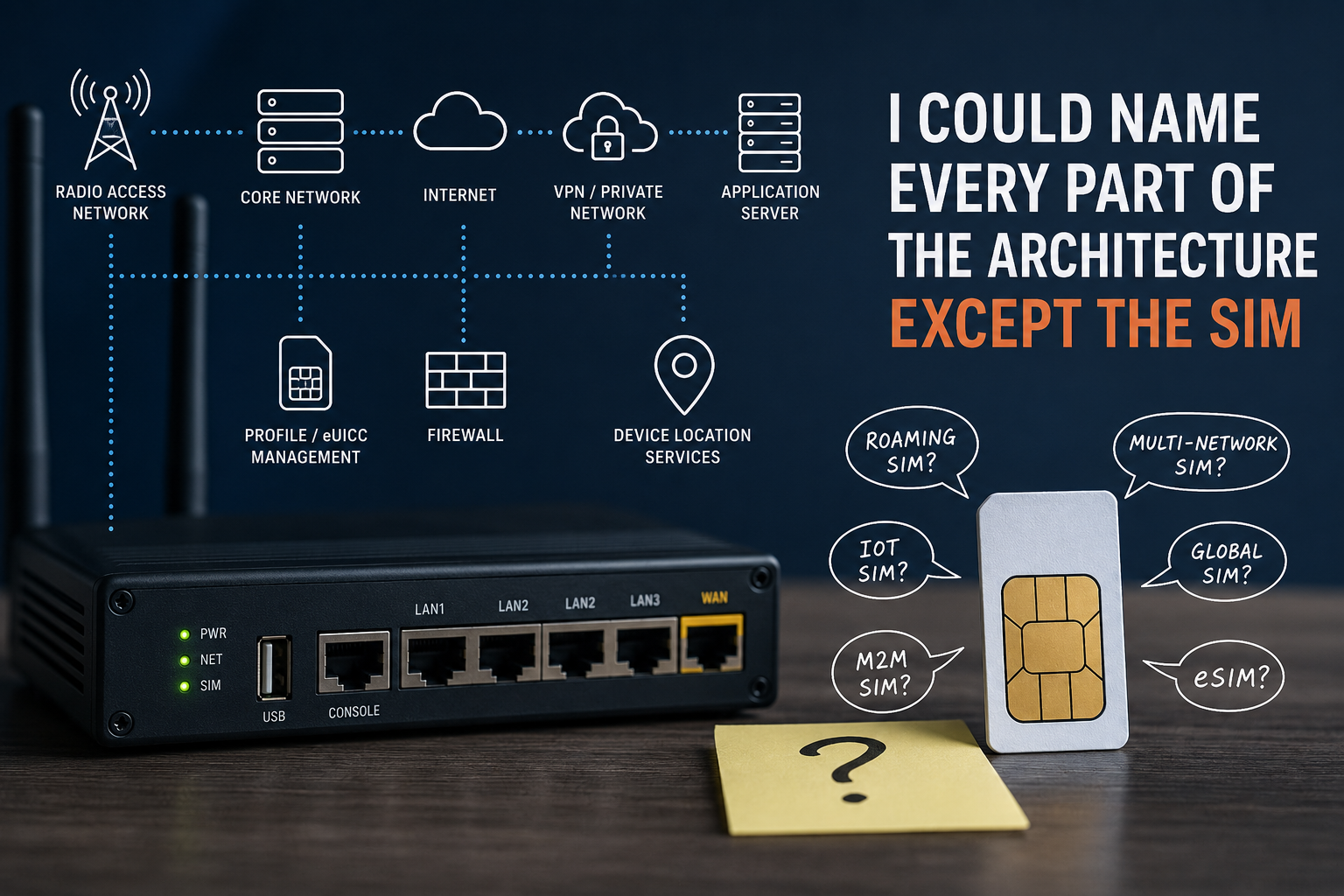
A new essay on RoamingSIM.co.uk argues that the most widely deployed connectivity model in European IoT has never been named. On a recent sensor deployment, that stopped being a semantic problem and became a reporting one.
I spent most of last year on sensor deployments. Multi-thousand-endpoint estates, mostly LoRaWAN, environmental and building monitoring, with a long tail of remote sites that had nothing resembling a fixed line. Gateways backhauled over cellular. Edge compute at the gateway to keep the backhaul sensible, because nobody wants to pay to move raw sensor readings across a mobile network for the pleasure of averaging them later.
My job was coordination and the write-up afterwards. Not engineering.
Describing most of that architecture was straightforward. Sensors, gateways, network server, join server, Class A devices with a handful of Class C where somebody wanted to actuate something. Every one of those words has a published definition. If I wrote “join server” in a report, the reader either knew what it meant or could look it up and find one answer.
Then I got to the SIM in the gateway.
In a single meeting I heard the same product called a roaming SIM, a multi-network SIM, a global SIM, an IoT SIM and an M2M SIM. Nobody corrected anybody. Everyone understood each other perfectly well. I sat there assuming the gap was mine.
Same project. Same document. One half of the architecture I could name precisely and the other half I could not name at all.
Names with edges
That contrast is what I keep coming back to.
The LoRaWAN half of that estate had names and the names had edges. Not because LoRaWAN is a paragon of clarity, and not because the people who built it were more careful than the people who built GSM. It is simply a young standard with a foundation that had both a reason to define its terms and the authority to make the definitions stick.
Cellular IoT had neither. The technology arrived, marketing named it, competitors named it differently, and the standards bodies carried on being extremely precise about components while the product category went unnamed for twenty-five years.
You get used to it. That is rather the trouble.
Edge computing makes this worse, not better
There is a reasonable objection here, which is that this is a procurement inconvenience and the packets do not care what you call them.
Except the architecture has been moving in a direction that raises the stakes.
Push processing to the gateway and you end up with fewer connections carrying more consequence. On the deployments I worked on, a gateway was not one of four thousand things. It was the thing a few hundred sensors depended on, sitting at a site nobody was going to visit twice. The connectivity got cheaper and thinner and considerably more load-bearing at the same time.
That is not a context in which you can afford to be vague about what the connection actually is.
The paragraph I could not write
Here is the practical version.
A few dozen gateways out of the estate did not behave. Ordinary rate, nobody panicking, but they were the ones at the sites that justified the whole project. My job was to explain it in a document a facilities director would read.
Every explanation I reached for needed a vocabulary that did not exist. Was the SIM roaming? Yes, permanently, but that word means a holiday to the person reading the report. Was it multi-network? Yes, but that describes what we were hoping for rather than what happened. Was it an IoT SIM? That tells you who was supposed to buy it and nothing else.
The estate looked healthy on the dashboard. It was not healthy in the field. I could not close that gap in writing because the language available to me described the brochure rather than the architecture.
I wrote something vague. It was accepted. That is worse, not better.
Somebody has finally asked the question properly
Peter Green has published a long piece on RoamingSIM.co.uk that goes at this seriously. He is not claiming to have solved it. He has explored it, which is more than the rest of us have managed, and his conclusion is more interesting than the one I had arrived at.
The obvious argument is that the names are sloppy. That is not his argument. He accepts that every term in use is accurate, then asks why accurate terms leave everyone confused. His answer is that we are not disagreeing about words at all. We are naming different objects and assuming we mean the same one. Roaming SIM names the mechanism. Multi-network SIM names the experience. Global SIM names the geography. IoT SIM names the intended buyer. Seven terms, seven different referents, and not one of them naming the service.
Reading that, I realised I had not been struggling to remember the right name. I had been looking for a name that does not exist.
He also makes a point I had not considered and have not stopped thinking about. Every previous abstraction in this industry got a name reasonably quickly, because somebody had a commercial reason to sell it. Modern IoT connectivity abstracted something new: not the radio, not the transport, not the card, but the operator. The counterparty. As he puts it, naming a component is easy and naming the disappearance of a relationship is hard.
Which explains my report rather well. The LoRaWAN half of that architecture was full of components, and components get named. The cellular half had a company-shaped hole in it where a relationship used to be.
On his own motivation he is blunt:
I wrote the words “roaming SIM” again last week. I have written them thousands of times. This time I stopped halfway through the sentence, and not because the term was wrong. It was fine. It was accurate. It just wasn’t right, and I could not immediately explain the difference.
There is a water meter in Rotherham in there too, which does the work of about four diagrams.
I have no standing to adjudicate the technical argument and I am not going to try. He can tell you what an IMSI does and where it lives. I can tell you what it is like to be the person explaining a gateway estate to somebody paying for it, using words designed for a phone in Spain.
Read the full essay: What Are We Actually Naming? Twenty-Five Years of Arguing About SIM Cards
Why now rather than five years ago
The timing matters, because SGP.32 changes the mechanism the vocabulary has been describing for the past two decades.
For twenty-five years, “roaming SIM” has at least been technically correct. Awkward, misleading to anyone new, but correct. The SIM really did belong to a foreign operator and really was a visitor on the network it used. The word was inherited from GSM and it survived the transition to permanent deployment because, at the protocol level, nothing had changed.
Under SGP.32, something does change. A device that downloads a local operator profile and attaches as a native subscriber is not roaming. Not temporarily, not permanently, not at all. There is no visited network and no home network somewhere else. The mechanism the word describes has gone.
So the industry is about to acquire a connectivity model that its incumbent vocabulary cannot describe even inaccurately. We will presumably carry on saying roaming SIM for a few years, because we always do.
That seems a reasonable moment to ask what we should have been calling it.
One question
Peter’s essay ends by asking for better names. I would ask something narrower, because it is the version I can actually judge.
If you have deployed a fleet in the last two years: could you write down, in one sentence, what you bought? Not the benefits. The thing.
I could not, and it was my job.
James Hatton covers industrial IoT for IoTUK. He came to the sector from B2B SaaS and has been asking the naive questions ever since.